The Story in Order
The Bible did not arrive in the order it was lived. Kings and Chronicles retell the same reigns; the Psalms were written across a lifetime but collected in one book; the prophets are filed apart from the history they spoke into; four Gospels tell one life four times. Read chronologically, the pieces slide back into place — you watch the story move, cause into effect, promise toward fulfilment. This guide walks it chapter by chapter, telling you where each passage sits in the story, what it is doing, and — where the date is contested — exactly how sure anyone can be.
- Documented
- The date or sequence is well anchored — by outside records, synchronisms, or broad scholarly agreement.
- Debated
- Genuinely contested — the year, the century, or the placement is disputed. We give the bounds and our reading.
Creation to Babel
Before recorded history (undated) — Genesis 1–11: creation, the first sin, the flood and the scattering at Babel. No date can be fixed here, and how to read these chapters is itself debated.
In the Beginning, God
Before anything else, the Bible answers who is behind the world and what it is for: an ordered, good creation, made in six days and crowned by humans made in God's image.
Genesis 2 · Undated — before recorded historyDust, Breath and a Garden
The camera moves close: God shapes a man from the ground, breathes life into him, plants a garden, gives one command, and brings him a partner who completes him.
Genesis 3 · Undated — before recorded historyThe Garden Is Lost
A serpent's question, a fruit, and eyes opened to shame. Trust breaks between humans and God, between man and woman, and with the ground itself — yet the chapter ends with clothing and a hint of rescue.
Genesis 4 · Undated — before recorded historyCain and Abel
Outside Eden, jealousy grows into the first murder. Cain's line builds cities, music and metalwork — and a boast of seventy-sevenfold revenge — while Seth's line begins to call on the LORD.
Genesis 5 · Undated — before recorded historyFrom Adam to Noah
Ten generations from Adam to Noah, each ending 'and he died' — except Enoch, who walked with God and was taken. The long lifespans are among the most discussed numbers in Genesis.
Genesis 6 · Undated — before recorded historyGrief, Violence and an Ark
Humanity's wickedness fills the earth and God is grieved to his heart. He resolves to send a flood — but Noah finds favour, and is told to build an ark and bring life through the water.
Genesis 7 · Undated — before recorded historyThe Door Shuts, the Waters Rise
Noah's family and the animals go into the ark, God shuts the door, and the waters cover everything. The world of Genesis 1 is undone, and one boat carries what is left.
Genesis 8 · Undated — before recorded historyGod Remembers Noah
The waters recede, a dove comes back with an olive leaf, and Noah steps onto dry ground. His first act is worship, and God's answer is a promise that the seasons will hold.
Genesis 9 · Undated — before recorded historyThe Rainbow and the Vineyard
God blesses Noah, sets a value on every human life, and makes a covenant with all living things under the sign of the rainbow. Then the hero of the flood gets drunk, and the old trouble returns.
Genesis 10 · Undated — before recorded historyThe Table of Nations
A family tree becomes a map: Noah's three sons spread into the peoples of the known world. Before God calls one family, Genesis names the many it will be sent to bless.
Genesis 11 · Undated — before recorded historyBabel, and the Road to Abram
Humanity builds a tower to make a name for itself and ends up scattered. Then the story narrows, generation by generation, to Terah's family in Ur — and a son whose wife cannot have children.
The reading order · 11 of 11 readings written
- Genesis 1 In the Beginning, God Debated
- Genesis 2 Dust, Breath and a Garden Debated
- Genesis 3 The Garden Is Lost Debated
- Genesis 4 Cain and Abel Debated
- Genesis 5 From Adam to Noah Debated
- Genesis 6 Grief, Violence and an Ark Debated
- Genesis 7 The Door Shuts, the Waters Rise Debated
- Genesis 8 God Remembers Noah Debated
- Genesis 9 The Rainbow and the Vineyard Debated
- Genesis 10 The Table of Nations Debated
- Genesis 11 Babel, and the Road to Abram Debated
The Patriarchs
c. 2100–1800 BC (debated) — Abraham to Joseph — one family carrying a promise, long before there is a nation. Dating here is a range, not a year.
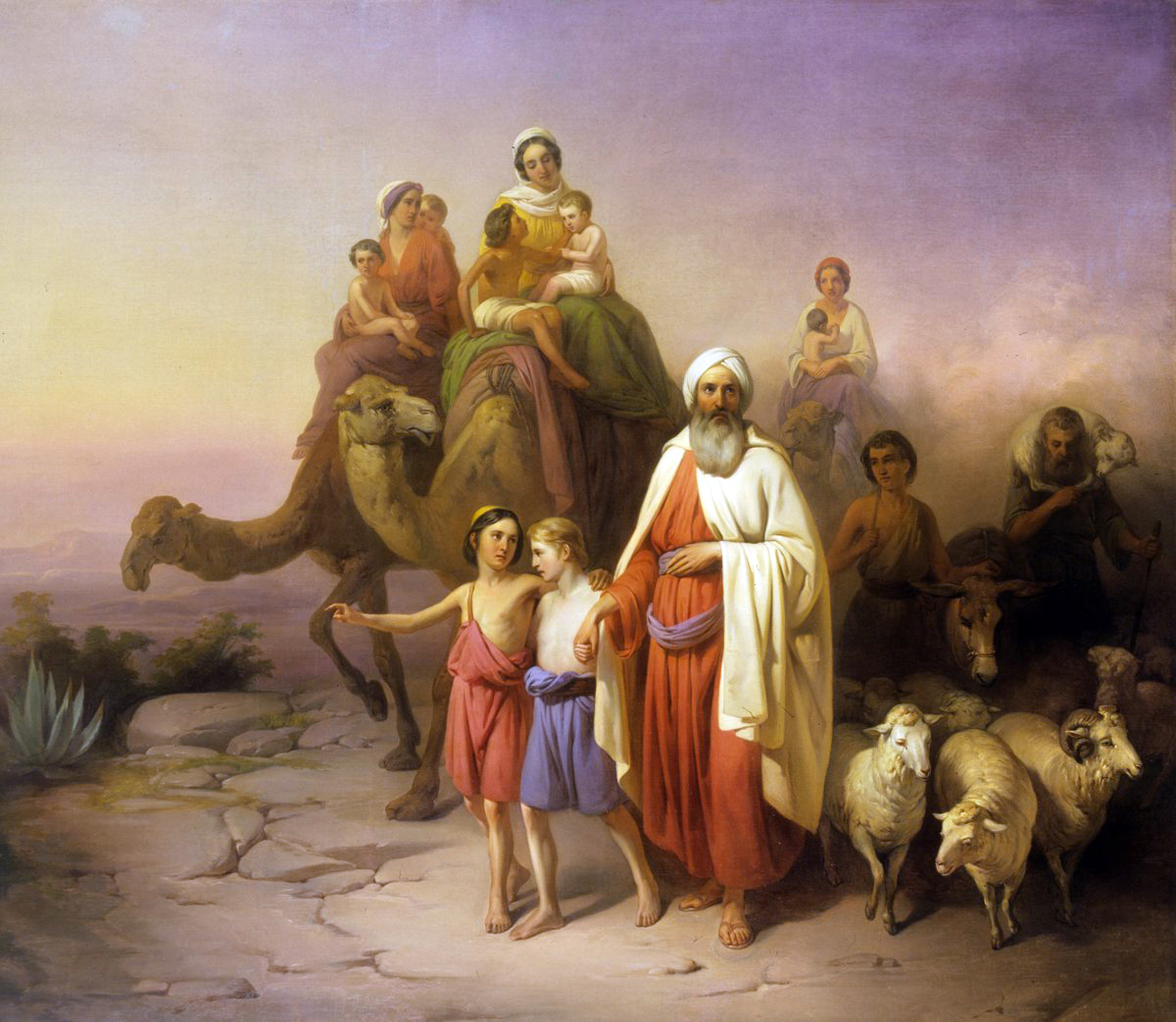 Genesis 12 · c. 2091 BC (on the traditional chronology; see below)
The Call of Abram
The whole Bible narrows from 'everyone' to one childless old man and a promise — land, a nation, and blessing for all peoples. Here the rescue plan gets a face.
Genesis 13 · Soon after c. 2091 BC (traditional chronology — a range, not a year)Abram and Lot Part Ways
Too many flocks, not enough grass. Abram lets his nephew choose first; Lot takes the green valley near Sodom, and Abram is left holding only a promise.
Genesis 14 · Between c. 2091 and 2081 BC (traditional chronology)War of the Kings, Bread of Melchizedek
Four eastern kings raid the Jordan valley and carry off Lot. Abram rescues him, is blessed by the mysterious priest-king Melchizedek, and refuses Sodom's reward.
Genesis 15 · Between c. 2091 and 2081 BC (traditional chronology)Stars, Belief and a Covenant
Childless and afraid, Abram is told to count the stars. He believes, and God binds himself to the promise in an eerie night-time covenant ritual.
Genesis 16 · c. 2081–2080 BC (traditional chronology; Abram 85–86)Hagar and the God Who Sees
Tired of waiting, Sarai gives her Egyptian servant Hagar to Abram. Pregnancy brings contempt and cruelty; Hagar flees, and God meets her by a desert spring.
Genesis 17 · c. 2067 BC (traditional chronology; Abraham 99)New Names, and a Sign
Thirteen years on, God renews the covenant: Abram becomes Abraham, Sarai becomes Sarah, circumcision becomes the sign, and the promised son will come within a year.
Genesis 18 · c. 2067 BC (traditional chronology)Guests at Mamre, Bargaining for Sodom
Abraham runs to welcome three strangers, who promise Sarah a son. Then, as Sodom's judgement looms, Abraham dares to argue with God for the city.
Genesis 19 · c. 2067 BC (traditional chronology)The Fall of Sodom
Two angels find in Sodom a mob that would violate its guests. Lot is dragged out, the cities burn, his wife looks back, and a dark epilogue follows in a cave.
Genesis 20 · c. 2067 BC (traditional chronology)Abraham's Old Lie at Gerar
Abraham repeats his Egypt lie, passing Sarah off as his sister to the king of Gerar. God protects her just before Isaac's birth, and the pagan king proves more honourable than the prophet.
Genesis 21 · c. 2066 BC (traditional chronology; Abraham 100)Laughter Born, a Son Sent Away
Isaac is born at last and Sarah laughs for joy. But Hagar and Ishmael are driven into the desert, where God hears the boy and opens a well.
Genesis 22 · Some years after c. 2066 BC (traditional chronology); Isaac's age is not givenThe Binding of Isaac
God tells Abraham to offer up Isaac, the son of the promise. On the mountain the knife is raised — and stopped. One of the most wrestled-over stories ever written.
Genesis 23 · c. 2030 BC on the traditional chronology (a framework date, not an anchored one)A Grave in the Promised Land
Sarah dies at Hebron, and Abraham, promised the whole land, pays full price for a single cave to bury her. His first owned ground in Canaan is a tomb.
Genesis 24 · c. 2025 BC on the traditional chronology (a framework date)A Bride Found at the Well
Abraham's servant travels to the old family homeland, prays for a sign at a well, and meets Rebekah — who chooses to leave everything and marry Isaac.
Genesis 25 · c. 2005–1990 BC on the traditional chronology (a framework range)Twins at War, a Birthright Sold
Abraham dies and is buried by both his sons. Rebekah bears twins who struggle from the womb, and hungry Esau trades his birthright to Jacob for a bowl of stew.
Genesis 26 · Undated within Isaac's lifetime; traditional chronology c. 2000–1950 BCIsaac and the Well-Diggers
In famine Isaac stays in the land, repeats his father's lie about his wife, grows rich, and keeps re-digging wells until he finds room — and peace — at Beersheba.
Genesis 27 · c. 1930 BC on the traditional chronology (a framework date)The Stolen Blessing
Rebekah and Jacob trick blind Isaac into blessing the younger son instead of Esau. The deception works — and splits the family, sending Jacob into exile.
Genesis 28 · c. 1930 BC on the traditional chronology (a framework date)A Stairway at Bethel
Running from Esau, Jacob sleeps on a stone and dreams of a stairway between earth and heaven. God repeats the promise and adds: 'I am with you.'
Genesis 29 · c. 1930–1920 BC on the traditional chronology (a framework range)The Deceiver Deceived
Jacob meets Rachel at a well and works seven years for her — then wakes to find Laban has given him Leah instead. Unloved Leah begins to bear sons.
Genesis 30 · c. 1920–1910 BC on the traditional chronology (a framework range)Sons, Mandrakes and Speckled Flocks
Rachel and Leah compete for Jacob through children and servant-wives until Rachel at last bears Joseph. Then Jacob outwits Laban and grows rich in flocks.
Genesis 31 · c. 1910 BC on the traditional chronology (a framework date)Flight from Laban
After twenty years, God tells Jacob to go home. He slips away with his family; Rachel steals her father's household gods; Laban gives chase, and the two men end with a boundary treaty.
Genesis 32 · c. 1910 BC on the traditional chronology (a framework date)Wrestling Until Daybreak
Afraid of Esau's four hundred men, Jacob prays, sends gifts ahead, and spends the night alone at the Jabbok — wrestling a mysterious man who renames him Israel.
Genesis 33 · c. 1900 BC (traditional range; debated)Esau Runs to Meet Him
Twenty years after stealing his brother's blessing, a limping Jacob bows seven times, braced for revenge. Esau runs, embraces him and weeps. Then Jacob settles near Shechem and builds an altar.
Genesis 34 · c. 1900 BC (traditional range; debated)Dinah, and the Sword at Shechem
Jacob's daughter Dinah is taken and violated by the prince of Shechem. Her brothers answer with deceit and a massacre. One of Genesis's darkest chapters, told without a single word from Dinah herself.
Genesis 35 · c. 1900 BC (traditional range; debated)Back to Bethel
Jacob buries the household idols and returns to Bethel, where God renews the name Israel and the promise. Then loss on loss: Rachel dies giving birth to Benjamin, Reuben dishonours his father, and Isaac is buried.
Genesis 36 · Esau c. 1900 BC (traditional range); the king list reaches forward to a later periodEsau's Line: the Kings of Edom
A genealogy of Esau: his wives and sons, the chiefs of Edom, the older Horite clans of Seir, and eight kings who ruled Edom before Israel had a king. The brother outside the promise is not forgotten.
Genesis 37 · c. 1900–1850 BC (traditional range; debated)Joseph Sold by His Brothers
Jacob's favourite son wears the special robe and dreams of his brothers bowing to him. They strip him, throw him into a pit, and sell him to traders bound for Egypt. Jacob is told he is dead.
Genesis 38 · c. 1900–1850 BC (traditional range; debated)Judah and Tamar
Twice widowed and then abandoned by her father-in-law Judah, Tamar takes a desperate risk to claim her place in the family. When she is exposed, Judah confesses: she is more in the right than he is.
Genesis 39 · c. 1900–1850 BC (traditional range; debated)Joseph in Potiphar's House
Sold as a slave in Egypt, Joseph rises to run his master's household. He refuses the advances of his master's wife, is falsely accused, and lands in prison — where, again, the LORD is with him.
Genesis 40 · c. 1900–1850 BC (traditional range; debated)Dreams in the King's Prison
Pharaoh's cupbearer and baker land in Joseph's prison and each has a troubling dream. Joseph interprets both: one will be restored, one executed. It happens exactly so — and the cupbearer forgets Joseph.
Genesis 41 · c. 1900–1800 BC (traditional range; debated)From Prison to Pharaoh's Right Hand
Pharaoh dreams of seven fat cows eaten by seven thin ones. Brought out of prison, Joseph interprets: seven years of plenty, then seven of famine. Pharaoh sets him over all Egypt to prepare.
Genesis 42 · c. 1900–1800 BC (traditional range; debated)The Brothers Bow Down
Famine sends ten of Jacob's sons to Egypt for grain. They bow before the governor, not knowing it is Joseph. He accuses them of spying, keeps Simeon hostage and demands they bring Benjamin.
Genesis 43 · c. 1876 BC on the traditional chronology; many place Joseph later (see Genesis 45)Benjamin Goes Down to Egypt
The grain runs out, and Jacob must risk the son he cannot bear to lose. Judah stakes his own life on Benjamin, and the brothers sit down to a feast they do not understand.
Genesis 44 · c. 1876 BC on the traditional chronology; the date is a rangeThe Silver Cup
Joseph plants his cup in Benjamin's sack and demands the boy as a slave. Judah steps forward and offers himself instead — the speech that turns the whole Joseph story.
Genesis 45 · c. 1876 BC on the traditional chronology; others place Joseph c. 1700–1550 BCI Am Joseph
Joseph sends everyone out, weeps aloud, and tells his brothers who he is. Their crime is named — and reframed: God sent him ahead to save lives. Jacob learns his son is alive.
Genesis 46 · c. 1876 BC on the traditional chronology; later on other reckoningsJacob Goes Down to Egypt
At Beersheba, God tells the aged Jacob not to fear going down to Egypt: 'I will go down with you.' Seventy people make the journey, and a father holds a son he thought was dead.
Genesis 47 · c. 1876–1859 BC on the traditional chronology; the date is a rangeJacob Blesses Pharaoh
The family settles in Goshen, and an old shepherd blesses the king of Egypt. Meanwhile Joseph's famine policy turns Egypt's people into Pharaoh's tenants — a passage readers still argue over.
Genesis 48 · c. 1859 BC on the traditional chronology; the date is a rangeCrossed Hands
The dying Jacob adopts Joseph's two Egyptian-born sons as his own and, crossing his hands, puts the younger Ephraim ahead of Manasseh. Once again the promise runs against the expected order.
Genesis 49 · c. 1859 BC on the traditional chronology; the poem's age is debatedJacob's Last Words
Jacob gathers his twelve sons and speaks over each in poetry — rebuke, warning, and promise. Judah is given the sceptre, and then the old man breathes his last.
Genesis 50 · c. 1859–1805 BC on the traditional chronology; the date is a rangeYou Meant Evil, God Meant Good
Egypt mourns Jacob and a great procession buries him in Canaan. His sons fear revenge, but Joseph forgives them. Genesis ends with a coffin in Egypt and a promise to go home.
Job 1 · Undated — set in the patriarchal age; written at an unknown dateDoes Job Fear God for Nothing?
A good man loses everything in one day after a question is raised in the heavenly court: is his faithfulness only a reward for blessing? Job grieves — and still worships.
Job 2 · Undated — set in the patriarchal age; written at an unknown dateSilence in the Ashes
The accuser returns and Job is struck with sores from head to foot. His wife tells him to curse God and die. Three friends come and sit with him in silence for seven days.
Job 3 · Setting: patriarchal age (date of writing unknown)Job Curses His Birthday
After seven days of silence, Job finally speaks — and his first words are a curse on the day he was born. The patient man of the prologue gives way to raw, honest lament.
Job 4 · Setting: patriarchal age (date of writing unknown)Eliphaz and the Night Vision
The first and gentlest friend speaks: Job has comforted others, so he should trust now — the innocent never perish. Then Eliphaz reports a chilling vision: no mortal is pure before God.
Job 5 · Setting: patriarchal age (date of writing unknown)Blessed Is the One God Corrects
Eliphaz finishes: trouble is part of human life, so turn to God, accept his discipline, and he will restore you. Beautiful words — aimed at the wrong man.
Job 6 · Setting: patriarchal age (date of writing unknown)Friends Like a Dry Stream
Job answers Eliphaz: his anguish outweighs the sand of the sea, he still wishes God would end his life, and his friends have proved as disappointing as a stream bed dry in summer.
Job 7 · Setting: patriarchal age (date of writing unknown)What Is Man?
Job turns from his friends to God himself: life is hard labour, his nights are torment, and he asks why God watches him so closely. He twists a psalm of praise into a complaint.
Job 8 · Setting: patriarchal age (date of writing unknown)Bildad: Ask the Ancestors
The second friend is blunter: God does not twist justice, so Job's children must have sinned. Ask the wisdom of past generations — the godless wither like reeds without water.
Job 9 · Setting: patriarchal age (date of writing unknown)If Only There Were an Umpire
Job accepts God is just and powerful — which is exactly the problem. How can a mortal argue with the One who moves mountains? He longs for an arbiter to stand between them.
Job 10 · Setting: patriarchal age (date of writing unknown)Your Hands Made Me
Job speaks straight to God: you shaped me carefully in the womb, so why do you now hunt me like a lion? He asks for a little relief before he goes into darkness.
Job 11 · Setting: patriarchal age (date of writing unknown)Zophar: Less Than You Deserve
The third friend loses patience: Job's many words need rebuking, God's wisdom is beyond searching, and Job is getting less punishment than he deserves. Repent, and hope will return.
Job 12 · Setting: patriarchal age (date of writing unknown)Ask the Animals
Job opens his longest reply with sarcasm — wisdom will die with you! — then insists he knows as much as they do. Even the animals know God's hand is behind everything; the question is what it means.
Job 13 · Setting: patriarchal age (date of writing unknown)Job Demands a Hearing
Job tells his friends their medicine is worthless and their defence of God dishonest. Then he turns away from them and speaks straight to God, asking for a fair hearing.
Job 14 · Setting: patriarchal age (date of writing unknown)Hope for a Tree
A cut tree can sprout again after rain; can a dead man live again? Job wishes God would hide him in the grave until anger passes — then admits he sees no such hope.
Job 15 · Setting: patriarchal age (date of writing unknown)Eliphaz Loses Patience
Eliphaz opens the second round with no softness left. Job's words are hot air and dangerous to faith; and the wise have always known the wicked live in terror and end in ruin.
Job 16 · Setting: patriarchal age (date of writing unknown)A Witness in Heaven
Job calls his friends miserable comforters, describes God as an attacker who has torn him apart — and then, astonishingly, says he has a witness in heaven who will plead his case.
Job 17 · Setting: patriarchal age (date of writing unknown)Who Will Stand Guarantor?
Job feels his life ending, mocked and made a byword. He asks God himself to stand surety for him — and asks where, if the grave is his home, his hope could possibly be.
Job 18 · Setting: patriarchal age (date of writing unknown)The Trap Closes on the Wicked
Bildad resents being treated like cattle and answers Job with a relentless poem: the wicked man's lamp goes out, traps close on his feet, and his name vanishes from the earth.
Job 19 · Setting: patriarchal age (date of writing unknown)I Know My Redeemer Lives
Abandoned by family and friends and feeling hunted by God, Job wishes his words were carved in rock — then declares that his redeemer lives and that he will see God.
Job 20 · Setting: patriarchal age (date of writing unknown)Sweet on the Tongue
Zophar, insulted, insists the joy of the wicked is always brief: stolen wealth is like sweet food that turns to poison in the stomach, and God's anger will empty it out.
Job 21 · Setting: patriarchal age (date of writing unknown)Why Do the Wicked Prosper?
Job answers his friends with evidence: the wicked often live long, grow rich, see their children dance, and die in peace. Their neat theory, he says, does not match the world.
Job 22 · Setting: patriarchal age (date of writing unknown)Eliphaz Invents the Charges
Out of arguments, Eliphaz accuses Job of specific crimes against the poor, the widow and the orphan — none of them true — then pleads with him to return to God and find peace.
Job 23 · Setting: patriarchal age (date of writing unknown)If Only I Knew Where to Find Him
Job stops answering his friends and starts searching for God — east, west, north, south — and finds him nowhere. Yet in the same breath he says God knows his road, and he will come out like gold.
Job 24 · Setting: patriarchal age (date of writing unknown)Why Does God Not Set a Court Day?
Job looks past his own pain to the landless poor — boundary stones moved, flocks stolen, families shivering on the hillside — and asks why God does not hold court. The chapter's ending raises a real textual puzzle.
Job 25 · Setting: patriarchal age (date of writing unknown)Bildad's Last, Short Word
Bildad's third speech is only six verses: God rules the heights, even the moon and stars are not pure in his sight, so how can any human be righteous? Then the friends fall silent.
Job 26 · Setting: patriarchal age (date of writing unknown)The Outskirts of His Ways
Job mocks the help he has received, then speaks one of the Bible's great poems of creation: the earth hung on nothing, the sea stilled, the serpent pierced — and all of it only a whisper of God's power.
Job 27 · Setting: patriarchal age (date of writing unknown)I Will Not Let Go of My Integrity
Job swears by the God who has wronged him that he will never lie about his innocence. Then comes a portrait of the wicked's fate so like the friends' speeches that many think it once belonged to Zophar.
Job 28 · Setting: patriarchal age (date of writing unknown)Where Can Wisdom Be Found?
A poem breaks into the argument: people dig deep into the earth for silver and sapphire, but wisdom lies in no mine and no market. Only God knows its place — and the fear of the Lord is wisdom.
Job 29 · Setting: patriarchal age (date of writing unknown)When God Was My Friend
Job remembers the good years: God's lamp over his head, his children around him, elders rising when he entered the city gate — and his own record as eyes to the blind and a father to the needy.
Job 30 · Setting: patriarchal age (date of writing unknown)But Now They Mock Me
The great man of chapter 29 is now the butt of songs sung by society's castoffs. His body burns, his nights give no rest, and when he cries to God there is no answer.
Job 31 · Setting: patriarchal age (date of writing unknown)Job Signs His Oath of Innocence
Job lists sin after sin — lust, deceit, cruelty to servants, neglect of the poor, trust in gold — and swears he has done none of them. Then he signs his case and waits for God to answer.
Job 32 · Setting: patriarchal age (date of writing unknown)A Young Man Speaks Up
With Job's words ended and the friends silent, Elihu steps in. He is young, he has waited, and he is angry at everyone — and he claims that understanding comes from God's Spirit, not from age.
Job 33 · Setting: patriarchal age (date of writing unknown)Elihu: God Speaks Twice
The young Elihu turns to Job directly and denies that God is silent: he speaks in dreams at night and through the pain of a sickbed, and a go-between may yet plead for the sufferer.
Job 34 · Setting: patriarchal age (date of writing unknown)Far Be It from God
Elihu takes on Job's complaint that it does no good to please God. The Almighty, he insists, cannot do wrong: the ruler of all breath judges kings and paupers alike.
Job 35 · Setting: patriarchal age (date of writing unknown)Songs in the Night
Elihu's shortest speech: your goodness does not enrich God nor your sin wound him. People cry out in oppression, he says, but rarely ask for the Maker who gives songs in the night.
Job 36 · Setting: patriarchal age (date of writing unknown)Affliction That Opens Ears
Elihu speaks 'on God's behalf': God does not despise anyone, and he uses suffering to teach. Then his speech turns to rain and lightning, as if a storm were gathering on the horizon.
Job 37 · Setting: patriarchal age (date of writing unknown)Thunder, Snow, and Golden Light
Elihu's last words tremble with the storm: thunder is God's voice, snow and rain stop human work, and no one can gaze at the blazing sky. Then he falls silent — and never speaks again.
Job 38 · Setting: patriarchal age (date of writing unknown)Out of the Whirlwind
At last God answers Job — not with an explanation but with questions. Where were you when I laid the earth's foundations? A tour of creation, from the morning stars to hungry lion cubs.
Job 39 · Setting: patriarchal age (date of writing unknown)Who Set the Wild Donkey Free?
God's questions roam through the wild: goats giving birth unseen, the untamable wild ox, the careless ostrich, the fearless war horse, the eagle high on its crag. None of it needs Job.
Job 40 · Setting: patriarchal age (date of writing unknown)Hand over Mouth, and Behemoth
Job puts his hand over his mouth. God speaks again: will you condemn me to justify yourself? Then he points to Behemoth, a massive creature of the river that only its Maker can approach.
Job 41 · Setting: patriarchal age (date of writing unknown)Leviathan, King of the Proud
God's last and longest portrait: Leviathan, a creature no hook can catch and no weapon can pierce, breathing fire and churning the deep. If no one dares face it, who can stand before its Maker?
Job 42 · Setting: patriarchal age (date of writing unknown)Now My Eye Sees You
Job answers: he had heard of God, but now he sees him. God rebukes the friends, accepts Job's prayer for them, and restores Job's fortunes double — with daughters who inherit alongside their brothers.
The reading order · 81 of 81 readings written
- Genesis 12 The Call of Abram Debated
- Genesis 13 Abram and Lot Part Ways Debated
- Genesis 14 War of the Kings, Bread of Melchizedek Debated
- Genesis 15 Stars, Belief and a Covenant Debated
- Genesis 16 Hagar and the God Who Sees Debated
- Genesis 17 New Names, and a Sign Debated
- Genesis 18 Guests at Mamre, Bargaining for Sodom Debated
- Genesis 19 The Fall of Sodom Debated
- Genesis 20 Abraham's Old Lie at Gerar Debated
- Genesis 21 Laughter Born, a Son Sent Away Debated
- Genesis 22 The Binding of Isaac Debated
- Genesis 23 A Grave in the Promised Land Debated
- Genesis 24 A Bride Found at the Well Debated
- Genesis 25 Twins at War, a Birthright Sold Debated
- Genesis 26 Isaac and the Well-Diggers Debated
- Genesis 27 The Stolen Blessing Debated
- Genesis 28 A Stairway at Bethel Debated
- Genesis 29 The Deceiver Deceived Debated
- Genesis 30 Sons, Mandrakes and Speckled Flocks Debated
- Genesis 31 Flight from Laban Debated
- Genesis 32 Wrestling Until Daybreak Debated
- Genesis 33 Esau Runs to Meet Him Debated
- Genesis 34 Dinah, and the Sword at Shechem Debated
- Genesis 35 Back to Bethel Debated
- Genesis 36 Esau's Line: the Kings of Edom Debated
- Genesis 37 Joseph Sold by His Brothers Debated
- Genesis 38 Judah and Tamar Debated
- Genesis 39 Joseph in Potiphar's House Debated
- Genesis 40 Dreams in the King's Prison Debated
- Genesis 41 From Prison to Pharaoh's Right Hand Debated
- Genesis 42 The Brothers Bow Down Debated
- Genesis 43 Benjamin Goes Down to Egypt Debated
- Genesis 44 The Silver Cup Debated
- Genesis 45 I Am Joseph Debated
- Genesis 46 Jacob Goes Down to Egypt Debated
- Genesis 47 Jacob Blesses Pharaoh Debated
- Genesis 48 Crossed Hands Debated
- Genesis 49 Jacob's Last Words Debated
- Genesis 50 You Meant Evil, God Meant Good Debated
- Job 1 Does Job Fear God for Nothing? Debated
- Job 2 Silence in the Ashes Debated
- Job 3 Job Curses His Birthday Debated
- Job 4 Eliphaz and the Night Vision Debated
- Job 5 Blessed Is the One God Corrects Debated
- Job 6 Friends Like a Dry Stream Debated
- Job 7 What Is Man? Debated
- Job 8 Bildad: Ask the Ancestors Debated
- Job 9 If Only There Were an Umpire Debated
- Job 10 Your Hands Made Me Debated
- Job 11 Zophar: Less Than You Deserve Debated
- Job 12 Ask the Animals Debated
- Job 13 Job Demands a Hearing Debated
- Job 14 Hope for a Tree Debated
- Job 15 Eliphaz Loses Patience Debated
- Job 16 A Witness in Heaven Debated
- Job 17 Who Will Stand Guarantor? Debated
- Job 18 The Trap Closes on the Wicked Debated
- Job 19 I Know My Redeemer Lives Debated
- Job 20 Sweet on the Tongue Debated
- Job 21 Why Do the Wicked Prosper? Debated
- Job 22 Eliphaz Invents the Charges Debated
- Job 23 If Only I Knew Where to Find Him Debated
- Job 24 Why Does God Not Set a Court Day? Debated
- Job 25 Bildad's Last, Short Word Debated
- Job 26 The Outskirts of His Ways Debated
- Job 27 I Will Not Let Go of My Integrity Debated
- Job 28 Where Can Wisdom Be Found? Debated
- Job 29 When God Was My Friend Debated
- Job 30 But Now They Mock Me Debated
- Job 31 Job Signs His Oath of Innocence Debated
- Job 32 A Young Man Speaks Up Debated
- Job 33 Elihu: God Speaks Twice Debated
- Job 34 Far Be It from God Debated
- Job 35 Songs in the Night Debated
- Job 36 Affliction That Opens Ears Debated
- Job 37 Thunder, Snow, and Golden Light Debated
- Job 38 Out of the Whirlwind Debated
- Job 39 Who Set the Wild Donkey Free? Debated
- Job 40 Hand over Mouth, and Behemoth Debated
- Job 41 Leviathan, King of the Proud Debated
- Job 42 Now My Eye Sees You Debated
Exodus & Wilderness
15th or 13th century BC (debated) — A slave people is rescued, met at Sinai, and formed into a nation on the march.
A New King, an Old Fear
Jacob's family has grown into a people, and a new Pharaoh sees them as a threat. Forced labour, then an order to kill the baby boys, and two midwives who quietly refuse.
Exodus 2 · 15th or 13th century BC (debated); Moses' birth, about 80 years before the ExodusA Basket in the Reeds
A Hebrew mother hides her son in a basket on the Nile, and Pharaoh's own daughter raises him. Grown, Moses kills an Egyptian, flees to Midian, and waits while Israel groans.
Exodus 3 · 15th or 13th century BC (debated); Moses about 80 (Exodus 7:7)The Bush That Did Not Burn
Tending sheep at Horeb, Moses sees a bush on fire but not burnt up. God calls him by name, reveals his name, I AM, and sends him back to Pharaoh.
Exodus 4 · 15th or 13th century BC (debated)Excuses, Signs and a Brother
Moses keeps saying no. God gives him signs, then his brother Aaron as a spokesman. On the road back to Egypt comes a strange night encounter, and then the people believe.
Exodus 5 · 15th or 13th century BC (debated)Bricks Without Straw
Moses asks Pharaoh to let Israel go and worship. Pharaoh answers by taking away their straw and keeping the brick quota. The people's hope turns to bitterness, and Moses turns to God.
Exodus 6 · 15th or 13th century BC (debated)I Am the LORD
God answers Moses' complaint with his name and seven promises: I will bring you out, rescue, redeem, take you as my people. The people are too crushed to listen, and a family tree roots Moses and Aaron in Israel.
Exodus 7 · 15th or 13th century BC (debated); Moses 80, Aaron 83The Nile Turns to Blood
Moses and Aaron confront Pharaoh. Aaron's staff becomes a serpent and swallows the magicians' staffs; then the Nile, Egypt's lifeline, turns to blood. Pharaoh's heart stays hard.
Exodus 8 · 15th or 13th century BC (debated)Frogs, Gnats and Flies
Frogs swarm Egypt, gnats cover the land, and flies fill Egyptian houses but not Goshen. The magicians admit 'the finger of God', and Pharaoh bargains, promises and backs out.
Exodus 9 · 15th or 13th century BC (debated)Cattle, Boils and Hail
Disease kills Egypt's livestock, boils break out on people, and the worst hailstorm in Egypt's history flattens the fields. Some Egyptians now fear God's word; Pharaoh confesses sin and hardens again.
Exodus 10 · 15th or 13th century BC (debated)Locusts and Darkness
Pharaoh's own officials beg him to give in. He tries to negotiate; locusts strip the land, then three days of darkness fall, except where Israel lives. Pharaoh throws Moses out for good.
Exodus 11 · 15th or 13th century BC (debated)One Last Blow
Before the final plague, God tells Moses what is coming: the death of every firstborn in Egypt. Moses delivers the warning and walks out of Pharaoh's presence in hot anger.
Exodus 12 · 15th or 13th century BC (debated)Blood on the Doorposts
God gives Israel the Passover — a lamb, blood on the doorframes, a hurried meal — and at midnight the firstborn of Egypt die. Pharaoh drives the people out, and they leave at last.
Exodus 13 · 15th or 13th century BC (debated)The Long Way Round
Israel's firstborn are set apart for God and the feast of unleavened bread is fixed as a yearly memory. Then God leads the people, not by the short road, but by the wilderness — with a pillar of cloud and fire.
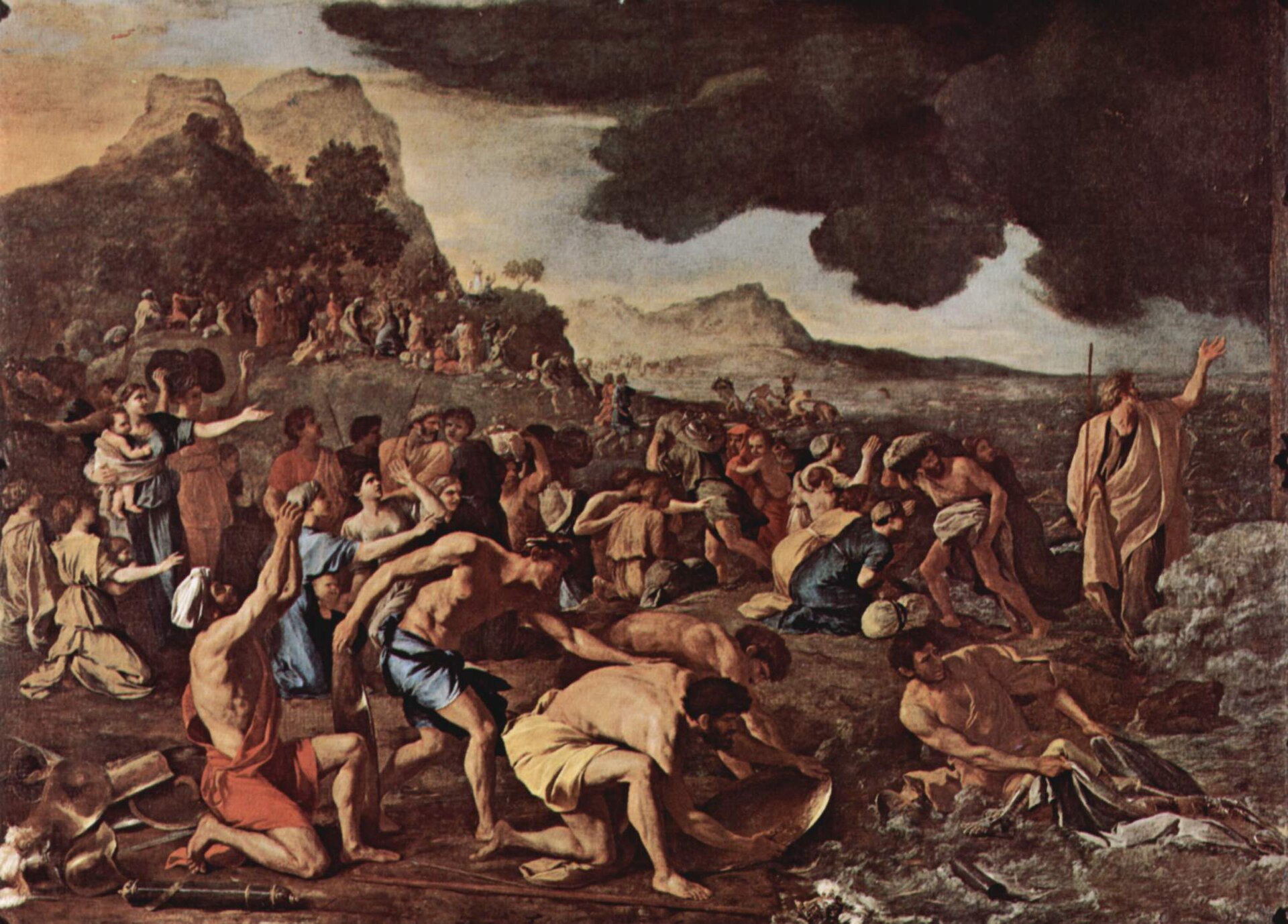 Exodus 14 · 15th century BC (c. 1446) or 13th century BC (c. 1260) — the great Exodus-date debate
The Sea Divides
Trapped between Pharaoh's chariots and deep water, Israel is told to go forward. The rescue that becomes the Old Testament's master-image of salvation.
Exodus 15 · 15th or 13th century BC (debated)The Song of the Sea
On the far shore Moses and Israel sing of God's victory over Pharaoh's army, and Miriam leads the women with tambourines. Three days later, at Marah, the singing turns to grumbling over bitter water.
Exodus 16 · 15th or 13th century BC (debated)Bread from Heaven
Hungry in the wilderness, Israel wishes it were back in Egypt. God sends quail in the evening and manna each morning — enough for one day, double before the Sabbath — and teaches a people to trust daily.
Exodus 17 · 15th or 13th century BC (debated)Water from the Rock
At Rephidim the people nearly stone Moses for water, and God brings it from a rock. Then Amalek attacks, and Israel wins while Moses' raised hands are held up by Aaron and Hur.
Exodus 18 · 15th or 13th century BC (debated)Jethro's Good Advice
Moses' father-in-law Jethro, a Midianite priest, hears what God has done and blesses him. Seeing Moses judge the people alone from dawn to dusk, he advises him to share the load with capable leaders.
Exodus 19 · 15th or 13th century BC (debated)At the Foot of the Mountain
Three months after leaving Egypt, Israel camps before Mount Sinai. God offers to make them his treasured possession, a kingdom of priests; the people consecrate themselves, and the mountain shakes in smoke and fire.
Exodus 20 · 15th or 13th century BC (debated)Ten Words from the Mountain
God speaks the Ten Commandments to Israel — loyalty to him alone, no idols, reverence for his name, the Sabbath, honour for parents, and respect for life, marriage, property and truth. The terrified people ask Moses to speak for God.
Exodus 21 · 15th or 13th century BC (debated); date of composition debatedLaws for Servants and Injuries
The Book of the Covenant begins with case laws: release for Hebrew servants after six years, penalties for violence, and compensation for injuries — including 'eye for eye.' It is ancient law, both limiting harm and reflecting its world.
Exodus 22 · 15th or 13th century BC (debated); setting at SinaiStolen Oxen and the Widow's Cloak
Laws on theft, damage, borrowing and seduction give way to God's fierce protection of the foreigner, the widow, the orphan and the poor borrower.
Exodus 23 · 15th or 13th century BC (debated); setting at SinaiJustice, Rest and Three Feasts
Honest courts, help even for an enemy's donkey, a sabbath year for the land, three yearly festivals, and a promise that God's angel will lead Israel into Canaan.
Exodus 24 · 15th or 13th century BC (debated); setting at SinaiBlood of the Covenant
Israel says yes to God's words; Moses seals the covenant with sacrificial blood, the elders see God and eat on the mountain, and Moses enters the cloud for forty days.
Exodus 25 · 15th or 13th century BC (debated); setting at SinaiA House for God to Dwell
God asks for freely given gifts and gives Moses plans for a portable sanctuary, beginning with its three treasures: the ark, the table and the golden lampstand.
Exodus 26 · 15th or 13th century BC (debated); setting at SinaiCurtains, Frames and the Veil
The tent itself: layered curtains and coverings, a framework of gold-covered acacia boards, and a woven veil that separates the Holy Place from the Most Holy Place.
Exodus 27 · 15th or 13th century BC (debated); setting at SinaiThe Altar and the Courtyard
A bronze altar for sacrifice, a large linen-walled courtyard around the tent, and oil for a lamp that must burn through every night.
Exodus 28 · 15th or 13th century BC (debated); setting at SinaiGarments for Glory and Beauty
Aaron and his sons are set apart as priests, with garments that carry Israel's tribes on the high priest's shoulders and heart, and a gold plate reading 'Holy to the LORD'.
Exodus 29 · 15th or 13th century BC (debated); setting at SinaiOrdaining the Priests
A seven-day ceremony of washing, robing, anointing and sacrifice sets Aaron's family apart, followed by the daily morning and evening offering and God's promise to dwell with Israel.
Exodus 30 · 15th or 13th century BC (debated); setting at SinaiIncense, Ransom and Holy Oil
An altar of incense before the veil, a half-shekel paid equally by rich and poor, a bronze basin for washing, and a sacred anointing oil and incense set apart for God alone.
Exodus 31 · 15th or 13th century BC (debated); setting at SinaiSpirit-Filled Craftsmen and the Sabbath
God names Bezalel and Oholiab and fills them with skill to build the sanctuary, repeats the sabbath as the covenant's sign, and gives Moses two tablets of stone.
Exodus 32 · Weeks after the Sinai covenant; 15th or 13th century BC (debated)The Golden Calf
While Moses is on the mountain, Israel melts its gold into a calf and calls it the god who saved them. God threatens judgement; Moses stands in the gap.
Exodus 33 · Soon after the golden calf; 15th or 13th century BC (debated)Show Me Your Glory
God offers Israel the land without his presence. Moses refuses to go without him, speaks with God face to face, and asks to see his glory.
Exodus 34 · At Sinai, after the golden calf; 15th or 13th century BC (debated)The Name Proclaimed Again
On new stone tablets the broken covenant is renewed. God passes by Moses declaring himself merciful, gracious and just, and Moses comes down with a shining face.
Exodus 35 · At Sinai, after the covenant renewal; 15th or 13th century BC (debated)Willing Hearts, Skilled Hands
Moses calls for freely given gifts and skilled workers. Men and women pour in gold, cloth and craft, and Bezalel and Oholiab are named as Spirit-filled master artisans.
Exodus 36 · At Sinai, in the year after the Exodus; 15th or 13th century BC (debated)More Than Enough
The people give so generously that Moses has to stop them. The craftsmen weave the curtains, raise the frames and hang the veil that will hide the Most Holy Place.
Exodus 37 · At Sinai, in the year after the Exodus; 15th or 13th century BC (debated)Ark, Table and Lampstand
Bezalel crafts the furniture of God's dwelling: the ark with its cherub-covered lid, the table for bread, the seven-branched lampstand and the golden altar of incense.
Exodus 38 · At Sinai, in the year after the Exodus; 15th or 13th century BC (debated)The Altar and the Accounts
The bronze altar, the basin made from women's mirrors and the courtyard are finished, and the chapter ends with an audit of every talent of gold, silver and bronze.
Exodus 39 · At Sinai, in the year after the Exodus; 15th or 13th century BC (debated)Robes for the Priests
The high priest's ephod, jewelled breastpiece, blue robe and gold plate are made. Every finished piece is brought to Moses, who sees it was done as commanded and blesses them.
Exodus 40 · First day of the second year after the Exodus; 15th or 13th century BC (debated)The Glory Fills the Tent
On New Year's Day Moses sets up the tabernacle and anoints it. The cloud covers the tent and the glory of the LORD fills it, so that even Moses cannot enter.
Leviticus 1 · Soon after the tabernacle was set up; 15th or 13th century BC (debated)The Offering That Goes Up
From the new tent, the LORD teaches the burnt offering: a whole animal given up in smoke, with a costly option for the wealthy and a pair of birds for the poor.
Leviticus 2 · 15th or 13th century BC (debated) — Israel camped at SinaiFlour, Oil and Salt
The grain offering: a gift of flour, oil and incense, baked or raw, seasoned with salt and kept free of yeast and honey. The everyday offering almost anyone could bring.
Leviticus 3 · 15th or 13th century BC (debated) — Israel camped at SinaiThe Meal Shared with God
The peace or fellowship offering: an animal sacrificed and then eaten, with the choicest fat given to God. A sacrifice that ends not in smoke alone but at a table.
Leviticus 4 · 15th or 13th century BC (debated) — Israel camped at SinaiWhen Someone Sins Unknowingly
The sin or purification offering, scaled to who has done wrong — high priest, whole community, leader or ordinary person. Even unintended wrongs leave a stain that must be cleansed.
Leviticus 5 · 15th or 13th century BC (debated) — Israel camped at SinaiTwo Doves or a Handful of Flour
Everyday lapses — a silence in court, an unnoticed defilement, a rash oath — are to be confessed. The poor may bring birds or flour instead of a lamb, and the guilt offering adds repayment.
Leviticus 6 · 15th or 13th century BC (debated) — Israel camped at SinaiThe Fire Must Never Go Out
Wronging a neighbour is also a wrong against God, and must be repaid with a fifth added. Then the priests learn their duties: keep the altar fire burning and handle holy food with care.
Leviticus 7 · 15th or 13th century BC (debated) — Israel camped at SinaiThanksgiving Bread and the Priests' Share
The priestly manual finishes: rules for the guilt offering, the thanksgiving and vow offerings, the ban on fat and blood, and the portions set aside to feed the priests.
Leviticus 8 · 15th or 13th century BC (debated) — about a year after leaving EgyptAaron and His Sons Ordained
Before the whole community, Moses washes, robes and anoints Aaron and his sons, offers the ordination sacrifices, and marks them with blood. For seven days they stay at the tent's entrance.
Leviticus 9 · 15th or 13th century BC (debated) — about a year after leaving EgyptFire from Before the LORD
On the eighth day Aaron offers his first sacrifices for himself and the people, then blesses them. The glory of the LORD appears, and fire consumes the offering on the altar.
Leviticus 10 · 15th or 13th century BC (debated) — the priests' first day of serviceNadab, Abihu and Strange Fire
Two of Aaron's sons offer fire the LORD had not commanded and are consumed. Aaron is silent; the priests are told not to mourn publicly, never to serve drunk, and to teach holy from common.
Leviticus 11 · 15th or 13th century BC (debated) — Israel camped at SinaiClean and Unclean Food
Which animals Israel may eat — land animals that chew the cud and have split hooves, fish with fins and scales, certain insects — and how contact with carcasses makes a person unclean.
Leviticus 12 · Set at Sinai, 15th or 13th century BC (debated)After the Birth
A short law for new mothers: a set time of separation after childbirth, then an offering that brings her back to the sanctuary. It is the offering Mary will one day make.
Leviticus 13 · Set at Sinai, 15th or 13th century BC (debated)The Priest Examines the Skin
A priest's handbook for skin conditions and mould: look, wait seven days, look again. Those declared unclean must live outside the camp — one of the loneliest sentences in the law.
Leviticus 14 · Set at Sinai, 15th or 13th century BC (debated)Two Birds and the Way Home
A healed person is brought back into the camp through a vivid ritual — one bird killed over running water, one set free — and eight days later is restored at the altar. Houses with mould get their own procedure.
Leviticus 15 · Set at Sinai, 15th or 13th century BC (debated)The Body and the Sanctuary
Frank laws on male and female bodily discharges — ordinary ones and prolonged ones — and how to become clean again. The closing verse explains the point: a holy dwelling among ordinary bodies.
Leviticus 16 · Set at Sinai, 15th or 13th century BC (debated)The Day of Atonement
Once a year the high priest passes behind the curtain with blood, and a second goat carries the people's sins into the wilderness. The centre of Leviticus, still kept today as Yom Kippur.
Leviticus 17 · Set at Sinai, 15th or 13th century BC (debated)The Life Is in the Blood
The Holiness Code opens: all sacrifice must come to the tabernacle, and blood must never be eaten — because life belongs to God and blood is given for atonement.
Leviticus 18 · Set at Sinai, 15th or 13th century BC (debated)Not as Egypt, Not as Canaan
A list of forbidden sexual relationships — close relatives, a neighbour's wife, a man with a man, animals — alongside the ban on sacrificing children to Molech, framed as Israel refusing the ways of Egypt and Canaan.
Leviticus 19 · Set at Sinai, 15th or 13th century BC (debated)Love Your Neighbour as Yourself
Holiness becomes everyday life: leave grain for the poor, pay wages the same day, don't mock the deaf, honour the old, love the foreigner — and love your neighbour as yourself.
Leviticus 20 · Set at Sinai, 15th or 13th century BC (debated)The Penalties for Holiness Broken
Many of the forbidden acts of Leviticus 18–19 now receive penalties, several of them death: for Molech worship, cursing parents, adultery, incest, sex between men, bestiality and consulting mediums.
Leviticus 21 · Set at Sinai, 15th or 13th century BC (debated)Holiness Rules for the Priests
Priests, and the high priest above all, live under stricter rules on mourning and marriage; priests with physical defects may not serve at the altar, though they still share the holy food.
Leviticus 22 · At Sinai, 15th or 13th century BC (debated)Only the Best at the Altar
Priests must handle holy food with care, and no blind, lame or blemished animal may be offered. What you bring to God should cost you something real.
Leviticus 23 · At Sinai, 15th or 13th century BC (debated)A Calendar of Holy Days
Sabbath, Passover, Firstfruits, Weeks, Trumpets, the Day of Atonement and Booths — Israel's year is set to the rhythm of rescue, harvest and forgiveness.
Leviticus 24 · At Sinai, 15th or 13th century BC (debated)Lamp, Bread, and a Name Cursed
The lamp must burn and the twelve loaves must stand before God — then a fight in the camp ends with a man cursing the Name, and one law is set for citizen and foreigner alike.
Leviticus 25 · At Sinai, 15th or 13th century BC (debated)The Year of Jubilee
Every seventh year the land rests; every fiftieth, debts of land are cancelled and families return home. God owns the land — Israel only lives on it as his guests.
Leviticus 26 · At Sinai, 15th or 13th century BC (debated)Two Roads: Blessing or Ruin
Rain, harvest, peace and God walking among them — or drought, defeat and exile. The Holiness Code ends with a stark choice, and a promise that God will not forget his covenant.
Leviticus 27 · At Sinai, 15th or 13th century BC (debated)Promises Made to God
Leviticus ends with the small print of devotion: how to keep vows, redeem what you dedicated, and give a tenth. Words spoken to God must be taken seriously.
Numbers 1 · Second year after the Exodus: 15th or 13th century BC (debated)Counting the Camp
A year after leaving Egypt, Moses counts every man able to fight: 603,550. The Levites are set apart to guard the tabernacle. A slave crowd is becoming an organised nation.
Numbers 2 · Second year after the Exodus: 15th or 13th century BC (debated)Everyone Facing the Centre
Twelve tribes, three on each side, all pitched around the tabernacle. Judah leads from the east. The shape of the camp says who stands at the heart of Israel.
Numbers 3 · Second year after the Exodus: 15th or 13th century BC (debated)The Levites in Place of the Firstborn
God claims the Levites instead of every firstborn son in Israel. Their clans are counted, placed around the tabernacle, and the extra firstborn are redeemed with silver.
Numbers 4 · Second year after the Exodus: 15th or 13th century BC (debated)Carrying the Holy Things
Before the tabernacle can move, every piece must be covered, packed and assigned. The Kohathites carry the holiest objects, but may not touch or even look at them uncovered.
Numbers 5 · 15th or 13th century BC (debated); law dated to the Sinai campA Clean Camp and Bitter Water
The camp is ordered around God's presence: the unclean move outside, wrongs are repaid with a fifth added, and a jealous husband's suspicion is taken out of his hands and brought before God.
Numbers 6 · 15th or 13th century BC (debated); law dated to the Sinai campThe Nazirite and the Blessing
Any Israelite, man or woman, may set themselves apart to God for a time by a Nazirite vow. Then the priests are given words to bless the people, words later found on silver amulets from Jerusalem.
Numbers 7 · 15th or 13th century BC (debated); the day the tabernacle was set upTwelve Days of Identical Gifts
The leaders of the twelve tribes bring wagons for the Levites and then, on twelve successive days, identical gifts for the altar's dedication. The Torah's longest chapter ends with Moses hearing God's voice from above the ark.
Numbers 8 · 15th or 13th century BC (debated); law dated to the Sinai campLamps Lit, Levites Given
Aaron sets up the lampstand's seven lamps to shine forward. Then the Levites are cleansed and presented to God as a living offering in place of Israel's firstborn, to serve at the tabernacle.
Numbers 9 · 15th or 13th century BC (debated); first month of the second year after the ExodusA Second Passover and the Cloud
A year after leaving Egypt, Israel keeps Passover, and men barred by contact with a corpse are given a second date a month later. Then the cloud over the tabernacle begins to decide when the camp moves.
Numbers 10 · 15th or 13th century BC (debated); second month of the second year after the ExodusTrumpets Sound, Sinai Left Behind
Two silver trumpets are made to gather and move the camp. On the twentieth day of the second month the cloud lifts, and after nearly a year at Sinai Israel marches out in order, with the ark leading the way.
Numbers 11 · 15th or 13th century BC (debated); soon after leaving SinaiCraving Meat, Carrying Burdens
Days out from Sinai, the people grumble and crave the food of Egypt. Moses breaks down under the weight of leadership; God shares his spirit with seventy elders and sends quail in overwhelming, deadly abundance.
Numbers 12 · 15th or 13th century BC (debated); during the wilderness journeyMiriam and Aaron Speak Against Moses
Moses' sister and brother criticise his Cushite wife and question whether God speaks only through him. God defends Moses, Miriam is struck with a skin disease, and Moses prays for her healing.
Numbers 13 · 15th or 13th century BC (debated); second year after the ExodusTwelve Spies, Two Reports
Twelve tribal leaders scout Canaan for forty days and bring back huge grapes and frightening news. Caleb says they can take the land; the others say they looked like grasshoppers beside its giants.
Numbers 14 · 15th or 13th century BC (debated); second year after the ExodusThe Refusal at Kadesh
Israel refuses to enter the land and talks of returning to Egypt. Moses pleads and God forgives, yet the adult generation will die in the wilderness over forty years. A late attempt to invade ends in defeat.
Psalms 90 · Heading names Moses; date of composition debatedA Prayer from the Wilderness
The only psalm headed 'of Moses' sets God's endlessness against our short, fading lives — and asks for wisdom to count our days and for joy to match our sorrows.
Numbers 15 · Wilderness years, 15th or 13th century BC (debated)Laws for a Land Not Yet Reached
Straight after the forty-year sentence, God speaks of 'when you come into the land'. Offerings, forgiveness for unintended sin, a Sabbath case, and blue-corded tassels to help Israel remember.
Numbers 16 · Wilderness years, 15th or 13th century BC (debated)Korah's Rebellion
Korah, a Levite, joins Dathan, Abiram and 250 leaders to challenge Moses and Aaron. The ground opens, fire falls, and a plague stops only when Aaron stands between the dead and the living.
Numbers 17 · Wilderness years, 15th or 13th century BC (debated)The Staff That Blossomed
Twelve tribal staffs are laid before the LORD overnight. By morning Aaron's has sprouted, blossomed and borne almonds — a quiet, living sign that ends the argument over the priesthood.
Numbers 18 · Wilderness years, 15th or 13th century BC (debated)Guardians of the Holy Place
Answering the people's fear, God assigns priests and Levites to guard the sanctuary and bear its risks. In return they receive offerings and tithes instead of land: God himself is Aaron's portion.
Numbers 19 · Wilderness years, 15th or 13th century BC (debated)The Red Heifer
A flawless red cow is burned outside the camp, and its ashes mixed with water cleanse anyone who has touched a dead body. One of the Torah's most puzzling rites, answering death with purification.
Numbers 20 · Usually placed in the fortieth year of the wanderings (cf. Numbers 33:38); 15th or 13th century BC (debated)Water from the Rock
Miriam dies at Kadesh. Moses, provoked by a thirsty people, strikes the rock and is barred from the land. Edom refuses passage, and Aaron dies on Mount Hor. A generation is passing.
Numbers 21 · Final year of the wanderings, 15th or 13th century BC (debated)The Bronze Serpent
Israel defeats Arad, then grumbles again and is bitten by venomous snakes; looking at a bronze serpent on a pole brings healing. Victories over Sihon and Og open the land east of the Jordan.
Numbers 22 · Final year of the wanderings, 15th or 13th century BC (debated)Balaam and the Donkey
Frightened Moab hires the famous seer Balaam to curse Israel. God forbids, then allows him to go — and on the road his donkey sees the angel he cannot. He may speak only what God gives.
Numbers 23 · Final year of the wanderings, 15th or 13th century BC (debated)Blessing from a Hired Mouth
Balak builds altars and waits for a curse. Twice Balaam opens his mouth and blesses Israel instead — a people set apart, and a God who does not lie or change his mind.
Numbers 24 · 15th or 13th century BC (debated); the fortieth year in the wildernessA Star Out of Jacob
Balaam stops looking for omens and simply looks at Israel's camp. What comes out is blessing, then a far-off vision of a ruler rising from Jacob.
Numbers 25 · 15th or 13th century BC (debated); the fortieth year in the wildernessTrouble at Peor
Blessed from the hilltops, Israel stumbles in the valley: feasting and sex with Moabite and Midianite women become worship of Baal of Peor, and a plague follows until Phinehas acts.
Numbers 26 · 15th or 13th century BC (debated); the fortieth year in the wildernessThe Second Census
After the plague Israel is counted again, tribe by tribe and clan by clan. The totals are close to the first census, but the names are new: the wilderness generation is gone.
Numbers 27 · 15th or 13th century BC (debated); the fortieth year in the wildernessFive Daughters and a Shepherd
The daughters of Zelophehad ask for their father's inheritance and God says they are right. Then Moses, told he will soon die, asks for a shepherd, and Joshua is commissioned.
Numbers 28 · Set in the fortieth year in the wilderness; date of composition debatedThe Rhythm of Offerings
Before entering the land Israel is given a worship calendar: lambs every morning and evening, extra offerings on Sabbaths and new moons, and the spring feasts of Passover and Weeks.
Numbers 29 · Set in the fortieth year in the wilderness; date of composition debatedThe Seventh Month's Feasts
The autumn festivals: a day of trumpet blasts, the solemn Day of Atonement, and the eight days of Tabernacles, with seventy bulls offered in a slowly shrinking count.
Numbers 30 · Set in the fortieth year in the wilderness; date of composition debatedKeeping Your Word
A man's vow to God must be kept. A woman's vow stands too, but a father or husband may cancel it on the day he hears of it. An honest look at a law from a patriarchal household.
Numbers 31 · 15th or 13th century BC (debated); the fortieth year in the wildernessThe War on Midian
Israel attacks Midian for its part at Peor. The account includes the killing of women and boys and the taking of young girls as captives: a hard text read here honestly.
Numbers 32 · 15th or 13th century BC (debated); the fortieth year in the wildernessThe Tribes Who Stayed East
Reuben and Gad, rich in cattle, ask to settle in the grasslands east of the Jordan. Moses fears a repeat of the spies' failure, until they promise to fight alongside their brothers first.
Numbers 33 · 15th or 13th century BC (debated); looking back over the forty yearsForty Years, Camp by Camp
Moses records every stopping place from Egypt to the plains of Moab, a travel diary of the whole journey, then gives commands for taking the land ahead.
Numbers 34 · End of the wilderness years — 15th or 13th century BC (debated)Drawing the Lines of Home
Before a single tribe crosses the Jordan, God traces the borders of Canaan and names the men who will divide it. A map drawn in faith for land not yet held.
Numbers 35 · End of the wilderness years — 15th or 13th century BC (debated)Cities of Refuge
The Levites receive towns scattered through every tribe, and six of them become places where someone who has killed by accident can flee — justice with a pause button built in.
Numbers 36 · End of the wilderness years — 15th or 13th century BC (debated)Zelophehad's Daughters Again
The clan leaders of Gilead ask what happens to the daughters' land if they marry outside the tribe. The answer keeps both the women's inheritance and the tribe's portion intact, and Numbers ends.
Deuteronomy 1 · Fortieth year after the Exodus — c. 1406 or c. 1220 BC (debated)Eleven Days, Forty Years
On the edge of the promised land, Moses begins his farewell by retelling the journey — the judges he appointed, the spies, and the failure of nerve that turned an eleven-day trip into forty years.
Deuteronomy 2 · Fortieth year after the Exodus — c. 1406 or c. 1220 BC (debated)Lands That Are Not Yours
Moses recalls the long circling of Seir, and God's surprising order to leave Edom, Moab and Ammon untouched — their lands were his gift too. Then comes the clash with Sihon of Heshbon.
Deuteronomy 3 · Fortieth year after the Exodus — c. 1406 or c. 1220 BC (debated)Moses Sees but Cannot Cross
Og of Bashan falls, the eastern lands are shared among two and a half tribes, and Moses begs to cross the Jordan. God tells him to climb Pisgah, look, and hand the leadership to Joshua.
Deuteronomy 4 · Fortieth year after the Exodus — c. 1406 or c. 1220 BC (debated)You Saw No Form
Moses' first speech reaches its climax: keep the law, remember Horeb, where you heard a voice but saw no shape, make no idols — and even in exile, if you seek God, you will find him.
Deuteronomy 5 · Fortieth year after the Exodus — c. 1406 or c. 1220 BC (debated)The Ten Words, Spoken Again
Moses repeats the Ten Commandments to the generation born in the wilderness, insisting the covenant was made 'with us, who are all alive today'. Small changes, like the Sabbath's reason, carry big meaning.
Deuteronomy 6 · Fortieth year after the Exodus — c. 1406 or c. 1220 BC (debated)Hear, O Israel
The Shema — the LORD our God, the LORD is one; love him with all your heart, soul and strength — is spoken, and the rest of the chapter asks how such love survives comfort, forgetfulness and children's questions.
Deuteronomy 7 · Fortieth year after the Exodus — c. 1406 or c. 1220 BC (debated)Chosen, Not Because You Were Great
Israel is ordered to destroy the seven nations of Canaan and their altars, and told it was chosen not for its size but because God loved it. One of the Bible's hardest commands beside one of its tenderest promises.
Deuteronomy 8 · End of the wilderness years — 15th or 13th century BC (debated)Not by Bread Alone
Moses tells Israel to remember the hungry wilderness years, because the real danger lies ahead: a rich land where full stomachs make people forget who fed them.
Deuteronomy 9 · End of the wilderness years — 15th or 13th century BC (debated)Not Because You Are Good
Before Israel crosses, Moses punctures any pride: the land is not a reward for virtue. He retells the golden calf and his forty days of pleading on the people's behalf.
Deuteronomy 10 · End of the wilderness years — 15th or 13th century BC (debated)What Does God Require?
New tablets are cut and placed in the ark, the Levites are set apart, and Moses boils the law down: fear God, love him, and love the stranger, because you were strangers once.
Deuteronomy 11 · End of the wilderness years — 15th or 13th century BC (debated)A Land That Drinks the Rain
Moses contrasts Egypt's irrigated fields with a land that depends on rain from heaven, repeats the call to bind God's words on hearts and doorposts, and sets blessing and curse before Israel.
Deuteronomy 12 · End of the wilderness years — 15th or 13th century BC (debated); composition debatedThe Place God Will Choose
The law code opens with a sweeping change: tear down the Canaanite shrines and bring offerings only to the one place God will choose, while meat may now be eaten anywhere.
Deuteronomy 13 · End of the wilderness years — 15th or 13th century BC (debated); composition debatedWhen a Sign Leads Astray
A prophet who works signs, a beloved relative, even a whole town — if any of them urges Israel toward other gods, loyalty to God must come first. One of Deuteronomy's hardest chapters.
Deuteronomy 14 · End of the wilderness years — 15th or 13th century BC (debated); composition debatedA Holy People at the Table
Israel is to be distinct even in grief and at meals: no mourning rites of cutting, a list of clean and unclean animals, and a tithe that becomes a feast and, every third year, food for the poor.
Deuteronomy 15 · End of the wilderness years — 15th or 13th century BC (debated); composition debatedThe Year of Release
Every seventh year debts are released and Hebrew servants go free with generous gifts. Moses warns against tight-fisted hearts as the release year approaches.
Deuteronomy 16 · End of the wilderness years — 15th or 13th century BC (debated); composition debatedThree Feasts and Just Judges
Passover, Weeks and Booths are to be celebrated at the chosen place, with servants, foreigners, orphans and widows sharing the joy. Then: appoint judges and pursue justice.
Deuteronomy 17 · End of the wilderness years — 15th or 13th century BC (debated); composition debatedA King Under the Law
Laws on witnesses and a central court lead to a startling passage: if Israel has a king, he must not pile up horses, wives or gold, and must copy and read God's law every day.
Deuteronomy 18 · 15th or 13th century BC (debated); final written form also debatedA Prophet Like Moses
Moses provides for the Levites, bans every form of fortune-telling, and promises that God will raise up another prophet like him, with a test for telling a true prophet from a false one.
Deuteronomy 19 · 15th or 13th century BC (debated); final written form also debatedCities of Refuge
Moses sets aside cities where someone who killed by accident can flee from revenge, protects property lines, and requires two or three witnesses in court, with a false witness paying the penalty he intended.
Deuteronomy 20 · 15th or 13th century BC (debated); final written form also debatedThe Rules of War
Israel's army is told not to fear, generous exemptions send many soldiers home, distant cities must be offered peace, the Canaanite cities are to be devoted to destruction, and fruit trees must be spared.
Deuteronomy 21 · 15th or 13th century BC (debated); final written form also debatedBlood, Captives and a Rebellious Son
A ritual for an unsolved killing, rules for a woman taken captive in war, protection for an unloved wife's firstborn, the case of a rebellious son, and prompt burial for the executed.
Deuteronomy 22 · 15th or 13th century BC (debated); final written form also debatedNeighbours, Birds and Marriage
Laws on returning lost animals, sparing a mother bird and building a roof railing sit beside hard laws on a bride accused of not being a virgin, adultery, and sexual violence.
Deuteronomy 23 · 15th or 13th century BC (debated); final written form also debatedWho Belongs, and a Runaway's Refuge
Rules for who may join the LORD's assembly, cleanliness in the war camp, refuge for escaped slaves, no interest on loans to fellow Israelites, keeping vows, and eating from a neighbour's field.
Deuteronomy 24 · 15th or 13th century BC (debated); final written form also debatedWages Before Sunset
Laws on divorce and remarriage, a newlywed's year at home, fair treatment of borrowers and hired workers, individual responsibility for crime, and leaving harvest leftovers for the poor.
Deuteronomy 25 · 15th or 13th century BC (debated); final written form also debatedDo Not Muzzle the Ox
Limits on flogging, a working ox allowed to eat, the duty to marry a dead brother's widow, honest weights and measures, and the command to remember what Amalek did.
Deuteronomy 26 · 15th or 13th century BC (debated); final written form also debatedA Basket of Firstfruits
Settled in the land, each Israelite brings the first harvest to the sanctuary and tells the family story from 'a wandering Aramean' to freedom. God and Israel then declare their mutual commitment.
Deuteronomy 27 · 15th or 13th century BC (debated); the ceremony is set after the Jordan crossing (Joshua 8)Stones and Curses at Ebal
Moses orders the law to be written on plastered stones and an altar built on Mount Ebal once Israel crosses the Jordan, with the tribes divided between two mountains and twelve curses answered by 'Amen'.
Deuteronomy 28 · End of the wilderness years — 15th or 13th century BC (debated); see note on compositionTwo Roads: Blessing and Curse
Moses sets two futures side by side — the life of a people who keep faith with God, and the long unravelling of one who does not. The curses run longest, and read like a map of exile.
Deuteronomy 29 · End of the wilderness years — 15th or 13th century BC (debated)The Covenant Renewed in Moab
Forty years after Sinai, Moses gathers a new generation — leaders, children, foreigners, even water-carriers — and binds them into the covenant, including 'those not here today.'
Deuteronomy 30 · End of the wilderness years — 15th or 13th century BC (debated)Choose Life
After the curses, a promise: even from exile God will gather his people and change their hearts. Then Moses puts the choice plainly — life and good, or death and evil. Choose life.
Deuteronomy 31 · End of the wilderness years — 15th or 13th century BC (debated)Joshua Commissioned, the Law Written
Moses, now 120, knows he will not cross the Jordan. He commissions Joshua, writes the law down for public reading every seven years, and is told — with painful honesty — that Israel will turn away.
Deuteronomy 32 · End of the wilderness years — 15th or 13th century BC (debated); the poem's own date is debatedThe Song of Moses
Moses teaches Israel a song to remember when they forget: God the faithful Rock, a people who went astray, judgement, and mercy at the last. Then he is told to climb Mount Nebo to die.
Deuteronomy 33 · End of the wilderness years — 15th or 13th century BC (debated); the poem's date is debatedMoses Blesses the Tribes
Like Jacob before him, Moses gives a parting blessing tribe by tribe — Levi the teachers, Joseph the fruitful, Benjamin the beloved — and ends with a happy shout over the whole people.
Deuteronomy 34 · End of the wilderness years — 15th or 13th century BC (debated)The Death of Moses
Moses climbs Mount Nebo, sees the whole promised land he will not enter, and dies. God buries him in an unknown grave. Israel mourns thirty days, and Joshua takes up the leadership.
The reading order · 138 of 138 readings written
- Exodus 1 A New King, an Old Fear Debated
- Exodus 2 A Basket in the Reeds Debated
- Exodus 3 The Bush That Did Not Burn Debated
- Exodus 4 Excuses, Signs and a Brother Debated
- Exodus 5 Bricks Without Straw Debated
- Exodus 6 I Am the LORD Debated
- Exodus 7 The Nile Turns to Blood Debated
- Exodus 8 Frogs, Gnats and Flies Debated
- Exodus 9 Cattle, Boils and Hail Debated
- Exodus 10 Locusts and Darkness Debated
- Exodus 11 One Last Blow Debated
- Exodus 12 Blood on the Doorposts Debated
- Exodus 13 The Long Way Round Debated
- Exodus 14 The Sea Divides Debated
- Exodus 15 The Song of the Sea Debated
- Exodus 16 Bread from Heaven Debated
- Exodus 17 Water from the Rock Debated
- Exodus 18 Jethro's Good Advice Debated
- Exodus 19 At the Foot of the Mountain Debated
- Exodus 20 Ten Words from the Mountain Debated
- Exodus 21 Laws for Servants and Injuries Debated
- Exodus 22 Stolen Oxen and the Widow's Cloak Debated
- Exodus 23 Justice, Rest and Three Feasts Debated
- Exodus 24 Blood of the Covenant Debated
- Exodus 25 A House for God to Dwell Debated
- Exodus 26 Curtains, Frames and the Veil Debated
- Exodus 27 The Altar and the Courtyard Debated
- Exodus 28 Garments for Glory and Beauty Debated
- Exodus 29 Ordaining the Priests Debated
- Exodus 30 Incense, Ransom and Holy Oil Debated
- Exodus 31 Spirit-Filled Craftsmen and the Sabbath Debated
- Exodus 32 The Golden Calf Debated
- Exodus 33 Show Me Your Glory Debated
- Exodus 34 The Name Proclaimed Again Debated
- Exodus 35 Willing Hearts, Skilled Hands Debated
- Exodus 36 More Than Enough Debated
- Exodus 37 Ark, Table and Lampstand Debated
- Exodus 38 The Altar and the Accounts Debated
- Exodus 39 Robes for the Priests Debated
- Exodus 40 The Glory Fills the Tent Debated
- Leviticus 1 The Offering That Goes Up Debated
- Leviticus 2 Flour, Oil and Salt Debated
- Leviticus 3 The Meal Shared with God Debated
- Leviticus 4 When Someone Sins Unknowingly Debated
- Leviticus 5 Two Doves or a Handful of Flour Debated
- Leviticus 6 The Fire Must Never Go Out Debated
- Leviticus 7 Thanksgiving Bread and the Priests' Share Debated
- Leviticus 8 Aaron and His Sons Ordained Debated
- Leviticus 9 Fire from Before the LORD Debated
- Leviticus 10 Nadab, Abihu and Strange Fire Debated
- Leviticus 11 Clean and Unclean Food Debated
- Leviticus 12 After the Birth Debated
- Leviticus 13 The Priest Examines the Skin Debated
- Leviticus 14 Two Birds and the Way Home Debated
- Leviticus 15 The Body and the Sanctuary Debated
- Leviticus 16 The Day of Atonement Debated
- Leviticus 17 The Life Is in the Blood Debated
- Leviticus 18 Not as Egypt, Not as Canaan Debated
- Leviticus 19 Love Your Neighbour as Yourself Debated
- Leviticus 20 The Penalties for Holiness Broken Debated
- Leviticus 21 Holiness Rules for the Priests Debated
- Leviticus 22 Only the Best at the Altar Debated
- Leviticus 23 A Calendar of Holy Days Debated
- Leviticus 24 Lamp, Bread, and a Name Cursed Debated
- Leviticus 25 The Year of Jubilee Debated
- Leviticus 26 Two Roads: Blessing or Ruin Debated
- Leviticus 27 Promises Made to God Debated
- Numbers 1 Counting the Camp Debated
- Numbers 2 Everyone Facing the Centre Debated
- Numbers 3 The Levites in Place of the Firstborn Debated
- Numbers 4 Carrying the Holy Things Debated
- Numbers 5 A Clean Camp and Bitter Water Debated
- Numbers 6 The Nazirite and the Blessing Debated
- Numbers 7 Twelve Days of Identical Gifts Debated
- Numbers 8 Lamps Lit, Levites Given Debated
- Numbers 9 A Second Passover and the Cloud Debated
- Numbers 10 Trumpets Sound, Sinai Left Behind Debated
- Numbers 11 Craving Meat, Carrying Burdens Debated
- Numbers 12 Miriam and Aaron Speak Against Moses Debated
- Numbers 13 Twelve Spies, Two Reports Debated
- Numbers 14 The Refusal at Kadesh Debated
- Psalms 90 A Prayer from the Wilderness Debated
- Numbers 15 Laws for a Land Not Yet Reached Debated
- Numbers 16 Korah's Rebellion Debated
- Numbers 17 The Staff That Blossomed Debated
- Numbers 18 Guardians of the Holy Place Debated
- Numbers 19 The Red Heifer Debated
- Numbers 20 Water from the Rock Debated
- Numbers 21 The Bronze Serpent Debated
- Numbers 22 Balaam and the Donkey Debated
- Numbers 23 Blessing from a Hired Mouth Debated
- Numbers 24 A Star Out of Jacob Debated
- Numbers 25 Trouble at Peor Debated
- Numbers 26 The Second Census Debated
- Numbers 27 Five Daughters and a Shepherd Debated
- Numbers 28 The Rhythm of Offerings Debated
- Numbers 29 The Seventh Month's Feasts Debated
- Numbers 30 Keeping Your Word Debated
- Numbers 31 The War on Midian Debated
- Numbers 32 The Tribes Who Stayed East Debated
- Numbers 33 Forty Years, Camp by Camp Debated
- Numbers 34 Drawing the Lines of Home Debated
- Numbers 35 Cities of Refuge Debated
- Numbers 36 Zelophehad's Daughters Again Debated
- Deuteronomy 1 Eleven Days, Forty Years Debated
- Deuteronomy 2 Lands That Are Not Yours Debated
- Deuteronomy 3 Moses Sees but Cannot Cross Debated
- Deuteronomy 4 You Saw No Form Debated
- Deuteronomy 5 The Ten Words, Spoken Again Debated
- Deuteronomy 6 Hear, O Israel Debated
- Deuteronomy 7 Chosen, Not Because You Were Great Debated
- Deuteronomy 8 Not by Bread Alone Debated
- Deuteronomy 9 Not Because You Are Good Debated
- Deuteronomy 10 What Does God Require? Debated
- Deuteronomy 11 A Land That Drinks the Rain Debated
- Deuteronomy 12 The Place God Will Choose Debated
- Deuteronomy 13 When a Sign Leads Astray Debated
- Deuteronomy 14 A Holy People at the Table Debated
- Deuteronomy 15 The Year of Release Debated
- Deuteronomy 16 Three Feasts and Just Judges Debated
- Deuteronomy 17 A King Under the Law Debated
- Deuteronomy 18 A Prophet Like Moses Debated
- Deuteronomy 19 Cities of Refuge Debated
- Deuteronomy 20 The Rules of War Debated
- Deuteronomy 21 Blood, Captives and a Rebellious Son Debated
- Deuteronomy 22 Neighbours, Birds and Marriage Debated
- Deuteronomy 23 Who Belongs, and a Runaway's Refuge Debated
- Deuteronomy 24 Wages Before Sunset Debated
- Deuteronomy 25 Do Not Muzzle the Ox Debated
- Deuteronomy 26 A Basket of Firstfruits Debated
- Deuteronomy 27 Stones and Curses at Ebal Debated
- Deuteronomy 28 Two Roads: Blessing and Curse Debated
- Deuteronomy 29 The Covenant Renewed in Moab Debated
- Deuteronomy 30 Choose Life Debated
- Deuteronomy 31 Joshua Commissioned, the Law Written Debated
- Deuteronomy 32 The Song of Moses Debated
- Deuteronomy 33 Moses Blesses the Tribes Debated
- Deuteronomy 34 The Death of Moses Debated
Conquest & the Judges
c. 1400 or 1200 – 1050 BC (debated) — Joshua takes the land, then generations of judges and a spiral of forgetting — with Ruth, a quiet story of loyalty set in the same dark days.
Be Strong and Courageous
Moses is dead, and the job falls to his assistant. God commissions Joshua to lead Israel across the Jordan, tells him three times to be strong and courageous, and the eastern tribes pledge to follow.
Joshua 2 · c. 1400 or c. 1200 BC (debated)Rahab and the Scarlet Cord
Two Israelite spies slip into Jericho and are hidden by Rahab, a Canaanite prostitute who has heard what Israel's God has done. She saves them, confesses faith in their God, and wins a promise for her family.
Joshua 3 · c. 1400 or c. 1200 BC (debated); spring, at harvest floodCrossing the Jordan
The priests carry the ark of the covenant into the Jordan at flood stage. The water stops upstream near a town called Adam, and the whole nation crosses on dry ground opposite Jericho.
Joshua 4 · c. 1400 or c. 1200 BC (debated); the tenth day of the first monthTwelve Stones at Gilgal
One man from each tribe carries a stone out of the dry riverbed. The stones are set up at Gilgal so that when children ask what they mean, the story of the crossing will be told again.
Joshua 5 · c. 1400 or c. 1200 BC (debated); Passover seasonCircumcision, Passover and a Commander
Before any battle, Israel renews the covenant sign of circumcision and keeps the first Passover in the land. The manna stops. Then Joshua meets a sword-bearing figure who says he is commander of the Lord's army.
Joshua 6 · c. 1400 or c. 1200 BC (debated)The Walls of Jericho Fall
Israel marches silently around Jericho once a day for six days and seven times on the seventh. The trumpets sound, the people shout, the walls collapse, and the city is devoted to destruction — except Rahab and her family.
Joshua 7 · c. 1400 or c. 1200 BC (debated)Achan and the Defeat at Ai
After Jericho, a small force attacks Ai and is routed. God tells Joshua the cause: someone has stolen from the devoted plunder. The lot falls on Achan, who confesses, and he and his household are stoned in the Valley of Achor.
Joshua 8 · c. 1400 or c. 1200 BC (debated)Ai Taken, the Law Renewed
Israel takes Ai by drawing its defenders out and springing an ambush behind them. Then Joshua leads the people north to Mount Ebal, builds an altar, writes the law on stones and reads it aloud to everyone.
Joshua 9 · c. 1400 or c. 1200 BC (debated)The Gibeonite Deception
The people of Gibeon, afraid of Israel, pretend to have come from a far country, with worn-out sacks and mouldy bread. Israel makes a treaty without asking God. When the trick is discovered, the oath is kept anyway.
Joshua 10 · c. 1400 or c. 1200 BC (debated)The Day the Sun Stood Still
Five Amorite kings attack Gibeon. Joshua marches overnight to its defence, the enemy is routed with hailstones, and — in a line quoted from the Book of Jashar — the sun stands still. A sweeping southern campaign follows.
Joshua 11 · c. 1400 or c. 1200 BC (debated)Fire Over Hazor
The northern kings unite under Jabin of Hazor; Joshua breaks them at the waters of Merom and burns Hazor. Then a sweeping summary of the whole war, and a hint that it took far longer than it seems.
Joshua 12 · c. 1400 or c. 1200 BC (debated)Thirty-One Kings
A roll-call of every king defeated, two east of the Jordan under Moses and thirty-one west under Joshua. Read closely, the list quietly shows that beating a king is not the same as holding his city.
Joshua 13 · c. 1400 or c. 1200 BC (debated)Much Land Remains
Joshua is old, and God tells him plainly that much land is still untaken. Then the portions of Reuben, Gad and half of Manasseh east of the Jordan are laid out, and Levi is given no land at all.
Joshua 14 · c. 1400 or c. 1200 BC (debated)Give Me This Mountain
The western allotment begins by lot. First in line is Caleb, eighty-five and still strong, who asks for the hill country of the giants that he was promised forty-five years earlier.
Joshua 15 · c. 1400 or c. 1200 BC (debated); town lists likely reflect later administrationJudah's Map and Achsah's Springs
The longest allotment: Judah's borders and more than a hundred towns, grouped by district. In the middle of the map, Caleb's daughter Achsah asks for springs of water and gets them.
Joshua 16 · c. 1400 or c. 1200 BC (debated)Ephraim's Border and Gezer
The lot for Joseph's family, and Ephraim's share of the central hills. The chapter is short, and it ends by admitting that the Canaanites of Gezer were never driven out, only put to forced labour.
Joshua 17 · c. 1400 or c. 1200 BC (debated)Five Sisters and the Forest
Manasseh's share, including land for the five daughters of Zelophehad, who hold Moses to his word. Then the Joseph tribes complain their land is too small, and Joshua tells them to clear the forest.
Joshua 18 · c. 1400 or c. 1200 BC (debated)Surveyors Sent Out from Shiloh
The tent of meeting is set up at Shiloh. Seven tribes are still waiting, so Joshua sends surveyors to write up the land in seven parts. The first lot falls to Benjamin, squeezed between Judah and Ephraim.
Joshua 19 · c. 1400 or c. 1200 BC (debated)Six Lots and a Lost Inheritance
Simeon, Zebulun, Issachar, Asher, Naphtali and Dan receive their shares. Simeon lives inside Judah, Dan loses its land and moves north, and Joshua takes his own town last of all.
Joshua 20 · c. 1400 or c. 1200 BC (debated)Six Cities of Refuge
Six towns are set apart where someone who has killed by accident can flee from the victim's avenging relative and receive a fair hearing. It is justice with a way of escape built in.
Joshua 21 · c. 1400 or c. 1200 BC (debated)Towns for the Levites
The tribe with no territory is given forty-eight towns scattered through every other tribe — and the book pauses to say that not one of God's good promises has failed.
Joshua 22 · c. 1400 or c. 1200 BC (debated)The Altar of Witness
The eastern tribes go home and build a huge altar by the Jordan. The rest of Israel prepares for war — until someone asks what the altar is for.
Joshua 23 · Late in Joshua's life — c. 1380 or c. 1180 BC (debated)Joshua's Warning to the Leaders
An old man who has seen every battle tells Israel's leaders what will really decide their future: not swords, but whether they stay loyal to the God who fought for them.
Joshua 24 · End of Joshua's life — c. 1380 or c. 1180 BC (debated)Choose Whom You Will Serve
At Shechem Joshua retells Israel's whole story as God's gift, then sets the choice before them. The people bind themselves by covenant; Joshua dies, and Joseph's bones are finally laid to rest.
Judges 1 · Early judges period — c. 14th or 12th century BC (debated)The Land Not Taken
After Joshua dies, the tribes fight on without a leader. Judah wins ground, Achsah asks for water, and then comes a long, sobering list of Canaanites Israel did not drive out.
Judges 2 · Early judges period — c. 14th or 12th century BC (debated)A Generation That Forgot
At Bochim the people weep over their disobedience. Then the book lays out its pattern: a new generation forgets God, falls to enemies, cries out, is rescued by a judge — and falls again.
Judges 17 · Early judges period — c. 14th or 12th century BC (debated)Micah's Homemade Shrine
A man steals silver from his mother, returns it, and she has it made into an idol "for the Lord." He builds a household shrine and hires a wandering Levite, sure God must now bless him.
Judges 18 · Early judges period — c. 14th or 12th century BC (debated)The Danites Take a Priest
The tribe of Dan, squeezed out of its land, sends spies north, steals Micah's idols and priest on the way, and wipes out the peaceful town of Laish to make a new home.
Judges 19 · Early judges period — c. 14th or 12th century BC (debated)The Outrage at Gibeah
A Levite fetches back his concubine from Bethlehem. In Gibeah of Benjamin, men of the town surround the house; he forces her out to them, and she dies at the door. One of Scripture's darkest chapters.
Judges 20 · Early judges period — c. 14th or 12th century BC (debated)Israel at War with Benjamin
The tribes demand that Benjamin hand over the men of Gibeah. Benjamin refuses; after two bloody defeats Israel wins by ambush and nearly wipes out a whole tribe.
Judges 21 · Early in the judges period — c. 1380 or c. 1200 BC (debated)Wives for Benjamin
Having nearly wiped out one of its own tribes, Israel grieves — then fixes an oath it will not break by slaughtering a town and seizing dancing girls at Shiloh. The book's verdict closes it.
Judges 3 · Early judges period — c. 1370–1300 or 1200 BC (debated)Othniel, Ehud and the Ox-Goad
The pattern of Judges begins to turn: Israel forgets, is oppressed, cries out, and God raises a deliverer. First Othniel, then left-handed Ehud with a hidden blade, then Shamgar.
Judges 4 · Judges period — 13th or 12th century BC on most reckonings (debated)Deborah, Barak and Jael
A prophet-judge under a palm tree, a hesitant general, nine hundred chariots, and a tent peg. The honour of victory, Deborah warns, will go to a woman — and it does.
Judges 5 · Same victory as Judges 4; the poem is often dated to the 12th or 11th century BC (debated)The Song of Deborah
The victory over Sisera, sung. An ancient war poem that praises the tribes who came, shames those who stayed home, blesses Jael, and ends at the window of Sisera's waiting mother.
Judges 6 · Judges period — often placed in the 12th century BC (debated)Gideon in the Winepress
Midian's raiders strip the land every harvest. God finds a frightened farmer hiding in a winepress, calls him a mighty warrior, and starts with his father's altar to Baal.
Judges 7 · Judges period — often placed in the 12th century BC (debated)Three Hundred with Torches
God cuts Gideon's army from thirty-two thousand to three hundred, so no one can boast. With trumpets, jars and torches they throw the vast Midianite camp into panic.
Judges 8 · Judges period — often placed in the 12th century BC (debated)Gideon Refuses a Crown
Gideon calms Ephraim, punishes Succoth and Penuel, and kills the Midianite kings. He refuses to be king — then makes a golden ephod that becomes a snare to all Israel.
Judges 9 · Judges period — often placed in the 12th century BC (debated)Abimelech and the Bramble King
Gideon's son murders seventy brothers and makes himself king at Shechem. The sole survivor tells a fable of trees choosing a thornbush; within three years it comes true in fire.
Judges 10 · Later judges period — c. 1100 BC on many reckonings (debated)“I Will Not Save You Again”
Two quiet judges, then Israel's worst relapse yet — seven sets of foreign gods. Oppressed by Philistines and Ammonites, they cry out, and God at first refuses. Then he cannot bear their misery.
Judges 11 · c. 1100 BC on some reckonings, partly based on the '300 years' of 11:26 (debated)Jephthah and His Daughter
The outcast son of a prostitute is recalled to save Gilead from Ammon. He argues history with the Ammonite king, wins the war — and pays for a rash vow with his only child.
Judges 12 · Perhaps c. 1100 BC (approximate; the judges' dates are debated)Shibboleth and the Quiet Judges
Ephraim picks a fight with Jephthah, and a single mispronounced word becomes a death sentence at the Jordan fords. Then three short notices: Ibzan, Elon and Abdon judge Israel in quieter years.
Judges 13 · Late 12th or 11th century BC (approximate; debated)A Son Promised to Manoah
Israel falls under the Philistines for forty years. An angel tells Manoah's childless wife she will bear a son set apart as a Nazirite from birth — the one who will begin to rescue Israel. Samson is born.
Judges 14 · Late 12th or 11th century BC (approximate; debated)The Lion, the Honey, the Riddle
Samson insists on marrying a Philistine woman from Timnah, kills a lion bare-handed, eats honey from its carcass and sets a riddle at his wedding feast. Pressured wedding guests threaten his bride; the feast ends in thirty deaths.
Judges 15 · Late 12th or 11th century BC (approximate; debated)Foxes, Fire and a Jawbone
Samson returns for his wife, finds her given away, and burns the Philistine harvest with three hundred foxes. Revenge answers revenge. Judah hands him over bound, but he breaks free and kills a thousand men with a donkey's jawbone.
Judges 16 · Late 12th or 11th century BC (approximate; debated)Delilah and the Fall of Samson
Samson carries off the gates of Gaza, then falls for Delilah, who is paid to learn the secret of his strength. Shaved, blinded and enslaved, he prays one last time and brings down Dagon's temple on the Philistine lords.
Ruth 1 · In the days of the judges — perhaps 12th–11th century BC (debated)Where You Go, I Will Go
Famine drives Naomi's family from Bethlehem to Moab. Her husband and both sons die there. She heads home empty and bitter, and her Moabite daughter-in-law Ruth refuses to let her go alone.
Ruth 2 · In the days of the judges — perhaps 12th–11th century BC (debated)Gleaning in Boaz's Field
Ruth goes out to gather leftover grain and happens to arrive in the field of Boaz, a relative of Naomi's husband. He protects and feeds her, and Naomi begins to hope again.
Ruth 3 · In the days of the judges — perhaps 12th–11th century BC (debated)Night at the Threshing Floor
Naomi sends Ruth to Boaz at the threshing floor by night. Ruth asks him to spread his garment over her — to marry and redeem. Boaz promises, but there is a closer relative who has the first right.
Ruth 4 · In the days of the judges — perhaps 12th–11th century BC (debated)A Redeemer and a Son
At the town gate the nearer relative declines to redeem, and Boaz buys Elimelech's land and marries Ruth. Their son Obed is laid in Naomi's lap. The book ends with a genealogy leading to David.
The reading order · 49 of 49 readings written
- Joshua 1 Be Strong and Courageous Debated
- Joshua 2 Rahab and the Scarlet Cord Debated
- Joshua 3 Crossing the Jordan Debated
- Joshua 4 Twelve Stones at Gilgal Debated
- Joshua 5 Circumcision, Passover and a Commander Debated
- Joshua 6 The Walls of Jericho Fall Debated
- Joshua 7 Achan and the Defeat at Ai Debated
- Joshua 8 Ai Taken, the Law Renewed Debated
- Joshua 9 The Gibeonite Deception Debated
- Joshua 10 The Day the Sun Stood Still Debated
- Joshua 11 Fire Over Hazor Debated
- Joshua 12 Thirty-One Kings Debated
- Joshua 13 Much Land Remains Debated
- Joshua 14 Give Me This Mountain Debated
- Joshua 15 Judah's Map and Achsah's Springs Debated
- Joshua 16 Ephraim's Border and Gezer Debated
- Joshua 17 Five Sisters and the Forest Debated
- Joshua 18 Surveyors Sent Out from Shiloh Debated
- Joshua 19 Six Lots and a Lost Inheritance Debated
- Joshua 20 Six Cities of Refuge Debated
- Joshua 21 Towns for the Levites Debated
- Joshua 22 The Altar of Witness Debated
- Joshua 23 Joshua's Warning to the Leaders Debated
- Joshua 24 Choose Whom You Will Serve Debated
- Judges 1 The Land Not Taken Debated
- Judges 2 A Generation That Forgot Debated
- Judges 17 Micah's Homemade Shrine Debated
- Judges 18 The Danites Take a Priest Debated
- Judges 19 The Outrage at Gibeah Debated
- Judges 20 Israel at War with Benjamin Debated
- Judges 21 Wives for Benjamin Debated
- Judges 3 Othniel, Ehud and the Ox-Goad Debated
- Judges 4 Deborah, Barak and Jael Debated
- Judges 5 The Song of Deborah Debated
- Judges 6 Gideon in the Winepress Debated
- Judges 7 Three Hundred with Torches Debated
- Judges 8 Gideon Refuses a Crown Debated
- Judges 9 Abimelech and the Bramble King Debated
- Judges 10 “I Will Not Save You Again” Debated
- Judges 11 Jephthah and His Daughter Debated
- Judges 12 Shibboleth and the Quiet Judges Debated
- Judges 13 A Son Promised to Manoah Debated
- Judges 14 The Lion, the Honey, the Riddle Debated
- Judges 15 Foxes, Fire and a Jawbone Debated
- Judges 16 Delilah and the Fall of Samson Debated
- Ruth 1 Where You Go, I Will Go Debated
- Ruth 2 Gleaning in Boaz's Field Debated
- Ruth 3 Night at the Threshing Floor Debated
- Ruth 4 A Redeemer and a Son Debated
The United Kingdom
c. 1050–930 BC — Saul, David and Solomon. Samuel, Kings and Chronicles run side by side, and David's psalms drop into the life that produced them.
Hannah's Prayer at Shiloh
A childless woman, mocked at home and misread at the shrine, pours out her grief to God and vows her son back to him. Samuel — the man who will anoint Israel's first kings — is born.
1 Samuel 2 · Late 11th century BC (approximate; debated)A Song and a Scandal
Hannah sings of a God who turns the world upside down, while at the shrine Eli's sons treat worship as their private meat market. The young Samuel grows up between the two.
1 Samuel 3 · Late 11th century BC (approximate; debated)Speak, Your Servant Is Listening
In a season when God's word was rare, a boy asleep near the ark hears his name called three times. Samuel's first message is a hard one — for the old priest who raised him.
1 Samuel 4 · Late 11th century BC (approximate; debated)The Glory Has Departed
Israel carries the ark into battle like a lucky charm and loses it to the Philistines. Eli's sons die, Eli falls and dies at the news, and a baby is named Ichabod — 'the glory has gone.'
1 Samuel 5 · Late 11th century BC (approximate; debated)The Ark in Dagon's House
The Philistines set the captured ark beside their god Dagon as a trophy. Dagon ends up face-down and broken, a plague of tumours spreads, and three cities pass the ark along like a hot coal.
1 Samuel 6 · Late 11th century BC (approximate; debated)Two Cows and a Cart
The Philistines send the ark home on a new cart pulled by nursing cows, with gold offerings — a test to see whether God is behind their troubles. The cows walk straight to Beth-shemesh.
1 Samuel 7 · Late 11th century BC, some twenty years after the ark's return (approximate; debated)Thus Far the LORD Has Helped
After twenty years of mourning, Samuel calls Israel to put away its foreign gods. At Mizpah the Philistines attack, thunder routs them, and Samuel sets up a stone called Ebenezer.
1 Samuel 8 · c. 1050 BC, just before Saul's reign (conventional; debated)Give Us a King
Samuel's sons take bribes, and the elders ask for a king 'like all the nations.' God tells Samuel it is himself they are rejecting, and Samuel warns what a king will take from them.
1 Samuel 9 · c. 1050 BC, the start of Saul's reign (conventional; debated)Looking for Donkeys, Finding a Crown
Saul, a tall young Benjaminite, is sent to find his father's lost donkeys. The search leads him to Samuel, whom God has told to expect the man who will lead Israel.
1 Samuel 10 · c. 1050 BC (conventional; debated)Anointed in Secret, Chosen in Public
Samuel pours oil on Saul's head and gives him three signs, which all come true. Then, at Mizpah, the lot falls on Saul — who is found hiding among the baggage.
1 Samuel 11 · Start of Saul's reign, c. 1050 BC (conventional; debated)Saul Rescues Jabesh-gilead
An Ammonite king threatens to gouge out the right eye of every man in Jabesh-gilead. Saul, still ploughing his fields, rallies Israel, breaks the siege and is confirmed as king at Gilgal.
1 Samuel 12 · Start of Saul's reign, c. 1050 BC (conventional; debated)Samuel's Farewell
The old prophet steps aside for the new king. Samuel asks Israel to witness his honesty, retells their history, calls down thunder in harvest time — and promises never to stop praying for them.
1 Samuel 13 · Early in Saul's reign, c. 1050–1040 BC (conventional; the reign-length numbers in 13:1 are missing)Saul Cannot Wait
With the Philistines massing and his army melting away, Saul offers the sacrifice himself instead of waiting for Samuel. Samuel arrives and announces that Saul's kingdom will not last.
1 Samuel 14 · Early in Saul's reign, c. 1050–1040 BC (conventional; debated)Jonathan at the Pass
Jonathan and his armour-bearer climb a cliff and throw a Philistine camp into panic. But Saul's rash oath nearly costs his own son's life, until the army refuses to let Jonathan die.
1 Samuel 15 · Saul's reign, c. 1050–1010 BC (conventional; debated)To Obey Is Better
Told to destroy the Amalekites completely, Saul spares their king and the best livestock. Samuel confronts him — obedience matters more than sacrifice — and the Lord rejects Saul as king.
1 Samuel 16 · Late in Saul's reign, c. 1025 BC (conventional; debated)The Youngest Son Anointed
Samuel goes to Bethlehem to anoint a new king among Jesse's sons. God passes over the impressive older brothers and chooses David, the youngest, who then enters Saul's court as a musician.
1 Samuel 17 · Late in Saul's reign, c. 1025 BC (conventional; debated)David and Goliath
For forty days the Philistine champion Goliath mocks Israel's army. A shepherd boy bringing food to his brothers takes up the challenge with a sling and five stones — and trust in the living God.
1 Samuel 18 · Late in Saul's reign, c. 1020 BC (conventional; debated)Loved by All, Feared by Saul
Jonathan binds himself to David in friendship, and the women sing David's praises louder than Saul's. The king's admiration curdles into jealousy: a thrown spear, a dangerous bride-price, and a growing fear.
1 Samuel 19 · Late in Saul's reign, c. 1020 BC (conventional; debated)Escape Through the Window
Saul orders David's death. Jonathan pleads for him, Michal lowers him from a window and fools the guards, and when Saul pursues him to Samuel at Ramah, the king himself is overwhelmed by the Spirit.
Psalms 59 · David's lifetime, c. 1020 BC (by its heading; debated)Dogs Prowling at Evening
A prayer for rescue from men who return each evening, snarling like dogs around the city. The speaker asks God to act, then turns to morning praise of the God who is his fortress and his steadfast love.
1 Samuel 20 · Late in Saul's reign, c. 1020–1010 BC (conventional dating; debated)Jonathan's Arrows
Jonathan tests his father's mood at the new-moon feast, finds murder there, and sends David a warning by arrows. Two friends make a covenant and part in tears.
1 Samuel 21 · Late in Saul's reign, c. 1020–1010 BC (conventional dating; debated)Holy Bread and a Feigned Madness
On the run and empty-handed, David lies to a priest for bread and Goliath's sword, then flees to Gath — where he escapes the Philistine king only by pretending to be mad.
Psalms 34 · David's lifetime, c. 1015 BC (by its heading; debated)Taste and See
An alphabet poem of thanks from a man who has just escaped by the skin of his teeth: God is near the broken-hearted, and those who look to him are not put to shame.
Psalms 56 · David's lifetime, c. 1015 BC (by its heading; debated)Tears in a Bottle
A prayer from Gath with enemies on every side: God keeps count of every sleepless night and every tear, and so the refrain comes back — in God I trust; I will not be afraid.
1 Samuel 22 · Late in Saul's reign, c. 1020–1010 BC (conventional dating; debated)Adullam's Outcasts and the Massacre at Nob
Four hundred debtors and misfits gather around David in a cave, while Saul, convinced of a conspiracy, has eighty-five priests of Nob slaughtered. One survivor escapes to David.
Psalms 52 · David's lifetime, c. 1015 BC (by its heading; debated)The Boaster and the Olive Tree
A short, fierce psalm against a powerful man who loves lies and trusts his wealth. He will be uprooted; the one who trusts God will flourish like an olive tree in God's house.
1 Samuel 23 · Late in Saul's reign, c. 1020–1010 BC (conventional dating; debated)Keilah, Ziph and the Rock of Escape
David saves a town that then plans to hand him over, Jonathan finds him in the wilderness to strengthen his faith, and Saul's net closes — until a Philistine raid calls the king away.
Psalms 54 · David's lifetime, c. 1015 BC (by its heading; debated)When the Neighbours Tell
A short, urgent prayer from a man whose hiding place has just been reported to the king: save me by your name, O God. It ends, before any rescue is visible, in a promised offering of thanks.
1 Samuel 24 · Late in Saul's reign, c. 1020–1010 BC (conventional dating; debated)The Corner of Saul's Robe
Saul walks alone into the very cave where David is hiding. David's men urge him to strike; he cuts off a corner of the king's robe instead, and then calls out to Saul, who weeps and admits David will be king.
Psalms 57 · David's lifetime, c. 1015 BC (by its heading; debated)Awake, Harp and Lyre
Prayed from a cave with enemies like lions outside, this psalm shelters under the shadow of God's wings — then rises to wake the dawn with song and to praise God among the nations.
Psalms 142 · David's outlaw years, c. 1015–1010 BC (by its heading; debated)A Prayer from the Cave
Hunted and alone in a cave, David pours out his complaint aloud — and then names God as his refuge and his portion in the land of the living.
1 Samuel 25 · Late in Saul's reign, c. 1010 BC (conventional dating; debated)Abigail Stops a Massacre
Samuel dies, and a rich fool insults David's men. David rides out for revenge — until a wise woman meets him on the road and talks him out of bloodshed.
1 Samuel 26 · Late in Saul's reign, c. 1010 BC (conventional dating; debated)The Spear and the Water Jug
For the second time David stands over a sleeping Saul and refuses to kill him. He takes the king's spear and water jug instead — and the two men part for the last time.
1 Samuel 27 · c. 1011–1010 BC, sixteen months before Saul's death (conventional dating)David Among the Philistines
Worn out by flight, David defects to Israel's enemy, the king of Gath. From Ziklag he raids desert peoples, leaves no survivors, and lies to his host about it.
1 Samuel 28 · The eve of Saul's last battle, c. 1010 BC (conventional dating; debated)Saul at Endor
With the Philistines massing and heaven silent, Saul disguises himself and asks a medium at Endor to call up the dead Samuel. What he hears is his own sentence.
1 Samuel 29 · Days before Saul's death, c. 1010 BC (conventional dating; debated)Sent Home from the Battle
David marches with the Philistines toward the war against Israel, but their commanders do not trust him. Achish sends him home — sparing him from fighting his own people.
1 Samuel 30 · The days of Saul's last battle, c. 1010 BC (conventional dating; debated)Ziklag Burned, Everything Recovered
David comes home to ashes: Amalekites have taken every wife and child. His own men talk of stoning him, but he finds strength in God, pursues the raiders and brings everyone back.
1 Chronicles 1 · Written after the exile (commonly c. 400–250 BC); the lists reach back to AdamFrom Adam to Edom
The Chronicler opens with bare names: Adam to Noah, the nations of the world, Abraham's sons and Esau's kings. Before telling Israel's story, he sets it inside humanity's.
1 Chronicles 2 · Written after the exile (commonly c. 400–250 BC); the lines run from the patriarchs to David's timeJudah's Line to David
Israel's twelve sons are named, then the list turns to Judah — through Tamar, Perez and Boaz down to Jesse and his seventh son, David — and on through Judah's wider clans.
1 Chronicles 3 · Written after the exile (commonly c. 400–250 BC); the line runs from c. 1000 BC past 500 BCThe Royal Line of David
David's sons born in Hebron and Jerusalem, then Judah's kings from Solomon to the exile — and past it, through the captive king Jeconiah to Zerubbabel and his descendants.
1 Chronicles 4 · Written after the exile (commonly c. 400–250 BC); the clans reach back to the settlementJudah, Simeon and a Man Named Jabez
Long lists of Judah's and Simeon's clans, broken open by a one-verse prayer from a man whose name meant 'pain' — and by potters, weavers and herdsmen who were remembered too.
1 Chronicles 5 · Written after the exile (commonly c. 400–250 BC); the lists run to the Assyrian deportations of c. 733–732 BCThe Tribes Beyond the Jordan
Reuben, Gad and half of Manasseh settle east of the Jordan, win battles when they cry out to God, and lose everything when they drift from him — carried off by Assyria.
1 Chronicles 6 · Written after the exile (commonly c. 400–250 BC); the priestly line runs to the exile of 586 BCPriests, Singers and Levite Towns
The longest list in the genealogies: Levi's family — high priests from Aaron to the exile, the singers David appointed, and the towns across Israel set aside for the Levites.
1 Chronicles 7 · Written after the exile (commonly c. 400–250 BC); the clan counts are set in David's era and earlierNorthern Tribes, Soldiers and Sorrow
A brisk roll-call of six northern tribes counted as fighting men — interrupted by a father mourning sons killed in a raid, and a woman remembered for building towns.
1 Chronicles 8 · Written after the exile (commonly c. 400–250 BC); Saul's line is traced well past his reign (c. 1050–1010 BC)Benjamin and the House of Saul
Benjamin's clans — some in Jerusalem, some in Moab, some in exile — lead up to the family of King Saul, the first king, whose death the story is about to reach.
1 Chronicles 9 · The resettlement after the exile (from 538 BC onward); written c. 400–250 BC (commonly)Home Again: Jerusalem's Returnees
The genealogies arrive at the Chronicler's own world: the families, priests, Levites and gatekeepers who resettled Jerusalem after exile — then Saul's family once more, to open the story.
1 Samuel 31 ‖ 1 Chronicles 10 · c. 1010 BC (conventional dating)Death on Mount Gilboa
Israel's first king dies by his own sword as the Philistines overrun Gilboa. His sons fall beside him, and only the men of Jabesh-gilead remember what he once did for them.
2 Samuel 1 · c. 1010 BC (conventional dating)How the Mighty Have Fallen
An Amalekite brings Saul's crown to David and claims he killed the king. David has him executed, then sings one of the Bible's great laments for Saul and Jonathan.
2 Samuel 2 · c. 1010 BC, start of David's reign at Hebron (conventional dating)Two Kings, One Pool
Judah crowns David at Hebron, while Abner makes Saul's son Ish-bosheth king over the rest of Israel. A deadly contest at the pool of Gibeon turns into civil war.
2 Samuel 3 · c. 1010–1003 BC, during David's years at Hebron (conventional dating)Abner Changes Sides
As David's house grows stronger, Abner quarrels with Ish-bosheth and offers David all Israel. Joab murders him in Hebron's gate, and David publicly mourns the man.
2 Samuel 4 · c. 1000 BC (end of David's Hebron years; conventional dating)A Murder David Refused
Two captains kill Saul's son Ish-bosheth in his bed and carry his head to David, expecting a reward. David executes them instead. The throne will not be won by murder.
2 Samuel 5 ‖ 1 Chronicles 11–12 ‖ 1 Chronicles 14 · c. 1003 BC onward (conventional dating; see below)King Over All Israel
The tribes come to Hebron and anoint David king over all Israel. He takes Jebusite Jerusalem, makes it his capital, and defeats the Philistines twice. Chronicles adds the roll-call of warriors who stood with him.
2 Samuel 6 ‖ 1 Chronicles 13 ‖ 1 Chronicles 15–16 · Early in David's Jerusalem reign, c. 1000 BC (conventional dating)The Ark Comes to Jerusalem
David's first attempt to bring the ark to Jerusalem ends in Uzzah's death. The second, done properly, becomes a festival with David dancing before the LORD, and Chronicles adds the Levites, the singers and a psalm of thanks.
Psalms 105 · Undated (quoted by Chronicles at the ark's arrival, c. 1000 BC; composition debated)Tell the Story Again
A long hymn of thanks that retells Israel's history as a chain of promises kept, from Abraham through Joseph, Egypt, the plagues and the wilderness to the land. Chronicles puts its opening at the ark's arrival.
Psalms 96 · Undated (quoted by Chronicles at the ark's arrival, c. 1000 BC; composition debated)Sing to the LORD, All the Earth
A 'new song' that calls every nation to praise Israel's God, dismisses the gods of the peoples as idols, and pictures the whole creation celebrating because the LORD comes to judge the world fairly.
Psalms 106 · Undated (its frame is quoted by Chronicles at the ark's arrival; composition debated)We Have Sinned Like Our Ancestors
The history of Psalm 105 told again, this time as a confession: Israel's repeated failures from the Red Sea to the land, met each time by God's patience. Chronicles closes David's song with its first and last lines.
2 Samuel 7 ‖ 1 Chronicles 17 · David's Jerusalem reign, c. 1000–990 BC (conventional dating; placement in his reign debated)A House for David
David wants to build God a house. Through Nathan, God says no, and promises instead to build David a house: a dynasty whose throne will stand for ever. David answers with a prayer of astonished thanks.
2 Samuel 8 ‖ 1 Chronicles 18 · David's middle years, c. 1000–980 BC (conventional dating; summary, not strict sequence)David's Wars on Every Side
A compressed report of David's victories over Philistia, Moab, the Aramean kingdoms of Zobah and Damascus, and Edom, ending with the list of his officials. Chronicles adds that the captured bronze later went into Solomon's temple.
Psalms 60 · David's wars with Aram and Edom, c. 1000–980 BC (by its heading; debated)When the Victory Nearly Failed
A national lament from wartime: God seems to have rejected his people and shaken the land. The psalm recalls God's claim over the nations and ends trusting that with God they will do valiantly.
2 Samuel 9 · Some years into David's Jerusalem reign, c. 995–985 BC (conventional dating)A Seat at the King's Table
For Jonathan's sake, David seeks out any survivor of Saul's house. He finds Mephibosheth, Jonathan's lame son, restores Saul's land to him, and gives him a permanent place at the royal table.
2 Samuel 10 ‖ 1 Chronicles 19 · Mid-reign of David, c. 1000–990 BC (approximate)Shaved Beards and a Wider War
David sends condolences to a new Ammonite king; the envoys come home humiliated, and an insult grows into a war with Ammon and the Aramean kingdoms that ends with David's power reaching toward the Euphrates.
2 Samuel 11 · Mid-reign of David, c. 1000–990 BC (approximate)David, Bathsheba and Uriah
While his army is at war, the king takes another man's wife. When she becomes pregnant he tries a cover-up, and when that fails he arranges her husband's death. The chapter's final line gives God's verdict.
2 Samuel 12 ‖ 1 Chronicles 20 · Mid-reign of David, c. 1000–990 BC (approximate)'You Are the Man'
Nathan tells the king a story about a stolen lamb, and David condemns himself. He confesses and is forgiven, but the consequences remain: a child dies, Solomon is born, and Rabbah falls.
Psalms 51 · David's lifetime, c. 1000 BC (by its heading; debated)A Clean Heart Created
The best-known prayer of confession in the Bible: a plea for mercy, an admission of guilt with no excuses, and a request not only to be washed but to be made new.
Psalms 32 · Traditionally David's lifetime, c. 1000 BC (by its heading; debated)The Relief of Being Forgiven
A song from the far side of confession: silence about wrongdoing wore the psalmist down, telling the truth to God brought forgiveness, and the lesson is passed on to anyone willing to listen.
2 Samuel 13 · David's middle reign, c. 990–980 BC (approximate)Tamar's Protest and Absalom's Revenge
David's son Amnon rapes his half-sister Tamar. David is angry but does nothing, Tamar is left desolate, and two years later Absalom has Amnon murdered and flees into exile.
2 Samuel 14 · David's middle reign, c. 985–980 BC (approximate)The Wise Woman of Tekoa
Joab sends a wise woman with an invented story to move David to bring Absalom home. Absalom returns but is kept from the king for two years, until he forces a meeting and receives a kiss.
2 Samuel 15 · Late in David's reign, c. 980–975 BC (approximate)The King Flees Jerusalem
Absalom spends years winning Israel's loyalty at the city gate, then declares himself king at Hebron. David leaves Jerusalem on foot, sends the ark back, and climbs the Mount of Olives weeping.
Psalms 3 · David's flight from Absalom, c. 980–975 BC (by its heading; debated)Sleep in the Middle of a Siege
A short morning prayer from a man surrounded by enemies who say God has abandoned him. He answers that God is his shield, reports that he slept and woke safely, and ends by asking blessing on the people.
2 Samuel 16 · Late in David's reign, c. 980–975 BC (approximate)Curses on the Road
On the road out of Jerusalem, Ziba brings supplies and slanders his master, and Shimei curses and stones David, who refuses revenge. In Jerusalem, Ahithophel counsels Absalom to take his father's concubines publicly.
Psalms 63 · David's lifetime, c. 980 BC (by its heading; debated)Thirst in the Wilderness
Driven into the Judean desert, David writes not about water but about God: a thirst deeper than the dry land around him, and a trust that holds through the night watches.
2 Samuel 17 · Late in David's reign, c. 980 BC (approximate)Two Counsels in Absalom's Tent
Ahithophel gives Absalom the plan that would have ended David that night; Hushai talks him out of it. A chain of spies reaches the Jordan, Ahithophel takes his own life, and David finds friends at Mahanaim.
2 Samuel 18 · Late in David's reign, c. 980 BC (approximate)O Absalom, My Son
David's army wins in the forest of Ephraim, but Absalom, caught in an oak, is killed by Joab against the king's orders. The news reaches Mahanaim, and David weeps for the son who tried to kill him.
2 Samuel 19 · Late in David's reign, c. 980 BC (approximate)The Long Road Home
Joab shakes David out of his mourning, and the king starts back to Jerusalem. On the way he meets Shimei, Mephibosheth and old Barzillai — and a quarrel between Judah and Israel that signals the next crisis.
2 Samuel 20 · Late in David's reign, c. 980 BC (approximate)Sheba's Revolt and a Wise Woman
A Benjaminite named Sheba leads the northern tribes away from David. Joab murders his rival Amasa, besieges Abel of Beth-maacah, and a wise woman saves her town by bargaining for one man's head.
2 Samuel 21 · Episodes from David's reign, c. 1000–975 BC (placement uncertain)Rizpah's Vigil and the Giant-Killers
A famine is traced to Saul's massacre of the Gibeonites, and seven of his descendants are handed over to die. A grieving mother guards their bodies for months. Then come four stories of Philistine champions defeated.
2 Samuel 22 ‖ Psalms 18 · David's lifetime, c. 1000–970 BC (by its heading; debated)The LORD Is My Rock
David's great song of deliverance, kept twice in the Bible: a cry from the edge of death, a storm in which God comes down to rescue, and praise for the God who keeps faith with his anointed king.
2 Samuel 23 · Late in David's life, c. 970 BC (approximate)Last Words and Mighty Men
David's final oracle pictures a just ruler like sunrise after rain. Then comes the roll of his warriors: the Three, Abishai, Benaiah and the Thirty — ending, pointedly, with Uriah the Hittite.
Psalms 1 · Undated (introduction to the Psalter; debated)Two Ways, One Tree
The doorway to the Psalms: a blessed person rooted like a tree by flowing water, delighting in God's instruction, set against the wicked who blow away like chaff.
Psalms 2 · Undated (royal psalm; attributed to David in Acts 4:25; debated)The King on Zion
Nations plot against the LORD and his anointed king, and heaven laughs. God announces the king he has set on Zion as his son, and the rulers of the earth are urged to serve wisely.
Psalms 4 · Undated; heading 'of David' (debated)Peace on a Hungry Night
David calls on the God who has made room for him before, rebukes those who chase lies, and ends with a joy deeper than a good harvest and a sleep that fear cannot break.
Psalms 5 · Undated; heading 'of David' (debated)Requests Laid Out at Dawn
In the morning David sets his case before God and watches. He contrasts a God who takes no pleasure in evil with the deceit of his enemies, and ends with joy for all who take refuge in the LORD.
Psalms 6 · Undated; heading 'of David' (debated)A Bed Soaked with Tears
Sick in body and soul, David begs God not to punish him in anger and asks how long this will last. Then, abruptly, he tells his enemies to leave: the LORD has heard his weeping.
Psalms 7 · Undated; heading 'of David' (debated)Judge Me, LORD
Hunted and slandered, David takes an oath of innocence and asks God, the righteous judge, to rise and decide his case. Evil, he says, digs a pit and falls into it.
Psalms 8 · Undated; heading 'of David' (debated)What Is Man?
Under the night sky David marvels that the Creator of moon and stars cares for frail humans at all, and has crowned them with glory and set them over his creation.
Psalms 9 · Undated; heading 'of David' (debated)The Needy Will Not Be Forgotten
David thanks God for defeating enemies and ruling the nations with justice, then prays again for rescue: the LORD is a stronghold for the oppressed, and nations fall into the pits they dug.
Psalms 10 · Undated; no heading, joined to Psalm 9 (debated)Why Do You Stand Far Off?
The psalmist asks why God seems absent while the arrogant hunt the poor and sneer that God never notices. He answers his own complaint: the LORD sees, hears the afflicted and will do them justice.
Psalms 11 · Undated; heading 'of David' (debated)Flee Like a Bird?
Friends urge David to escape to the mountains because the foundations are crumbling. He refuses: the LORD is still on his heavenly throne, testing the righteous and judging the wicked.
Psalms 12 · Undated; heading 'of David' (debated)Silver Words in a Lying Age
The faithful seem to have vanished and everyone speaks with flattering, double hearts. God answers that he will rise for the plundered poor, and his words are pure like silver refined seven times.
Psalms 13 · Undated; heading 'of David' (debated)How Long, O LORD?
In six short verses David asks four times how long God will forget him, begs for light before death takes him, and then chooses to trust God's steadfast love and sing.
Psalms 14 · Undated (psalm 'of David'; final verse possibly later; debated)The Fool Who Says 'No God'
The fool lives as though God is absent, and heaven looks down on a world gone wrong. Yet God stands with the poor he defends, and the psalm ends longing for rescue from Zion.
Psalms 15 · Undated (psalm 'of David'; temple or tent worship; debated)Who May Live on God's Hill?
A worshipper at the threshold asks who may dwell with the LORD. The answer is not a ritual but a life: truthful speech, loyalty to neighbours, promises kept, no exploiting the poor.
Psalms 16 · Undated (a miktam 'of David'; debated)My Portion and My Cup
A worshipper who has refused other gods finds in the LORD a better inheritance than any land. The psalm ends in confidence that God will not abandon him to the grave — words the apostles later applied to Jesus.
Psalms 17 · Undated (a prayer 'of David'; debated)Hide Me in Your Wings
Someone accused of wrongdoing asks God to hear his case, test his heart and shelter him from enemies who circle like lions. He ends content simply to see God's face.
Psalms 19 · Undated (psalm 'of David'; debated)The Skies Speak, the Law Speaks
The heavens proclaim God's glory without words, and the sun races across the sky. Then the psalm turns to God's law, sweeter than honey, and ends with a prayer for a cleansed heart and acceptable words.
Psalms 20 · Undated (royal psalm 'of David'; debated)A Prayer Before the Battle
The people pray for their king before he goes out to fight. A single voice declares that God has answered, and the assembly confesses its trust in the LORD's name, not in chariots and horses.
Psalms 21 · Undated (royal psalm 'of David'; debated)The King Comes Home Rejoicing
The king rejoices in the strength God has given him: his prayer answered, a golden crown, long life and splendour. The people then look ahead to the defeat of his enemies and praise God's power.
Psalms 22 · Undated (psalm 'of David'; debated)My God, Why Have You Forsaken Me?
A sufferer surrounded by mockers cries out that God has abandoned him. Yet the lament turns: God answers, and the psalm ends in praise spreading to the ends of the earth. The Gospels hear Jesus on the cross in it.
Psalms 23 · Undated (psalm 'of David'; debated)The LORD, My Shepherd and Host
The LORD guides like a shepherd — to grass, water and right paths, and through the darkest valley. Then he becomes a host who spreads a table, anoints his guest and welcomes him home for life.
Psalms 24 · Undated (psalm 'of David'; possibly linked to the ark's arrival in Jerusalem; debated)Lift Up Your Heads, O Gates
The whole earth belongs to the LORD. Only those with clean hands and pure hearts may climb his hill — and then the ancient gates are summoned to open for the King of glory.
Psalms 25 · David's lifetime, c. 1000 BC (by its heading; debated)Teach Me Your Paths
An alphabet prayer from someone who needs directions. The psalmist asks God to teach his ways, to forget the sins of youth, and to guard a lonely, troubled life, before widening the prayer to all Israel.
Psalms 26 · David's lifetime, c. 1000 BC (by its heading; debated)Walking in Integrity
A worshipper asks God to examine him, declares that he has kept away from deceit, washes his hands in innocence at the altar, and asks not to be swept away with the wicked.
Psalms 27 · David's lifetime, c. 1000 BC (by its heading; debated)The LORD Is My Light
Confidence and longing sit side by side: a fearless song of trust, then an urgent plea not to be abandoned, ending with the resolve to wait for the LORD and see his goodness in this life.
Psalms 28 · David's lifetime, c. 1000 BC (by its heading; debated)Do Not Be Silent to Me
A cry to God, the psalmist's rock, not to stay silent while the two-faced wicked prosper. Midway the prayer turns: he has been heard, and the psalm closes by praying for God's whole people.
Psalms 29 · David's lifetime, c. 1000 BC (by its heading; debated)The Voice in the Storm
Heavenly beings are called to give glory to the LORD as his voice thunders over the waters, shatters cedars and shakes the wilderness. He sits enthroned above the flood, and gives his people strength and peace.
Psalms 30 · David's lifetime, c. 1000 BC (by its heading; debated)Joy Comes With the Morning
A song of thanks from someone brought back from the edge of death. Confident prosperity gave way to crisis and desperate prayer, and God turned mourning into dancing.
Psalms 31 · David's lifetime, c. 1000 BC (by its heading; debated)My Times Are in Your Hand
A long prayer from someone worn down by grief, slander and isolation, who keeps choosing trust. It contains the words Jesus prayed on the cross and ends by urging all the faithful to take courage.
Psalms 33 · Undated (hymn in the Davidic collection; debated)A New Song to the Creator
A joyful hymn calling for skilful music to praise God, whose word made the heavens, whose plans outlast the nations, and whose watchful eye rests on those who hope in his steadfast love.
Psalms 35 · David's lifetime, c. 1000 BC (by its heading; debated)Contend With Those Who Contend
An imprecatory psalm: betrayed by people he once prayed and fasted for, the psalmist asks God to act as his advocate and warrior, and to turn the traps of his accusers back on themselves.
Psalms 36 · David's lifetime, c. 1000 BC (by its heading; debated)In Your Light We See Light
A short, vivid psalm that sets the inner life of the wicked, who flatter themselves and plot in bed, against God's love that reaches the heavens and a fountain of life for all who take refuge in him.
Psalms 37 · Undated; read with David's later years, c. 970 BC (debated)Do Not Fret: An Old Man's Counsel
A long, patient wisdom poem built on the Hebrew alphabet: when cheats prosper, do not burn up with envy. Trust, wait, do good — the wicked wither like grass, and the meek will inherit the land.
Psalms 38 · Undated; read with David's later years, c. 970 BC (debated)A Sick Man's Confession
A penitential psalm prayed from a sickbed: body failing, conscience heavy, friends keeping their distance and enemies circling. The sufferer stays silent before them and speaks only to God — 'do not forsake me.'
Psalms 39 · Undated; read with David's later years, c. 970 BC (debated)A Handbreadth and a Breath
The psalmist tries to keep quiet, cannot, and asks God to show him how short his life is. Every person is a breath; hope rests in God alone. It ends, unusually, without comfort — 'look away from me.'
Psalms 40 · Undated; read with David's later years, c. 970 BC (debated)Out of the Pit, a New Song
A rescue remembered, a new song sung, a life offered — 'I delight to do your will' — and then, surprisingly, fresh trouble and a fresh cry for help. Thanksgiving and lament in one psalm.
Psalms 41 · Undated; read with David's later years, c. 970 BC (debated)The Friend Who Ate My Bread
Blessed are those who care for the weak. The psalmist, now weak himself, finds visitors hoping he will die and a close friend turning against him — and still trusts God. A doxology closes Book One of the Psalms.
Psalms 53 · Undated; read with David's later years, c. 970 BC (debated)The Fool, Sung a Second Time
Nearly identical to Psalm 14: the fool says in his heart there is no God, corruption spreads to all, and those who devour God's people are thrown into terror. It ends longing for rescue from Zion.
Psalms 55 · Undated; read with David's later years, c. 970 BC (debated)Wings Like a Dove
A city full of violence and a companion who has broken faith drive the psalmist to wish he could fly away. Instead he prays evening, morning and noon, and learns to cast his burden on the LORD.
Psalms 58 · Undated; read with David's later years, c. 970 BC (debated)When the Judges Are Corrupt
A furious prayer against rulers who pervert justice: break their teeth, let them melt like a snail, sweep them away. Its hard images end in one conviction — there is a God who judges on earth.
Psalms 61 · Undated; read with David's later years, c. 970 BC (debated)From the End of the Earth
A short prayer from far away: 'lead me to the rock that is higher than I.' The psalmist longs to live in God's tent and under his wings, prays long life for the king, and vows daily praise.
Psalms 62 · Undated; read with David's later years, c. 970 BC (debated)For God Alone, in Silence
A quiet, steady psalm of trust. Against attackers who bless with their mouths and curse in their hearts, the psalmist waits for God alone. People weigh less than a breath; power and steadfast love belong to God.
Psalms 64 · Undated; attributed to David, c. 1000 BC (by its heading; debated)Arrows Made of Words
David describes enemies who plot in secret and wound with words like arrows. God answers with his own sudden arrow, and the schemers are tripped up by their own tongues.
Psalms 65 · Undated; attributed to David, c. 1000 BC (by its heading; debated)The Year Crowned with Rain
Praise waits for God in Zion: he forgives sins, stills the seas and the nations, and waters the land until the valleys shout for joy. A harvest hymn of thanks.
Psalms 68 · Undated; attributed to David, c. 1000 BC (by its heading; debated)God Marches from Sinai to Zion
A sweeping, difficult victory hymn: God rises, his enemies scatter, and he marches from Sinai to his sanctuary with the tribes in procession, defending orphans and widows as he goes.
Psalms 69 · Undated; attributed to David, c. 1000 BC (by its heading; debated)Up to My Neck in Deep Water
A sufferer sinking in mire and hated without cause pleads for rescue, calls down judgment on his tormentors, then ends in praise. It is among the psalms the New Testament quotes most often.
Psalms 70 · Undated; attributed to David, c. 1000 BC (by its heading; debated)Hurry, God, Help Me
A five-verse emergency prayer, nearly identical to the end of Psalm 40: shame those who seek my life, gladden those who seek you, and do not delay, for I am poor and needy.
Psalms 71 · Undated; placed with David's psalms (no heading in Hebrew; debated)Do Not Forsake Me When Old
An ageing believer who has trusted God since birth asks not to be cast aside now that his strength is failing, and vows to keep telling the next generation of God's faithfulness.
Psalms 86 · Undated; attributed to David, c. 1000 BC (by its heading; debated)Unite My Heart to Fear You
A poor and needy servant asks to be heard, confesses that no god is like the LORD, and prays for a heart made whole. The prayer is built largely from older words of Scripture.
Psalms 101 · Undated; attributed to David, c. 1000 BC (by its heading; debated)A King's Vows for His House
A king promises to walk with integrity at home, keep deceit and arrogance out of his court, surround himself with the faithful, and root out wrongdoing from the city of the LORD.
Psalms 103 · Undated; attributed to David, c. 1000 BC (by its heading; debated)Forget Not All His Benefits
David stirs his own soul to bless the LORD: God forgives, heals, redeems and remembers that we are dust. His love outlasts our brief, grass-like lives, and all creation joins the praise.
Psalms 108 · Undated; attributed to David, c. 1000 BC (by its heading; debated)Two Old Songs Joined for Battle
Parts of two earlier psalms of David are joined into one: a morning song of praise from Psalm 57 and a battle oracle from Psalm 60, ending in confidence that with God his people will act bravely.
Psalms 109 · Traditionally David's lifetime, c. 1000 BC (by its heading; debated)When Kindness Is Repaid With Hate
A man who prayed for his accusers finds himself slandered by them. The psalm pours out one of the Bible's fiercest curses, then turns to God as the only one who can set things right.
Psalms 110 · Undated (royal psalm; heading 'of David'; debated)Sit at My Right Hand
A court oracle promises the king victory and names him a priest forever in the order of Melchizedek. Originally a royal song, it became the Old Testament text the New Testament quotes most.
Psalms 122 · Traditionally David's lifetime, c. 1000 BC (by its heading; debated)Standing Inside Jerusalem's Gates
A pilgrim remembers the joy of being invited to go up to the house of the LORD, and now stands inside the city. He praises its unity and prays for its peace.
Psalms 124 · Traditionally David's lifetime, c. 1000 BC (by its heading; debated)If the LORD Had Not Been With Us
A whole community looks back at a disaster that almost swallowed it, like a flood or a trap. They escaped like a bird from a snare, and they know who to thank.
Psalms 131 · Traditionally David's lifetime, c. 1000 BC (by its heading; debated)Like a Weaned Child
In three verses a king lays down his ambition and grasping. His soul rests quietly like a weaned child with its mother, and he invites Israel to hope in the LORD.
Psalms 133 · Traditionally David's lifetime, c. 1000 BC (by its heading; debated)When Brothers Live in Unity
A short song celebrates how good and pleasant it is when family live together in harmony. Unity is pictured as fragrant oil on a priest's head and dew on the mountains of Zion.
Psalms 138 · Traditionally David's lifetime, c. 1000 BC (by its heading; debated)Thanks With a Whole Heart
The speaker thanks God with his whole heart because his cry was answered. He imagines the kings of the earth joining the praise, and trusts God to finish what he has begun.
Psalms 139 · Traditionally David's lifetime, c. 1000 BC (by its heading; debated)Known, Searched and Knit Together
God knows the speaker completely: every thought, every road, even his forming in the womb. There is nowhere to hide, and he ends by asking God to search his heart.
Psalms 140 · Traditionally David's lifetime, c. 1000 BC (by its heading; debated)Tongues Sharp as a Serpent's
Surrounded by violent schemers whose words are like snake venom, the speaker asks God to guard him, to let their plots fall back on them, and to uphold the cause of the poor.
Psalms 141 · Traditionally David's lifetime, c. 1000 BC (by its heading; debated)Prayer Rising Like Incense
An evening prayer asks that the speaker's prayer rise to God like incense. He asks God to guard his own mouth and heart, welcomes correction, and seeks refuge from traps set for him.
Psalms 143 · David's lifetime, c. 1000 BC (by its heading; debated)Like Dry Ground Waiting for Rain
A man hunted to the edge of darkness asks God not to put him on trial — because no one could survive that — but to answer him out of faithfulness, teach him, and lead him onto level ground.
Psalms 144 · David's lifetime, c. 1000 BC (by its heading; debated)Who Is Man, That You Notice Him?
A king thanks God for training his hands for war, marvels that God pays attention to fragile humans at all, asks for rescue from foreign enemies, and pictures a land of flourishing children, full barns and quiet streets.
Psalms 145 · David's lifetime, c. 1000 BC (by its heading; debated)An Alphabet of Praise
The last psalm under David's name praises God letter by letter through the Hebrew alphabet: great beyond searching, gracious and slow to anger, King for ever, near to all who call — whose open hand feeds every living thing.
2 Samuel 24 ‖ 1 Chronicles 21 · Late in David's reign, c. 980–970 BC (approximate; debated)The Census and the Threshing Floor
David counts his fighting men, is struck with guilt, and chooses to fall into God's hands. A plague sweeps the land and stops at a Jebusite's threshing floor — which David buys, and which becomes the site of the temple.
1 Chronicles 22 · Late in David's reign, c. 975–970 BC (approximate; debated)David Stockpiles for a House
Barred from building the temple because he has shed much blood, David gathers stone, iron, bronze and cedar, and charges his young son Solomon — the man of peace — to build it, and Israel's leaders to help.
1 Kings 1 · c. 970 BC (conventional date for Solomon's accession; approximate)Two Feasts, One Throne
With David old and bedridden, his son Adonijah throws himself a coronation feast. Nathan and Bathsheba move fast, David keeps his promise, and Solomon rides the king's mule to the Gihon spring to be anointed.
1 Chronicles 23 · End of David's reign, c. 970 BC (Chronicles' setting; the lists' date is debated)A Tribe Without a Tent to Carry
The aged David makes Solomon king and counts the Levites. With the tabernacle about to become a temple, their old job of carrying it ends — so David gives them new work: gates, courts, bread, music and daily praise.
1 Chronicles 24 · End of David's reign, c. 970 BC (Chronicles' setting; the lists' date is debated)Twenty-Four Lots for the Priests
The descendants of Aaron are divided into twenty-four rotating courses, assigned by lot and recorded by a scribe. It looks like a duty roster — and it is the same roster that, a thousand years later, puts Zechariah in the temple in Luke 1.
1 Chronicles 25 · End of David's reign, c. 970 BC (Chronicles' setting; the lists' date is debated)Prophets with Lyres and Cymbals
David and his commanders set apart the families of Asaph, Heman and Jeduthun to 'prophesy' with lyres, harps and cymbals. Two hundred and eighty-eight trained musicians are drawn by lot into twenty-four teams — teacher and pupil alike.
1 Chronicles 26 · Fortieth year of David's reign, c. 970 BC (Chronicles' setting; the lists' date is debated)Gatekeepers, Treasurers and Judges
Levite families are assigned by lot to guard the temple's four sides, others keep its treasuries — including war spoils dedicated since Samuel's day — and others serve as officials and judges across Israel, east and west of the Jordan.
1 Chronicles 27 · Late in David's reign, c. 970 BC (conventional dating)The Kingdom's Duty Roster
Army divisions for every month, tribal chiefs, stewards of the royal farms and David's inner circle: Chronicles shows a kingdom organised and ready to be handed on.
1 Chronicles 28 · Near the end of David's reign, c. 970 BC (conventional dating)David Hands Over the Plans
Before the assembled leaders, David explains why he could not build the temple, names Solomon as God's choice, and gives him the plans with a charge: be strong and do it.
1 Kings 2 ‖ 1 Chronicles 29 · c. 970 BC (conventional dating; David's reign given as 40 years)David Dies; Solomon Clears the Field
Chronicles remembers David's generous gifts and great prayer; Kings records his hard last instructions and Solomon's swift removal of every rival. Two honest angles on one handover.
Psalms 72 · Solomon's reign, c. 970–930 BC (by its heading; debated)A Prayer for the King
A royal psalm prays that the king will judge the poor fairly, rescue the needy and bring blessing to all nations, a picture of kingship that later readers saw fulfilled only in the Messiah.
1 Kings 3 ‖ 2 Chronicles 1 · Early in Solomon's reign, c. 970 BC (conventional dating)Solomon Asks for a Listening Heart
At Gibeon God invites Solomon to ask for anything. He asks for a discerning heart to govern, receives far more, and proves it when two mothers claim one baby.
1 Kings 4 · Solomon's reign, c. 970–930 BC (conventional dating)Solomon's Court and Kingdom
Officials, twelve district governors, the palace's daily food bill and Solomon's legendary learning: a snapshot of Israel at its most prosperous, with hints of what the cost would be.
Proverbs 1 · Read in Solomon's reign, c. 970–930 BC (by its heading; chapters 1–9 debated)Two Voices in the Street
Proverbs opens with its purpose and its motto, the fear of the LORD, then sets two voices against each other: a gang offering easy money, and Lady Wisdom calling in the public square.
Proverbs 2 · Read in Solomon's reign, c. 970–930 BC (by its heading; chapters 1–9 debated)Search for It Like Silver
One long sentence of promise: if you treasure wisdom and dig for it like buried silver, God will give it, and it will guard you from crooked men and from the woman who breaks her covenant.
Proverbs 3 · Read in Solomon's reign, c. 970–930 BC (by its heading; chapters 1–9 debated)Trust with All Your Heart
Trust God rather than your own cleverness, honour him with your wealth, accept his discipline, prize wisdom as a tree of life, and be generous and fair to your neighbour.
Proverbs 4 · Read in Solomon's reign, c. 970–930 BC (by its heading; chapters 1–9 debated)A Father's Words, Passed Down
A father repeats what his own father taught him: get wisdom above all. Then he sets out two paths, one brightening like dawn and one lost in darkness, and urges his son to guard his heart.
Proverbs 5 · Read in Solomon's reign, c. 970–930 BC (by its heading; chapters 1–9 debated)Honey on the Lips, Bitterness After
A father warns his son that the 'strange woman' offers sweet words and a bitter end, then turns to the positive: drink from your own well, and delight in the wife of your youth.
Proverbs 6 · Read in Solomon's reign, c. 970–930 BC (by its heading; chapters 1–9 debated)The Ant, the Loan and the Fire
Practical warnings on co-signing debts, laziness and troublemakers; seven things the LORD hates; then a vivid argument that adultery is like carrying fire in your lap.
Proverbs 7 · Read in Solomon's reign, c. 970–930 BC (by its heading; chapters 1–9 debated)A Story Seen Through the Window
The father watches from his window as a young man with no sense wanders at dusk toward a married woman's house, is flattered and follows her 'like an ox to the slaughter'.
Proverbs 8 · Read in Solomon's reign, c. 970–930 BC (by its heading; chapters 1–9 debated)Wisdom Was There at Creation
Wisdom speaks in her own voice at the city gates: better than silver, the source of just rule, and present with the LORD before the world was made, delighting in all he created.
Proverbs 9 · Read in Solomon's reign, c. 970–930 BC (by its heading; chapters 1–9 debated)Two Hostesses, Two Invitations
Wisdom builds a house, sets a feast and invites the simple to live; Folly sits at her door offering stolen water. Between them, a short word on correction and the fear of the LORD.
Proverbs 10 · c. 970–930 BC by its heading ('the proverbs of Solomon'); collected and edited laterThe Proverbs of Solomon Begin
A new heading opens the main collection of short two-line sayings. Chapter 10 sets the righteous against the wicked, the diligent against the lazy, and above all careful speech against careless words.
Proverbs 11 · c. 970–930 BC by its heading ('the proverbs of Solomon'); collected and edited laterHonest Scales and Open Hands
Sayings on fair business, humility and the life of a whole city, and a surprising economics of generosity: the one who gives freely grows richer, and the one who hoards grain is cursed.
Proverbs 12 · c. 970–930 BC by its heading ('the proverbs of Solomon'); collected and edited laterWords That Wound, Words That Heal
Sayings about accepting correction, caring for animals, working steadily and, above all, speech: rash words pierce like a sword, while a wise tongue brings healing and truthful lips last.
Proverbs 13 · c. 970–930 BC by its heading ('the proverbs of Solomon'); collected and edited laterHope Delayed, Wealth Built Slowly
Sayings about guarding your mouth, the heartache of waiting, money gathered little by little, the influence of friends, and the injustice that sweeps away the poor's harvest.
Proverbs 14 · c. 970–930 BC by its heading ('the proverbs of Solomon'); collected and edited laterThe Way That Seems Right
Sayings on building or tearing down a home, the hidden sorrows of the heart, a path that seems right but ends in death, patience over anger, and the claim that oppressing the poor insults their Maker.
Proverbs 15 · Read in Solomon's reign, c. 970–930 BC (by its heading; the collection's date is debated)A Gentle Answer
Sayings on speech that calms or inflames, on a LORD who sees everywhere, and on the surprising 'better than' truth that a simple meal with love beats a feast with hatred.
Proverbs 16 · Read in Solomon's reign, c. 970–930 BC (by its heading; the collection's date is debated)Plans Made, Steps Directed
People make their plans, but the LORD directs their steps. Sayings on God's hand in human purposes, on just kings, on pride before a fall, and on the strength of a patient spirit.
Proverbs 17 · Read in Solomon's reign, c. 970–930 BC (by its heading; the collection's date is debated)A Dry Crust in Peace
Sayings about the household: peace over feasting, the friend who loves at all times, quarrels that burst like a dam, bribes that twist justice, and a cheerful heart that works like medicine.
Proverbs 18 · Read in Solomon's reign, c. 970–930 BC (by its heading; the collection's date is debated)Death and Life in the Tongue
Sayings on listening before answering, gossip that tastes sweet, hearing both sides of a case, and a friend closer than a brother — with the name of the LORD as a strong tower.
Proverbs 19 · Read in Solomon's reign, c. 970–930 BC (by its heading; the collection's date is debated)A Loan to the LORD
Sayings on poverty with integrity, friends who follow money, patience that overlooks an offence, and kindness to the poor counted as a loan to the LORD himself.
Proverbs 20 · Read in Solomon's reign, c. 970–930 BC (by its heading; the collection's date is debated)Two Sets of Weights
Sayings on wine that mocks, honest scales, the deep waters of a person's purpose, the buyer who haggles then boasts, and the human spirit as the lamp of the LORD.
Proverbs 21 · Read in Solomon's reign, c. 970–930 BC (by its heading; the collection's date is debated)The King's Heart in God's Hand
Even a king's heart is a stream the LORD directs. Sayings on justice over sacrifice, haste and diligence, the cry of the poor, and the horse made ready for battle while victory belongs to God.
Proverbs 22 · Read in Solomon's reign, c. 970–930 BC; 22:17 onward is a separate 'words of the wise' collection of uncertain dateA Good Name, and Words from Egypt
Solomon's collection closes with sayings on a good name, rich and poor, and training a child. Then 'the words of the wise' begin — a section that closely parallels an Egyptian teaching, the Instruction of Amenemope.
Proverbs 23 · Read in Solomon's reign (c. 970–930 BC) by the book's order; the 'words of the wise' collection is of uncertain dateWho Has Woe?
The 'words of the wise' continue: caution at a ruler's table, riches that sprout wings, the orphan's field and its Redeemer, a parent's plea for a child's heart, and a vivid portrait of drunkenness.
Proverbs 24 · Read in Solomon's reign (c. 970–930 BC) by the book's order; the two 'sayings of the wise' collections are of uncertain dateThe Sluggard's Overgrown Field
The 'words of the wise' end with building a house by wisdom, rescuing those led to death, and not gloating over an enemy. Further sayings follow, closing with a walk past a lazy man's ruined vineyard.
Song of Solomon 1 · Solomon's reign, c. 970–930 BC, by its heading (final form debated)The Best of Songs
A woman speaks first, longing for her beloved and unembarrassed about it. The Bible's great love poem opens with desire, a sunburnt vineyard-keeper, and two lovers trading praise.
Song of Solomon 2 · Solomon's reign, c. 970–930 BC, by its heading (final form debated)The Winter Is Past
Springtime arrives and the beloved comes bounding over the hills to call her out. The chapter holds the Song's refrain — do not rush love — and its simplest line: my beloved is mine, and I am his.
Song of Solomon 3 · Solomon's reign, c. 970–930 BC, by its heading (final form debated)Searching the City at Night
Lying awake, she goes out through the streets to find the one she loves — and holds on when she does. Then a royal procession rises from the wilderness: King Solomon on his wedding day.
Song of Solomon 4 · Solomon's reign, c. 970–930 BC, by its heading (final form debated)A Garden Locked Up
He praises her beauty in a string of country images, calls her 'my bride' for the first time, and pictures her as a locked garden and a sealed spring. She answers by inviting him in.
Song of Solomon 5 · Solomon's reign, c. 970–930 BC, by its heading (final form debated)Too Late at the Door
The beloved knocks at night; she hesitates, and when she opens he is gone. Searching the streets, she is mistreated by the watchmen — then answers her friends with a glowing portrait of the man she loves.
Song of Solomon 6 · Solomon's reign, c. 970–930 BC, by its heading (final form debated)Lovely as Tirzah
Her beloved has gone down to his garden — not lost after all. He answers with fresh praise: she is as beautiful as Tirzah and Jerusalem, one of a kind among a court full of queens.
Song of Solomon 7 · Solomon's reign, c. 970–930 BC, by its heading (final form debated)His Desire Is for Me
A final song of praise pictures the woman as a tall palm tree. She answers with a line that quietly reverses Eden's curse — his desire is for me — and invites him out to the spring fields.
Song of Solomon 8 · Solomon's reign, c. 970–930 BC, by its heading (final form debated)Love as Strong as Death
The Song ends with its most famous words: set me as a seal on your heart, for love is as strong as death, and floods cannot drown it. Short closing poems follow — a little sister, a vineyard, a last call.
1 Kings 5 ‖ 2 Chronicles 2 · c. 967–966 BC, early in Solomon's reign (conventional dating)Cedars from Lebanon
Solomon strikes a deal with Hiram, king of Tyre: cedar and skilled Phoenician craftsmen for Israelite wheat and oil. The temple project begins with diplomacy, logistics and a heavy draft of labour.
1 Kings 6 ‖ 2 Chronicles 3 · Begun c. 966 BC in Solomon's 4th year; finished about seven years later (conventional dating)The House of the LORD Rises
In the 480th year after the Exodus, Solomon begins the temple on Mount Moriah: stone shaped at the quarry, cedar and gold within, and two great cherubim guarding the inner room. Seven years of building.
1 Kings 7 ‖ 2 Chronicles 4 · c. 966–946 BC (conventional chronology; exact years debated)Pillars, a Sea and a Palace
Solomon spends thirteen years on his own palace, and a bronze-master from Tyre casts the temple's great pillars, the huge bronze 'Sea' and its stands. Chronicles adds the altar and the gold furnishings.
1 Kings 8 ‖ 2 Chronicles 5–6 · c. 959 BC or somewhat later (conventional chronology; the year of the dedication is debated)Glory Fills the House
The ark is carried into the new temple, a cloud of glory fills it, and Solomon prays one of the Bible's great prayers: no house can contain God, yet let him hear every prayer prayed toward this place.
Psalms 132 · Undated (temple worship; debated)A Resting Place for God
A pilgrim song that remembers David's vow to find a home for the ark, and God's answering oath: a house for David's line and a resting place in Zion. Chronicles puts its words on Solomon's lips.
1 Kings 9 ‖ 2 Chronicles 7–8 · c. 959–940 BC (conventional chronology; debated)Fire, Warning and Forced Labour
God answers Solomon's prayer with a promise and a sober warning. Then the account turns to the cost of glory: cities fortified, a disappointed ally, conscripted labour, and a fleet sailing for gold.
Psalms 127 · Solomon's reign, c. 970–930 BC (by its heading; debated)Unless the Lord Builds
A short song headed 'of Solomon': all our building, guarding and early rising are useless without God, who gives rest to those he loves. Children are named as a gift, not an achievement.
Psalms 42 · Undated (temple worship; debated)As the Deer Thirsts
Far from the temple, a worshipper thirsts for God like a deer for water, remembers leading the festival crowds, and argues with his own downcast soul: hope in God.
Psalms 43 · Undated (temple worship; debated)Send Your Light and Truth
The longing of Psalm 42 turns into a direct request: defend me, and send your light and truth to lead me back to your holy hill and altar. The same refrain ends it.
Psalms 45 · Undated (a royal wedding; which king is debated)A Song for the King's Wedding
A court poet celebrates a king's wedding: his beauty, justice and victories, his throne, and his bride, who is urged to leave her father's house. Later readers heard in it the Messiah.
Psalms 47 · Undated (temple worship; debated)God Goes Up with a Shout
All the nations are called to clap and shout, because God has gone up with trumpets and reigns as King over the whole earth, gathering the peoples to the God of Abraham.
Psalms 49 · Undated (temple worship; debated)Wealth Cannot Ransom a Life
A wisdom song for rich and poor alike: no fortune can buy off death, the proud and the wise go to the same grave, but God will ransom the singer's life from the grave.
Psalms 50 · Undated (temple worship; heading 'of Asaph'; debated)The Owner of a Thousand Hills
God summons heaven and earth as witnesses and puts his own worshipping people on trial. He does not need their animals; he wants thankful hearts and lives that match the words they recite.
Psalms 66 · Undated (temple worship; debated)Come and See, Come and Hear
The whole earth is invited to see what God did at the sea, then one worshipper steps forward to pay his vows and tell what God has done for him personally.
Psalms 67 · Undated (temple worship, perhaps at harvest; debated)A Blessing Meant for Everyone
A short harvest prayer takes the priestly blessing and turns it outward: may God bless us, so that all nations may know his ways and praise him.
Psalms 73 · Undated (temple worship; heading 'of Asaph'; debated)My Feet Had Almost Slipped
A temple singer confesses he nearly gave up on God while envying the rich and ruthless. In the sanctuary he sees their end — and discovers that God himself is the good he wanted.
Psalms 75 · Undated (temple worship; heading 'of Asaph'; debated)At the Time I Appoint
The congregation gives thanks, and God answers that he will judge fairly at the time he chooses. Boasters are warned: promotion comes from God, and the cup of judgment is in his hand.
Psalms 77 · Undated (temple worship; heading 'of Asaph'; debated)Remembering in the Night
A sleepless singer asks whether God's love has run out. Then he chooses to remember the Exodus, when God led his people through the sea on a path no one could see.
Psalms 78 · Undated (temple worship; heading 'of Asaph'; date widely debated)Tell the Next Generation
The Bible's longest history psalm retells Israel's story from Egypt to David — a record of God's wonders and the people's forgetting — so that children will trust God and not repeat their parents' failures.
Psalms 81 · Undated (festival worship; heading 'of Asaph'; debated)Open Your Mouth Wide
A festival begins with trumpets and song, then God's voice breaks in: I rescued you from slavery — if only you would listen, I would feed you with the finest wheat and honey from the rock.
Psalms 82 · Undated (temple worship; heading 'of Asaph'; debated)God Judges the 'Gods'
God rises in the divine assembly and condemns the 'gods' who have judged unjustly and abandoned the weak. Jesus later quoted this psalm's line 'you are gods' in a dispute about his own claims.
Psalms 84 · Undated (pilgrim worship; heading 'of the sons of Korah'; debated)Better Is One Day
A pilgrim longs for the courts of God's house, envies the sparrows nesting by the altar, and would rather keep God's door than live in comfort far from him.
Psalms 87 · Undated (temple worship; debated)Born in Zion
A short, startling psalm: Egypt, Babylon, Philistia, Tyre and Cush are written into Zion's register as if born there. The city of God becomes a mother of nations.
Psalms 88 · Undated (temple worship; debated)Darkness, My Closest Friend
The bleakest prayer in the Bible: a lifelong sufferer cries to God day and night, hears nothing, and ends with darkness as his only companion. Scripture lets it stand unresolved.
1 Kings 10 ‖ 2 Chronicles 9 · Solomon's reign, c. 970–930 BC (conventional; debated)The Queen of Sheba Comes
A queen travels from far-off Sheba to test Solomon with hard questions, and leaves blessing Israel's God. Then the text piles up his gold, ivory, horses and chariots — splendour with a warning hidden inside.
1 Kings 11 · Late in Solomon's reign; his death c. 931–930 BCSolomon's Heart Turns
The wisest king marries hundreds of foreign wives, builds shrines for their gods, and drifts from the LORD. Adversaries rise, a prophet tears a cloak in twelve, and Solomon dies with the kingdom already splitting.
Ecclesiastes 1 · Solomon's voice, traditionally c. 930 BC; written date debatedVapour, Only Vapour
Qohelet, the Teacher, looks at the endless cycles of sun, wind and rivers and calls it all hevel — breath, vapour. His search for meaning through wisdom only adds grief.
Ecclesiastes 2 · Solomon's voice, traditionally c. 930 BC; written date debatedThe Great Experiment
The Teacher throws himself into pleasure, projects and possessions — houses, gardens, singers, gold — and finds it all vapour. Then, quietly, he names simple eating, drinking and work as God's gift.
Ecclesiastes 3 · Solomon's voice, traditionally c. 930 BC; written date debatedA Time for Everything
The famous poem of seasons — a time to be born and a time to die — then the ache of eternity in human hearts, injustice in the courts, and the shared fate of people and animals.
Ecclesiastes 4 · Solomon's voice, traditionally c. 930 BC; written date debatedTwo Are Better Than One
The Teacher sees the tears of the oppressed with no one to comfort them, work driven by envy, and a lonely man who toils for no one. His answer is companionship — a cord of three strands.
Ecclesiastes 5 · Solomon's voice, traditionally c. 930 BC; written date debatedFew Words, Kept Vows
The Teacher turns to worship — listen more, speak less, keep your vows — then to officials who exploit the poor and the restless love of money. Enjoying what God gives is the better way.
Ecclesiastes 6 · Solomon's voice, traditionally c. 930 BC; written date debatedHaving It All, Enjoying Nothing
A person may have wealth, honour, a hundred children and a long life, yet never be satisfied. The Teacher asks who knows what is good for us in our shadow-like days.
Ecclesiastes 7 · Undated — traditionally late in Solomon's reign (c. 940 BC); many scholars date the book c. 450–250 BCBetter the House of Mourning
Qohelet turns to 'better than' sayings — a funeral teaches more than a party — then admits that even wisdom cannot straighten what God has bent, or find the upright person it is looking for.
Ecclesiastes 8 · Undated — traditionally late in Solomon's reign (c. 940 BC); many scholars date the book c. 450–250 BCUnder the King's Word
Qohelet counsels caution before rulers, then faces the harder problem: justice delayed, the wicked honoured at their funerals, and a world whose work no one can fully find out.
Ecclesiastes 9 · Undated — traditionally late in Solomon's reign (c. 940 BC); many scholars date the book c. 450–250 BCEat Your Bread with Joy
The same end comes to the good and the wicked, and the living at least know they will die. So Qohelet urges joy in bread, wine and love now — and notices how easily wisdom is forgotten.
Ecclesiastes 10 · Undated — traditionally late in Solomon's reign (c. 940 BC); many scholars date the book c. 450–250 BCA Dead Fly in the Perfume
A cluster of sharp proverbs: a little folly spoils much wisdom, fools end up in high places, careless work bites back, and even a whispered curse against the king may find wings.
Ecclesiastes 11 · Undated — traditionally late in Solomon's reign (c. 940 BC); many scholars date the book c. 450–250 BCCast Your Bread on the Waters
Since no one knows what disaster or blessing is coming, Qohelet urges generous, bold action — sow in the morning and the evening — and tells the young to enjoy their days, remembering that God will judge.
Ecclesiastes 12 · Undated — traditionally late in Solomon's reign (c. 940 BC); many scholars date the book c. 450–250 BCRemember Your Creator
A haunting poem of old age and death — the silver cord snaps, dust returns to earth, the breath to God — then a narrator steps in, speaks of Qohelet in the third person, and closes: fear God, keep his commands.
The reading order · 226 of 226 readings written
- 1 Samuel 1 Hannah's Prayer at Shiloh Debated
- 1 Samuel 2 A Song and a Scandal Debated
- 1 Samuel 3 Speak, Your Servant Is Listening Debated
- 1 Samuel 4 The Glory Has Departed Debated
- 1 Samuel 5 The Ark in Dagon's House Debated
- 1 Samuel 6 Two Cows and a Cart Debated
- 1 Samuel 7 Thus Far the LORD Has Helped Debated
- 1 Samuel 8 Give Us a King Debated
- 1 Samuel 9 Looking for Donkeys, Finding a Crown Debated
- 1 Samuel 10 Anointed in Secret, Chosen in Public Debated
- 1 Samuel 11 Saul Rescues Jabesh-gilead Debated
- 1 Samuel 12 Samuel's Farewell Debated
- 1 Samuel 13 Saul Cannot Wait Debated
- 1 Samuel 14 Jonathan at the Pass Debated
- 1 Samuel 15 To Obey Is Better Debated
- 1 Samuel 16 The Youngest Son Anointed Debated
- 1 Samuel 17 David and Goliath Debated
- 1 Samuel 18 Loved by All, Feared by Saul Debated
- 1 Samuel 19 Escape Through the Window Debated
- Psalms 59 Dogs Prowling at Evening Debated
- 1 Samuel 20 Jonathan's Arrows Debated
- 1 Samuel 21 Holy Bread and a Feigned Madness Debated
- Psalms 34 Taste and See Debated
- Psalms 56 Tears in a Bottle Debated
- 1 Samuel 22 Adullam's Outcasts and the Massacre at Nob Debated
- Psalms 52 The Boaster and the Olive Tree Debated
- 1 Samuel 23 Keilah, Ziph and the Rock of Escape Debated
- Psalms 54 When the Neighbours Tell Debated
- 1 Samuel 24 The Corner of Saul's Robe Debated
- Psalms 57 Awake, Harp and Lyre Debated
- Psalms 142 A Prayer from the Cave Debated
- 1 Samuel 25 Abigail Stops a Massacre Debated
- 1 Samuel 26 The Spear and the Water Jug Debated
- 1 Samuel 27 David Among the Philistines Debated
- 1 Samuel 28 Saul at Endor Debated
- 1 Samuel 29 Sent Home from the Battle Debated
- 1 Samuel 30 Ziklag Burned, Everything Recovered Debated
- 1 Chronicles 1 From Adam to Edom Debated
- 1 Chronicles 2 Judah's Line to David Debated
- 1 Chronicles 3 The Royal Line of David Debated
- 1 Chronicles 4 Judah, Simeon and a Man Named Jabez Debated
- 1 Chronicles 5 The Tribes Beyond the Jordan Debated
- 1 Chronicles 6 Priests, Singers and Levite Towns Debated
- 1 Chronicles 7 Northern Tribes, Soldiers and Sorrow Debated
- 1 Chronicles 8 Benjamin and the House of Saul Debated
- 1 Chronicles 9 Home Again: Jerusalem's Returnees Debated
- 1 Samuel 31 ‖ 1 Chronicles 10 Death on Mount Gilboa Debated
- 2 Samuel 1 How the Mighty Have Fallen Debated
- 2 Samuel 2 Two Kings, One Pool Debated
- 2 Samuel 3 Abner Changes Sides Debated
- 2 Samuel 4 A Murder David Refused Debated
- 2 Samuel 5 ‖ 1 Chronicles 11–12 ‖ 1 Chronicles 14 King Over All Israel Debated
- 2 Samuel 6 ‖ 1 Chronicles 13 ‖ 1 Chronicles 15–16 The Ark Comes to Jerusalem Debated
- Psalms 105 Tell the Story Again Debated
- Psalms 96 Sing to the LORD, All the Earth Debated
- Psalms 106 We Have Sinned Like Our Ancestors Debated
- 2 Samuel 7 ‖ 1 Chronicles 17 A House for David Debated
- 2 Samuel 8 ‖ 1 Chronicles 18 David's Wars on Every Side Debated
- Psalms 60 When the Victory Nearly Failed Debated
- 2 Samuel 9 A Seat at the King's Table Debated
- 2 Samuel 10 ‖ 1 Chronicles 19 Shaved Beards and a Wider War Debated
- 2 Samuel 11 David, Bathsheba and Uriah Debated
- 2 Samuel 12 ‖ 1 Chronicles 20 'You Are the Man' Debated
- Psalms 51 A Clean Heart Created Debated
- Psalms 32 The Relief of Being Forgiven Debated
- 2 Samuel 13 Tamar's Protest and Absalom's Revenge Debated
- 2 Samuel 14 The Wise Woman of Tekoa Debated
- 2 Samuel 15 The King Flees Jerusalem Debated
- Psalms 3 Sleep in the Middle of a Siege Debated
- 2 Samuel 16 Curses on the Road Debated
- Psalms 63 Thirst in the Wilderness Debated
- 2 Samuel 17 Two Counsels in Absalom's Tent Debated
- 2 Samuel 18 O Absalom, My Son Debated
- 2 Samuel 19 The Long Road Home Debated
- 2 Samuel 20 Sheba's Revolt and a Wise Woman Debated
- 2 Samuel 21 Rizpah's Vigil and the Giant-Killers Debated
- 2 Samuel 22 ‖ Psalms 18 The LORD Is My Rock Debated
- 2 Samuel 23 Last Words and Mighty Men Debated
- Psalms 1 Two Ways, One Tree Debated
- Psalms 2 The King on Zion Debated
- Psalms 4 Peace on a Hungry Night Debated
- Psalms 5 Requests Laid Out at Dawn Debated
- Psalms 6 A Bed Soaked with Tears Debated
- Psalms 7 Judge Me, LORD Debated
- Psalms 8 What Is Man? Debated
- Psalms 9 The Needy Will Not Be Forgotten Debated
- Psalms 10 Why Do You Stand Far Off? Debated
- Psalms 11 Flee Like a Bird? Debated
- Psalms 12 Silver Words in a Lying Age Debated
- Psalms 13 How Long, O LORD? Debated
- Psalms 14 The Fool Who Says 'No God' Debated
- Psalms 15 Who May Live on God's Hill? Debated
- Psalms 16 My Portion and My Cup Debated
- Psalms 17 Hide Me in Your Wings Debated
- Psalms 19 The Skies Speak, the Law Speaks Debated
- Psalms 20 A Prayer Before the Battle Debated
- Psalms 21 The King Comes Home Rejoicing Debated
- Psalms 22 My God, Why Have You Forsaken Me? Debated
- Psalms 23 The LORD, My Shepherd and Host Debated
- Psalms 24 Lift Up Your Heads, O Gates Debated
- Psalms 25 Teach Me Your Paths Debated
- Psalms 26 Walking in Integrity Debated
- Psalms 27 The LORD Is My Light Debated
- Psalms 28 Do Not Be Silent to Me Debated
- Psalms 29 The Voice in the Storm Debated
- Psalms 30 Joy Comes With the Morning Debated
- Psalms 31 My Times Are in Your Hand Debated
- Psalms 33 A New Song to the Creator Debated
- Psalms 35 Contend With Those Who Contend Debated
- Psalms 36 In Your Light We See Light Debated
- Psalms 37 Do Not Fret: An Old Man's Counsel Debated
- Psalms 38 A Sick Man's Confession Debated
- Psalms 39 A Handbreadth and a Breath Debated
- Psalms 40 Out of the Pit, a New Song Debated
- Psalms 41 The Friend Who Ate My Bread Debated
- Psalms 53 The Fool, Sung a Second Time Debated
- Psalms 55 Wings Like a Dove Debated
- Psalms 58 When the Judges Are Corrupt Debated
- Psalms 61 From the End of the Earth Debated
- Psalms 62 For God Alone, in Silence Debated
- Psalms 64 Arrows Made of Words Debated
- Psalms 65 The Year Crowned with Rain Debated
- Psalms 68 God Marches from Sinai to Zion Debated
- Psalms 69 Up to My Neck in Deep Water Debated
- Psalms 70 Hurry, God, Help Me Debated
- Psalms 71 Do Not Forsake Me When Old Debated
- Psalms 86 Unite My Heart to Fear You Debated
- Psalms 101 A King's Vows for His House Debated
- Psalms 103 Forget Not All His Benefits Debated
- Psalms 108 Two Old Songs Joined for Battle Debated
- Psalms 109 When Kindness Is Repaid With Hate Debated
- Psalms 110 Sit at My Right Hand Debated
- Psalms 122 Standing Inside Jerusalem's Gates Debated
- Psalms 124 If the LORD Had Not Been With Us Debated
- Psalms 131 Like a Weaned Child Debated
- Psalms 133 When Brothers Live in Unity Debated
- Psalms 138 Thanks With a Whole Heart Debated
- Psalms 139 Known, Searched and Knit Together Debated
- Psalms 140 Tongues Sharp as a Serpent's Debated
- Psalms 141 Prayer Rising Like Incense Debated
- Psalms 143 Like Dry Ground Waiting for Rain Debated
- Psalms 144 Who Is Man, That You Notice Him? Debated
- Psalms 145 An Alphabet of Praise Debated
- 2 Samuel 24 ‖ 1 Chronicles 21 The Census and the Threshing Floor Debated
- 1 Chronicles 22 David Stockpiles for a House Debated
- 1 Kings 1 Two Feasts, One Throne Debated
- 1 Chronicles 23 A Tribe Without a Tent to Carry Debated
- 1 Chronicles 24 Twenty-Four Lots for the Priests Debated
- 1 Chronicles 25 Prophets with Lyres and Cymbals Debated
- 1 Chronicles 26 Gatekeepers, Treasurers and Judges Debated
- 1 Chronicles 27 The Kingdom's Duty Roster Debated
- 1 Chronicles 28 David Hands Over the Plans Debated
- 1 Kings 2 ‖ 1 Chronicles 29 David Dies; Solomon Clears the Field Debated
- Psalms 72 A Prayer for the King Debated
- 1 Kings 3 ‖ 2 Chronicles 1 Solomon Asks for a Listening Heart Debated
- 1 Kings 4 Solomon's Court and Kingdom Debated
- Proverbs 1 Two Voices in the Street Debated
- Proverbs 2 Search for It Like Silver Debated
- Proverbs 3 Trust with All Your Heart Debated
- Proverbs 4 A Father's Words, Passed Down Debated
- Proverbs 5 Honey on the Lips, Bitterness After Debated
- Proverbs 6 The Ant, the Loan and the Fire Debated
- Proverbs 7 A Story Seen Through the Window Debated
- Proverbs 8 Wisdom Was There at Creation Debated
- Proverbs 9 Two Hostesses, Two Invitations Debated
- Proverbs 10 The Proverbs of Solomon Begin Debated
- Proverbs 11 Honest Scales and Open Hands Debated
- Proverbs 12 Words That Wound, Words That Heal Debated
- Proverbs 13 Hope Delayed, Wealth Built Slowly Debated
- Proverbs 14 The Way That Seems Right Debated
- Proverbs 15 A Gentle Answer Debated
- Proverbs 16 Plans Made, Steps Directed Debated
- Proverbs 17 A Dry Crust in Peace Debated
- Proverbs 18 Death and Life in the Tongue Debated
- Proverbs 19 A Loan to the LORD Debated
- Proverbs 20 Two Sets of Weights Debated
- Proverbs 21 The King's Heart in God's Hand Debated
- Proverbs 22 A Good Name, and Words from Egypt Debated
- Proverbs 23 Who Has Woe? Debated
- Proverbs 24 The Sluggard's Overgrown Field Debated
- Song of Solomon 1 The Best of Songs Debated
- Song of Solomon 2 The Winter Is Past Debated
- Song of Solomon 3 Searching the City at Night Debated
- Song of Solomon 4 A Garden Locked Up Debated
- Song of Solomon 5 Too Late at the Door Debated
- Song of Solomon 6 Lovely as Tirzah Debated
- Song of Solomon 7 His Desire Is for Me Debated
- Song of Solomon 8 Love as Strong as Death Debated
- 1 Kings 5 ‖ 2 Chronicles 2 Cedars from Lebanon Debated
- 1 Kings 6 ‖ 2 Chronicles 3 The House of the LORD Rises Debated
- 1 Kings 7 ‖ 2 Chronicles 4 Pillars, a Sea and a Palace Debated
- 1 Kings 8 ‖ 2 Chronicles 5–6 Glory Fills the House Debated
- Psalms 132 A Resting Place for God Debated
- 1 Kings 9 ‖ 2 Chronicles 7–8 Fire, Warning and Forced Labour Debated
- Psalms 127 Unless the Lord Builds Debated
- Psalms 42 As the Deer Thirsts Debated
- Psalms 43 Send Your Light and Truth Debated
- Psalms 45 A Song for the King's Wedding Debated
- Psalms 47 God Goes Up with a Shout Debated
- Psalms 49 Wealth Cannot Ransom a Life Debated
- Psalms 50 The Owner of a Thousand Hills Debated
- Psalms 66 Come and See, Come and Hear Debated
- Psalms 67 A Blessing Meant for Everyone Debated
- Psalms 73 My Feet Had Almost Slipped Debated
- Psalms 75 At the Time I Appoint Debated
- Psalms 77 Remembering in the Night Debated
- Psalms 78 Tell the Next Generation Debated
- Psalms 81 Open Your Mouth Wide Debated
- Psalms 82 God Judges the 'Gods' Debated
- Psalms 84 Better Is One Day Debated
- Psalms 87 Born in Zion Debated
- Psalms 88 Darkness, My Closest Friend Debated
- 1 Kings 10 ‖ 2 Chronicles 9 The Queen of Sheba Comes Debated
- 1 Kings 11 Solomon's Heart Turns Documented
- Ecclesiastes 1 Vapour, Only Vapour Debated
- Ecclesiastes 2 The Great Experiment Debated
- Ecclesiastes 3 A Time for Everything Debated
- Ecclesiastes 4 Two Are Better Than One Debated
- Ecclesiastes 5 Few Words, Kept Vows Debated
- Ecclesiastes 6 Having It All, Enjoying Nothing Debated
- Ecclesiastes 7 Better the House of Mourning Debated
- Ecclesiastes 8 Under the King's Word Debated
- Ecclesiastes 9 Eat Your Bread with Joy Debated
- Ecclesiastes 10 A Dead Fly in the Perfume Debated
- Ecclesiastes 11 Cast Your Bread on the Waters Debated
- Ecclesiastes 12 Remember Your Creator Debated
The Divided Kingdom
c. 930–586 BC — One kingdom splits in two; here Kings, Chronicles, Psalms and the prophets all interleave. Dates are firm — anchored to Assyrian records.
 1 Kings 12 ‖ 2 Chronicles 10 · c. 930 BC
The Kingdom Splits
A labour dispute at Shechem tears one kingdom into two in a single afternoon — the great fault line the prophets will spend two centuries speaking into.
2 Chronicles 11 · c. 930–926 BC (Rehoboam's first years)Walls, Priests and a Crowded Palace
Stopped from civil war, Rehoboam builds a ring of fortress towns — and priests and Levites from the north walk south, choosing Jerusalem's temple over Jeroboam's calves.
1 Kings 13 · c. 930 BC (early in Jeroboam's reign)The Prophet Who Turned Back
A man of God from Judah splits Jeroboam's altar with a word — then is talked into disobeying by an old prophet's lie, and dies on the road home.
1 Kings 14 ‖ 2 Chronicles 12 · c. 925 BC (Rehoboam's fifth year)A Disguised Queen and Pharaoh's Raid
In the north, Jeroboam's wife goes in disguise to a blind prophet and hears her house condemned. In the south, Pharaoh Shishak strips Jerusalem's gold — a raid Egypt carved on a temple wall.
1 Kings 15 ‖ 2 Chronicles 13 · c. 913–886 BC (Abijah and Asa in Judah; Nadab and Baasha in Israel)Two Verdicts on One King
Kings dismisses Abijah of Judah in eight lines; Chronicles gives him a battlefield sermon and a victory. Then Asa clears out the idols, even his own grandmother's, while the north's first dynasty is murdered.
2 Chronicles 14 · Early in Asa's reign, c. 900 BCAsa and the Cushite Army
Ten quiet years let Asa clear out Judah's shrines and build its defences. Then a vast army under Zerah the Cushite arrives, and Asa's short prayer becomes one of the Bible's classic cries for help.
2 Chronicles 15 · Asa's fifteenth year (c. 896 BC on a conventional chronology)A Covenant with Shouting
A prophet meets Asa's victorious army with a promise and a warning. Judah, joined by northern defectors, swears a loud and binding covenant to seek the LORD — and Asa removes even his grandmother's idol.
2 Chronicles 16 · Late in Asa's reign (c. 895–870 BC; see the date question below)Asa Buys an Ally
Threatened by the north, Asa pays a foreign king with temple silver instead of praying. A seer rebukes him, Asa jails the messenger, and the king who once trusted so well ends his life bitter and ill.
1 Kings 16 · c. 886–853 BC (Elah to Ahab)Coups, a Capital and Ahab
Four kings in a few years — a murdered drunkard, a seven-day usurper, a civil war — until the general Omri builds Samaria and founds a dynasty Assyria would name Israel after. Then his son Ahab marries Jezebel.
1 Kings 17 · Reign of Ahab, c. 865 BCElijah, Ravens and a Widow's Jar
Elijah announces a drought to Ahab's face, then disappears — fed by ravens at a brook, then by a starving foreign widow whose flour never runs out, and whose son he brings back to life.
1 Kings 18 · Reign of Ahab, c. 865–850 BCFire on Mount Carmel
After three dry years Elijah calls Israel to choose: the LORD or Baal. On Mount Carmel Baal's prophets cry out all day to silence; Elijah's drenched altar is consumed by fire, and at last the rain comes.
1 Kings 19 · c. 860 BC, in the reign of AhabThe Whisper on the Mountain
One day after his greatest triumph, Elijah runs for his life and asks to die. God feeds him, meets him at Horeb in a quiet voice, and gives him work to do.
1 Kings 20 · c. 850 BC (placed in Ahab's reign by the text; see limits)Ahab Spares the Wrong King
Twice the Arameans of Damascus attack and twice Israel wins against the odds. Then Ahab lets the enemy king go for a trade deal — and a prophet in disguise pronounces the cost.
1 Kings 21 · c. 860–850 BC, in the reign of AhabNaboth's Vineyard
Ahab wants a neighbour's family vineyard; Naboth will not sell his ancestors' land. Jezebel arranges a fake trial and a stoning — and Elijah meets the king in the stolen field.
2 Chronicles 17 · c. 870–860 BC (early in Jehoshaphat's reign)Jehoshaphat Sends Out Teachers
Judah's new king seeks God, removes shrines, and sends officials, Levites and priests from town to town with the Book of the Law. Neighbours grow wary, and Judah grows strong.
1 Kings 22 ‖ 2 Chronicles 18 · c. 853 BC (Ahab's death; the same year Assyrian records place him at Qarqar)Four Hundred Yeses, One No
Four hundred court prophets promise Ahab victory at Ramoth-gilead; one prophet, Micaiah, says otherwise and is jailed. Ahab goes to battle in disguise, and a random arrow finds him anyway.
2 Chronicles 19 · c. 853 BC or soon afterJudges Who Fear God
Home from the disaster at Ramoth-gilead, Jehoshaphat is rebuked by a seer, then goes back out among his people and sets up judges in every fortified city: no bribes, no favouritism.
2 Chronicles 20 · c. 850 BC, late in Jehoshaphat's reign (Chronicles only; see limits)The Battle Belongs to God
A great eastern army invades. Jehoshaphat calls a fast and admits in prayer he does not know what to do. A Levite prophet says stand still; the singers march in front, and the enemy destroys itself.
Psalms 83 · Undated — read here beside Jehoshaphat's crisis (c. 850 BC); proposals range from the monarchy to much laterSurrounded on Every Side
An Asaph psalm names ten peoples plotting to wipe Israel's name from memory and asks God to scatter them like chaff — so that they will know his name and seek him.
2 Kings 1 · c. 852 BC (Ahaziah's short reign after Ahab's death)Is There No God in Israel?
Injured in a fall, King Ahaziah sends to a Philistine god for a prognosis. Elijah intercepts the messengers, and when soldiers come to seize him, fire falls. The king dies as foretold.
2 Kings 2 · c. 850–840 BC (not precisely datable; see limits)Chariots of Fire
Elijah walks his last road with Elisha, parts the Jordan, and is taken up in a whirlwind. Elisha picks up his cloak and his work — then comes a troubling scene at Bethel.
2 Kings 3 · c. 850 BC (Joram of Israel, c. 852–841 BC)Water in the Desert, Horror on the Wall
Moab's king Mesha stops paying tribute. Three kings march against him, nearly die of thirst, and are saved by Elisha's word — but the campaign ends in retreat after a terrible sacrifice on Moab's wall.
2 Kings 4 · c. 850–800 BC (Elisha's ministry; the episodes are not individually dated)Oil, a Son, and Bread Enough
Four household miracles: a widow's debt paid with multiplying oil, a promised son given and raised from death, a poisoned stew made safe, and twenty loaves that feed a hundred.
2 Kings 5 · c. 850–800 BC (Elisha's ministry; undated)Naaman Washes in the Jordan
A proud Aramean general is healed by washing in an ordinary Israelite river on the word of a captive slave girl — while Elisha's own servant, grasping for payment, ends up with the disease.
2 Kings 6 · c. 850–800 BC (the kings are unnamed; the date is uncertain)Chariots of Fire, a City Starving
Elisha makes an axe-head float, shows his servant hills full of fiery chariots, and feeds a blinded enemy army — then Samaria falls under a siege so severe that mothers eat their children.
2 Kings 7 · c. 850–800 BC (the same undated siege of Samaria)Four Outcasts and Good News
Elisha promises food at bargain prices by tomorrow; a royal officer scoffs. That night four men with leprosy find the Aramean camp abandoned — and decide they cannot keep the good news to themselves.
2 Kings 8 ‖ 2 Chronicles 21 · c. 848–841 BCHazael Rises, Jehoram Falls
A widow's land is restored; Elisha weeps as he foresees Hazael's cruelty, and Hazael seizes Damascus. In Judah, Jehoram, married to Ahab's daughter, kills his brothers, loses Edom and dies unmourned.
2 Kings 9 ‖ 2 Chronicles 22 · c. 841 BCJehu's Furious Ride
A young prophet anoints the army commander Jehu in a back room. Jehu drives furiously to Jezreel, kills Joram of Israel and Ahaziah of Judah, and has Jezebel thrown from a window.
2 Kings 10 · c. 841–814 BCZeal Without a Whole Heart
Jehu wipes out Ahab's seventy sons, Judah's princes and Baal's worshippers, and tears down Baal's temple — yet keeps Jeroboam's golden calves. God grants him four generations, and Hazael begins to shrink Israel.
2 Kings 11 ‖ 2 Chronicles 23 · c. 841–835 BCThe Hidden Boy-King
Athaliah, Ahab's daughter, murders Judah's royal heirs and rules six years. One infant, Joash, is hidden in the temple; at seven he is crowned by the priest Jehoiada, and Athaliah is executed.
2 Kings 12 ‖ 2 Chronicles 24 · c. 835–796 BCThe King Who Outlived His Mentor
Joash repairs the temple with a collection chest while Jehoiada lives. After the priest's death he turns to idols, has Jehoiada's son Zechariah stoned, pays off Hazael, and is killed by his own servants.
Joel 1 · Undated — possibly 9th century BC (c. 835) or after the exile (c. 400 BC)When the Locusts Came
A locust plague strips Judah bare — vines, fig trees, grain, even the temple offerings. Joel reads the disaster as a summons: gather everyone, fast, and cry out, because the day of the LORD is near.
Joel 2 · Undated — possibly 9th century BC (c. 835) or after the exile (c. 400 BC)Tear Your Hearts
An army darkens the sky — locusts or soldiers, the line blurs. Then comes the turn: tear your hearts, not your clothes. God restores the lost years and promises his Spirit on all people.
Joel 3 · Undated — possibly 9th century BC (c. 835) or after the exile (c. 400 BC)The Valley of Decision
God summons the nations to a valley of judgement for scattering his people and selling their children. Swords are called out of ploughshares — but the book ends with a fountain flowing from the temple.
2 Kings 13 · c. 814–782 BC (reigns of Jehoahaz and Jehoash of Israel)Elisha's Last Arrows
Israel is crushed by Aram until God sends relief. On his deathbed Elisha asks King Jehoash to strike the ground with arrows — he stops at three. Even Elisha's bones bring a dead man back.
2 Kings 14 ‖ 2 Chronicles 25 · c. 796–767 BC (Amaziah); Jeroboam II c. 793–753 BCThe Thistle Picks a Fight
Amaziah of Judah beats Edom, then challenges Israel and loses badly — Jerusalem's wall breached, the temple treasure taken. Meanwhile Jeroboam II rebuilds the north's borders, as the prophet Jonah had foretold.
Jonah 1 · Set in the reign of Jeroboam II, c. 780–760 BCThe Ticket to Tarshish
Told to go east to Nineveh, Jonah buys a ticket west. A storm, a ship of frightened sailors, and a lot that falls on the runaway prophet end with Jonah thrown overboard — and swallowed.
Jonah 2 · Set in the reign of Jeroboam II, c. 780–760 BCA Prayer From the Deep
From inside the fish Jonah prays a psalm of drowning and rescue — 'Salvation belongs to the LORD.' Then the fish spits him out on dry land.
Jonah 3 · Set in the reign of Jeroboam II, c. 780–760 BCNineveh Turns Around
Jonah preaches the shortest sermon in the Bible — forty days and Nineveh will be overthrown — and the whole city, king and cattle included, repents. God relents.
Jonah 4 · Set in the reign of Jeroboam II, c. 780–760 BCAngry at Mercy
Jonah is furious that God spared Nineveh. God answers with a shade plant, a worm and a hot wind — and a question the book leaves unanswered.
Amos 1 · c. 760 BC — 'two years before the earthquake'The Lion Roars From Zion
A herdsman from Tekoa announces God's judgement on Israel's neighbours, one after another — Damascus, Gaza, Tyre, Edom, Ammon — for cruelty in war and trafficking in people.
Amos 2 · c. 760 BCThe Circle Closes on Israel
After Moab and Judah, Amos turns on his northern audience: Israel sells the poor for a pair of sandals and silences its prophets — and will not escape.
Amos 3 · c. 760 BCWhen the Lion Roars
Amos explains why he speaks: being chosen means being answerable. Samaria's fortresses of plunder and houses of ivory will be torn down.
Amos 4 · c. 760 BCYet You Did Not Return
Amos mocks Bethel's busy religion and lists five disasters that should have turned Israel back — each ending with the same sad refrain. Now Israel must prepare to meet its God.
Amos 5 · c. 760 BCLet Justice Roll Down
Amos sings Israel's funeral song while it still lives, pleads 'seek the LORD and live', warns that the Day of the LORD will be darkness, and demands justice instead of festivals.
Amos 6 · c. 760–750 BCAt Ease in Zion
Amos pronounces woe on leaders who lounge on ivory beds and drink wine by the bowlful, untroubled by the nation's ruin — they will be first into exile.
Amos 7 · c. 760 BCThe Plumb Line and the Priest
Amos twice pleads and God relents; then comes the plumb line. Bethel's priest orders the herdsman home, and Amos replies with his own story and a stark word.
Amos 8 · c. 760 BCA Basket of Summer Fruit
Ripe fruit signals that Israel's end is ripe. Amos exposes merchants who resent the Sabbath and rig their scales, and warns of a coming famine of God's word.
Amos 9 · c. 760 BC (the ending possibly later)The Fallen Shelter Rebuilt
In the last vision God shakes the shrine and no one escapes. Yet the book ends in hope: David's fallen shelter will be raised, and exiles replanted never to be uprooted.
Hosea 1 · c. 755–750 BC, late in Jeroboam II's reignA Marriage That Speaks
God tells Hosea to marry Gomer, and their children are given names of judgement — Jezreel, No Mercy, Not My People — yet the chapter ends with a promise that those names will be reversed.
Hosea 2 · c. 750 BCFrom Courtroom to Courtship
God brings a case against unfaithful Israel, who credits Baal with her harvests. But the charge turns into a promise: God will woo her in the wilderness and betroth her forever.
Hosea 3 · c. 755–750 BC (Hosea's early ministry, on most views)Buying Back a Faithless Wife
God tells Hosea to love again a woman who has gone to another man. He pays to bring her home and sets a long season of waiting — a picture of Israel's discipline and return.
Hosea 4 · c. 750–740 BC (not precisely datable)God Brings a Charge
God opens a formal case against Israel: no faithfulness, no loyal love, no knowledge of him — and the priests who should have taught the people are leading the collapse.
Hosea 5 · c. 734–732 BC, if linked (as many scholars do) to the Syro-Ephraimite warThe Wrong Doctor
Priests, people and palace are all on trial. As war breaks out on the border between Israel and Judah, both kingdoms run to Assyria for a cure it cannot give.
Hosea 6 · c. 735–730 BC (not precisely datable)Love Like Morning Mist
Israel sings a quick song of return, and God answers with heartbreak: their love vanishes like dew by mid-morning. He wants steadfast love, not sacrifice — knowledge of himself, not burnt offerings.
Hosea 7 · c. 750–730 BC (Israel's years of palace coups)A Half-Baked Nation
Palace plots, murdered kings and a foreign policy that flutters between Egypt and Assyria: Hosea pictures Israel as a flat cake left unturned and a silly dove with no sense.
Hosea 8 · c. 740–725 BC (not precisely datable)Sow the Wind
The alarm sounds over Israel: kings chosen without God, a golden calf made by a craftsman, altars multiplied, allies hired like lovers. They have sown the wind and will reap the whirlwind.
Hosea 9 · c. 740–725 BC (not precisely datable)No More Harvest Songs
Israel is told to stop celebrating: exile is coming, the festivals will cease, and the prophet who warns them is called a madman. Hosea's words become some of the harshest in the book.
Hosea 10 · c. 730–725 BC (not precisely datable)A Vine Full of Altars
The richer Israel grew, the more altars it built. Now its calf will be carried off to Assyria, its king swept away like a twig — unless the people break up their hard ground and seek God.
Hosea 11 · c. 735–725 BC (not precisely datable)How Can I Give You Up?
God remembers Israel as a child he called out of Egypt, taught to walk and lifted to his cheek. Though judgement is deserved, his heart recoils: he will not destroy them utterly.
Hosea 12 · c. 730–725 BC (likely in Hoshea's reign)The Heel-Grabber's Children
Israel is still double-dealing — a treaty with Assyria, oil sent to Egypt, crooked scales in the market. Hosea holds up their ancestor Jacob as both a mirror and a way back.
Hosea 13 · c. 730–722 BC, the last years of SamariaMist, Chaff and Smoke
Ephraim once spoke and others trembled; now it is fading like morning mist. God recalls the wilderness years, turns lion against his own people — and asks whether even death gets the last word.
Hosea 14 · c. 730–722 BC, the last years of SamariaTake Words and Come Home
Hosea's last word is an invitation. Bring honest words, stop trusting Assyria and idols, and God will heal, love freely and make Israel blossom like a lily and grow deep roots like Lebanon's trees.
2 Kings 15 ‖ 2 Chronicles 26–27 · c. 790–732 BC (Uzziah's long reign to Pekah's fall; reign-lengths overlap)Five Kings in Fifteen Years
Judah's Uzziah reigns long and strong until pride leaves him isolated with a skin disease. Meanwhile Israel burns through five kings — four assassinated — as Assyria arrives, takes tribute and begins deporting the north.
Isaiah 1 · Isaiah's ministry c. 740–700 BC; this opening oracle possibly c. 701 BCCome, Let Us Reason Together
Isaiah's book opens like a court case: heaven and earth are called as witnesses against a people who worship busily and oppress freely. Then an offer — sins like scarlet can become white as snow.
Isaiah 2 · c. 740–730 BC (Isaiah's early ministry); the date of 2:2–4 is debatedSwords into Ploughshares
Isaiah sees the nations streaming uphill to learn God's ways, their weapons beaten into farm tools. Then he looks at Jerusalem's pride, wealth and idols, and announces a day when everything lofty is brought low.
Isaiah 3 · c. 740–730 BC (Isaiah's early ministry)When the Leaders Fall Away
God removes Jerusalem's props — soldiers, judges, prophets, elders — until inexperienced youths rule and no one wants the job. Leaders who grind the faces of the poor, and a wealthy class dressed in their spoils, face judgement.
Isaiah 4 · Isaiah's ministry, c. 740–700 BC; the date of 4:2–6 is debatedA Canopy over Zion
After war empties the city of men, a short chapter turns to hope: the 'Branch of the LORD' flourishes, a cleansed remnant is called holy, and God's cloud and fire shelter Zion like a tent.
Isaiah 5 · c. 740–735 BC (Isaiah's early ministry)The Song of the Vineyard
Isaiah sings a love song about a friend's vineyard that repays every care with rotten grapes — then reveals the vineyard is Israel. Six woes follow on land-grabbing, drunkenness and twisted justice, and a distant army is whistled in.
Isaiah 6 · c. 740 BC, 'in the year that King Uzziah died'Holy, Holy, Holy
In the year King Uzziah dies, Isaiah sees the LORD enthroned, hears the seraphim cry 'Holy', is cleansed by a burning coal and volunteers — only to be given a message almost no one will hear.
2 Kings 16 ‖ 2 Chronicles 28 · c. 735–732 BC (the Syro-Ephraimite war); Ahaz reigns c. 735–715 BCAhaz Calls in Assyria
Attacked by Aram and Israel, King Ahaz buys Assyria's help with temple silver. Damascus falls — and Ahaz comes home with a new altar design, reshaping the temple to please his new master.
Isaiah 7 · c. 735–734 BC (the Syro-Ephraimite crisis)A Sign for a Frightened King
With two armies closing in, Isaiah urges King Ahaz to trust God rather than Assyria — and gives him a sign he refused to ask for: a child called Immanuel, 'God with us'.
Isaiah 8 · c. 734–732 BCSwift to Plunder, Quick to Spoil
Isaiah gives a son a name that works as a countdown to Assyria's sweep, warns Judah not to fear what everyone fears, and seals his teaching among his disciples to wait for God.
Isaiah 9 · c. 732 BC or soon after (after Assyria annexed Galilee)A Child Is Born
Darkness over Galilee gives way to light and the birth of a royal child with extraordinary names — then a hard poem on northern Israel, whose judgement is not yet finished.
Isaiah 10 · c. 717–701 BC (after Carchemish fell to Sargon II), drawing on earlier oraclesThe Axe That Boasted
Isaiah finishes his poem against unjust rulers, then turns on Assyria: God's instrument has forgotten it is an instrument, and its pride will be cut down like a forest.
Isaiah 11 · Undated — placed with Isaiah's early oracles (late 8th century BC); parts often dated laterA Shoot from Jesse's Stump
After Assyria's forest falls, a new shoot rises from David's family stump: a Spirit-filled king who judges the poor fairly, a world where wolf and lamb lie down, and exiles brought home.
Isaiah 12 · Undated — placed with Isaiah's early oracles; many scholars see a later hymn closing chapters 1–12Wells of Salvation
A short song closes Isaiah's first section: anger has turned to comfort, God himself is salvation, and his people draw water with joy and tell the nations what he has done.
Micah 1 · c. 730–701 BC (before Samaria's fall in 722; the town-lament perhaps 701)The Prophet from Moresheth
A countryman from Judah's foothills sees God come down against Samaria's idols — then weeps as the same wound spreads town by town to the gate of Jerusalem.
Micah 2 · Late 8th century BC (reigns of Ahaz and Hezekiah)Plotting on Their Beds
Micah exposes the powerful who plan land-grabs at night and carry them out by morning, mocks the preachers people prefer, and ends with a surprising promise of a king breaking through.
Micah 3 · c. 715–700 BC (Hezekiah's reign, according to Jeremiah 26:18)Zion Ploughed Like a Field
Micah accuses Judah's rulers of devouring their own people and its prophets of preaching for pay — and announces that Jerusalem and its temple hill will become a ploughed field.
Micah 4 · Placed in Hezekiah's reign (c. 715–700 BC); parts often dated to the exileSwords into Ploughshares
Straight after announcing Zion's ruin, Micah pictures the same mountain raised high, nations coming to learn God's ways, weapons beaten into farm tools, and everyone safe under their own vine and fig tree.
Micah 5 · c. 735–700 BC (Micah's ministry)A Ruler from Little Bethlehem
With Jerusalem under siege and its judge struck on the cheek, Micah looks away from the capital to a small clan town, Bethlehem, for a shepherd-king who will be Judah's peace.
Micah 6 · c. 735–700 BC (Micah's ministry)What Does the LORD Require?
God takes his people to court with the mountains as witnesses. When they ask what offering could possibly satisfy him, Micah answers in one line: do justice, love kindness, walk humbly with your God.
Micah 7 · c. 735–700 BC (Micah's ministry; the closing psalm possibly later)Who Is a God Like You?
Micah walks through a picked-over vineyard of a society, where even family can't be trusted. Then he waits for God, and his book ends by celebrating a God who throws sins into the depths of the sea.
2 Kings 17 · c. 732–722 BC (Samaria taken 722 BC; some date it 721–720)Samaria Falls
After a failed revolt, Assyria besieges Samaria for three years, takes the city and deports its people. Kings stops the story to explain why, then tells of the new peoples settled in the land.
Psalms 80 · Undated; possibly soon after 722 BCRestore Us, Shepherd of Israel
A psalm for a vine God once planted that now lies trampled. Three times, each more urgently, it asks God to make his face shine so that his people can be saved.
2 Chronicles 29 · c. 715 BC (some date Hezekiah's accession c. 727/726 BC)Hezekiah Opens the Temple Doors
In his first month as king, Hezekiah reopens and cleans the temple his father had shut. After sixteen days of work, sacrifice and music return, and Judah celebrates.
2 Chronicles 30 · c. 715 BC, in Hezekiah's first year (date debated)A Passover for All Israel
Hezekiah sends runners from Beersheba to Dan inviting both kingdoms to Jerusalem for the Passover. Many laugh; some come. When worshippers arrive ritually unclean, the king prays for pardon and the feast is doubled.
2 Chronicles 31 · c. 715 BC and following (dates debated)Heaps of Gifts, Faithful Stewards
After the Passover the people tear down the old shrines. Hezekiah reorganises the priests and Levites, and the people's gifts pile up in heaps for months, so storerooms are built and trusted men are put in charge.
Isaiah 13 · Isaiah active c. 740–700 BC; the oracle's own date debatedThe Oracle Against Babylon
Isaiah's oracles against the nations begin with Babylon: an army mustered by God, a darkened sky on the Day of the LORD, and the proud city left empty, a home for jackals and owls.
Isaiah 14 · c. 715 BC (the Philistia oracle: 'the year King Ahaz died'); the taunt's date debatedHow You Have Fallen, Day Star
A mocking song over a dead tyrant: the trees celebrate, the dead rise to greet him, and the 'Day Star' who wanted to climb above the stars ends unburied. Then short oracles against Assyria and Philistia.
Isaiah 15 · Late 8th century BC (exact occasion uncertain)A Lament for Moab
Isaiah names Moab's towns one by one — Dibon, Nebo, Medeba, Heshbon — as they fall silent, and finds himself weeping for Israel's old rival.
Isaiah 16 · Late 8th century BC (exact occasion uncertain)Refugees at Zion's Door
Moab's fugitives gather at the fords of the Arnon and ask Judah to hide them. Isaiah pictures a just throne in David's tent — and still weeps over Moab's ruined vineyards.
Isaiah 17 · c. 735–732 BC, before Damascus fell to AssyriaDamascus Becomes a Heap
Damascus, Aram's capital, and its ally Israel will be stripped like an olive tree after harvest. Only a few berries are left at the top — and a people who finally look to their Maker.
Isaiah 18 · c. 715–701 BC (probably)Envoys in Papyrus Boats
Swift messengers arrive from Cush, the Nubian kingdom beyond Egypt, seeking allies against Assyria. Isaiah sends them home: God is watching quietly and will act in his own time.
Isaiah 19 · Late 8th century BC setting; parts possibly laterEgypt Shaken, Egypt Blessed
Egypt's gods tremble, its Nile dries and its wise men are fooled. Then the oracle turns: an altar to the LORD in Egypt, a highway to Assyria, and three nations blessed together.
Isaiah 20 · c. 711 BC (Ashdod's capture; some date it 712 BC)Three Years Barefoot
When Sargon's commander takes Ashdod, Isaiah walks stripped and barefoot for three years — a living picture of Egyptian and Cushite captives. Don't trust them to save you, the sign says.
Isaiah 21 · Late 8th or 6th century BC (debated)Watchman, What of the Night?
A watchman sees riders bring word that Babylon has fallen; a voice from Dumah asks how much of the night is left; Arabian caravans flee the sword.
Isaiah 22 · Probably c. 701 BC (some suggest 711 or 586 BC)Rooftop Party in the Valley
Jerusalem cheers on its rooftops, checks its armoury and cuts a new water supply — but never looks to God. Then a proud royal steward loses the keys of David's house.
Isaiah 23 · Late 8th century BC setting (debated)The Harbour Falls Silent
The ships of Tarshish come home to find no port. Tyre, the proud Phoenician trading city, is humbled and forgotten for seventy years — and afterwards its profits are turned to holy use.
Isaiah 24 · Undated; traditionally Isaiah's era (c. 700 BC), often dated laterThe Earth Reels
The whole earth is emptied and broken under a broken covenant. Songs of praise drift from the ends of the earth, but the prophet mourns — until the LORD reigns on Mount Zion, brighter than sun or moon.
Isaiah 25 · Undated (placed with Isaiah; often dated later)A Feast Where Death Is Swallowed
After a proud city falls, Isaiah pictures a banquet on Mount Zion for every people — and God swallowing death itself and wiping the tears from every face.
Isaiah 26 · Undated (placed with Isaiah; often dated later)Your Dead Shall Live
Judah sings of a city whose walls are salvation and a mind kept in perfect peace — then, after labour pains that birthed nothing, hears that its dead will rise.
Isaiah 27 · Undated (placed with Isaiah; often dated later)Leviathan Falls, the Vineyard Sings
God's sword falls on Leviathan, the twisting serpent; the ruined vineyard of Isaiah 5 becomes a guarded, fruitful one; and a great trumpet calls the scattered home.
Isaiah 28 · c. 725–701 BC (vv. 1–4 before 722 BC)Line upon Line, a Stone in Zion
Isaiah warns Samaria's drunken leaders, is mocked by Jerusalem's, and answers their boasted 'covenant with death' with a tested cornerstone that God himself lays in Zion.
Isaiah 29 · c. 705–701 BC (most likely)Ariel Besieged, Hearts Far Away
God himself lays siege to Jerusalem, 'Ariel', then scatters its attackers like a dream; a people who honour him with their lips are promised a day when the deaf hear and the blind see.
Isaiah 30 · c. 705–701 BCQuietness and Trust, Not Egypt
Judah's envoys trek through lion country to buy Egyptian help; Isaiah calls Egypt 'Rahab who sits still' and offers a harder, better way: return, rest, quietness and trust.
Isaiah 31 · c. 705–701 BCHorses Are Flesh, Not Spirit
Isaiah warns those who run to Egypt for horses and chariots: Egyptians are mortal, God is not — and like a lion over its prey, like birds over a nest, he will guard Jerusalem himself.
Isaiah 32 · Late 8th century BC (undated; likely Hezekiah's reign)A King Who Is Shade
Isaiah pictures a king and rulers who shelter the weak like shade in a weary land, warns Jerusalem's carefree women of a failed harvest, and promises a Spirit that turns desert into orchard.
Isaiah 33 · c. 701 BC (most likely)Who Can Live with Devouring Fire?
Treaty broken and roads empty, Jerusalem prays 'be our arm every morning'; God rises, asks who can live with his fire, and promises Zion a King whose people are forgiven.
Isaiah 34 · Undated (placed with Isaiah; often dated later)Edom Returned to Wilderness
Isaiah's darkest vision: the sky rolls up like a scroll, God's sword falls on Edom, and the land becomes a burning, empty haunt for owls, jackals and night creatures.
Isaiah 35 · Read in Hezekiah's reign, c. 715–701 BC; its date is debatedThe Desert Breaks into Bloom
Straight after Edom's desolation, Isaiah paints the reverse: a wilderness in flower, blind eyes opened, lame feet leaping, and a safe highway on which the ransomed walk home to Zion singing.
Proverbs 25 · Copied in Hezekiah's reign, c. 715–686 BC (by its heading)Apples of Gold, Coals of Fire
The Hezekiah collection opens with sayings about kings and courts, well-timed words, not outstaying your welcome — and a surprising instruction to feed your enemy when he is hungry.
Proverbs 26 · Copied in Hezekiah's reign, c. 715–686 BC (by its heading)The Fool, the Sluggard, the Meddler
Proverbs 26 draws three sharp caricatures — the fool who repeats his folly, the sluggard who invents lions in the street, and the troublemaker whose words are hidden traps.
Proverbs 27 · Copied in Hezekiah's reign, c. 715–686 BC (by its heading)Iron Sharpens Iron
A chapter about friendship and the long view: do not boast about tomorrow, value the honest wounds of a friend, and tend your flocks, because riches do not last for ever.
Proverbs 28 · Copied in Hezekiah's reign, c. 715–686 BC (by its heading)The Wicked Flee When No One Chases
Sayings on justice and integrity: rulers who oppress the poor, the value of keeping God's law, the honest poor person better than the crooked rich one, and mercy for those who confess.
Proverbs 29 · Copied in Hezekiah's reign, c. 715–686 BC (by its heading)Where There Is No Vision
The Hezekiah collection ends with sayings on leadership and the common good: rulers who listen to lies, justice for the poor, discipline of children, and the trap of fearing people.
Proverbs 30 · Undated; read here as part of the book's closing collectionsAgur's Honest Confession
Agur son of Jakeh admits he does not understand God, asks for neither poverty nor riches, and marvels in numbered lists at leeches, eagles, ants and the mysteries of life.
Proverbs 31 · Undated; read here as the close of the book of ProverbsA Mother's Advice, a Capable Woman
King Lemuel records his mother's counsel — avoid drink, speak up for the voiceless — and the book ends with an acrostic poem praising a strong, capable woman who fears the LORD.
2 Kings 18 ‖ Isaiah 36 · 701 BC (Sennacherib's campaign); Hezekiah reigns c. 715–686 BCThe Voice Outside the Wall
Hezekiah trusts the LORD and rebels against Assyria. In 701 BC Sennacherib takes Judah's fortified towns, Hezekiah pays heavy tribute, and an Assyrian officer stands outside Jerusalem mocking its trust in God.
2 Kings 19 ‖ Isaiah 37 ‖ 2 Chronicles 32 · 701 BC; Sennacherib's death c. 681 BCThe Siege That Never Came
Hezekiah spreads Sennacherib's threatening letter before the LORD, Isaiah promises that Assyria will not enter Jerusalem, and the army withdraws — Chronicles adds Hezekiah's water tunnel and defences.
Psalms 46 · Undated; read here after 701 BCThe River in the City of God
A song of calm in upheaval: though mountains fall into the sea and nations rage, a river gladdens God's city, he helps it at daybreak, and he tells the warring world to be still.
Psalms 48 · Undated; read here after 701 BCWalk Around Zion, Count Her Towers
A pilgrim's song about Jerusalem: kings gather against the city, take one look and flee in panic, and worshippers are told to walk its walls and tell the next generation that this God guides them for ever.
Psalms 76 · Undated; read here after 701 BCHorse and Rider Lie Still
A victory song from Salem: God breaks the flashing arrows, shield and sword, the bravest warriors sleep their last sleep, and at his rebuke horse and rider lie stunned. Even human fury ends in his praise.
2 Kings 20 ‖ Isaiah 38–39 · c. 703–701 BC (probably before Sennacherib's campaign)Hezekiah's Illness and the Babylonian Envoys
Near death, Hezekiah weeps and prays; Isaiah brings fifteen more years and a sign on the steps of Ahaz. Then envoys arrive from Babylon, the king shows them everything, and Isaiah foretells where Judah's treasures will go.
2 Kings 21 ‖ 2 Chronicles 33 · c. 697–640 BC (Manasseh c. 697–642; Amon c. 642–640)Manasseh: The Longest, Darkest Reign
Manasseh rules fifty-five years and rebuilds everything his father tore down, even sacrificing his son. Kings blames him for the coming exile; Chronicles adds his captivity in Babylon and late repentance. His son Amon is murdered after two years.
Nahum 1 · Between 663 and 612 BCSlow to Anger, Great in Power
Nahum opens with a hymn to God's awesome power: patient but not indifferent, he shakes mountains and dries up seas, shelters those who trust him, and promises Judah that Assyria's yoke will be broken.
Nahum 2 · Spoken between 663 and 612 BC; Nineveh fell in 612 BCThe River Gates Burst Open
In rapid, vivid images Nahum pictures the attack on Nineveh: scarlet-clad soldiers, flashing chariots, river gates opened, the palace melting, treasure looted, and the lions' den of Assyria left empty.
Nahum 3 · After 663 BC (Thebes' fall is past); before 612 BCWoe to the City of Blood
Nahum's final chapter: a woe on Nineveh's bloodshed and deceit, a warning that mighty Thebes also fell, taunts at its fortresses and merchants, and a closing dirge over a king whose wound will not heal.
2 Kings 22 ‖ 2 Chronicles 34 · c. 640–622 BC (the book found in 622 BC)The Book Found in the Temple
Josiah, crowned at eight, orders the temple repaired in his eighteenth year, and the priest Hilkiah finds the Book of the Law. Its words make the king tear his clothes, and the prophet Huldah announces judgment delayed because he humbled himself.
Zephaniah 1 · Josiah's reign, c. 640–609 BC (probably before 622 BC)The Great Day of the LORD
Zephaniah, prophesying in Josiah's reign, announces a day of wrath that sweeps the earth and searches Jerusalem with lamps, exposing idolaters, those with divided loyalties, and the complacent who say God does nothing.
Zephaniah 2 · c. 630 BC (Josiah's reign, 640–609 BC)Around the Compass
Zephaniah urges Judah to seek humility before the day of the LORD, then turns west, east, south and north — Philistia, Moab and Ammon, Cush, and proud Nineveh — announcing that no nation stands outside God's justice.
Zephaniah 3 · c. 630 BC (Josiah's reign, 640–609 BC)God Sings Over His People
Zephaniah indicts Jerusalem's corrupt leaders, then looks past judgment to purified nations and a humble remnant — and ends with the LORD himself rejoicing over his people with singing.
Jeremiah 1 · c. 627 BC (Josiah's 13th year)Too Young to Speak
In Josiah's thirteenth year, the LORD calls a young priest's son from Anathoth, touches his mouth, shows him an almond branch and a boiling pot, and makes him a fortified city against his own nation.
Jeremiah 2 · c. 627–622 BC (early in Jeremiah's ministry, under Josiah)Springs and Broken Cisterns
Jeremiah recalls Israel's early devotion like a bride's, then charges the nation with an absurd exchange: abandoning the fountain of living water for leaking cisterns, and running between Egypt and Assyria for help.
Jeremiah 3 · c. 627–622 BC (dated 'in the days of King Josiah', 3:6)Come Back, Faithless Children
Using the image of a broken marriage, Jeremiah compares 'faithless Israel' in the north with 'treacherous Judah', whose return under Josiah was only pretence — yet God still pleads: return, and I will heal you.
Jeremiah 4 · Josiah's reign or later, c. 627–605 BC (setting debated)The Siren from the North
Jeremiah pleads for heart-deep repentance, then sounds the alarm: a destroyer is coming from the north like a lion and a scorching wind — and the prophet's own heart breaks as he sees creation itself undone.
Jeremiah 5 · Josiah's reign or later, c. 627–605 BC (setting debated)Searching for One Honest Person
God sends Jeremiah through Jerusalem's streets to find a single person who acts justly; rich and poor alike fail, prophets lie, priests rule for themselves — and the people love it that way.
Jeremiah 6 · Josiah's reign or later, c. 627–605 BC (setting debated)Peace, Peace, When There Is No Peace
The enemy from the north tightens around Jerusalem while its prophets and priests dress deep wounds lightly; the people refuse the ancient good way, and Jeremiah, set as a refiner, finds only rejected silver.
Jeremiah 11 · Undated; read in Josiah's reign, c. 622–609 BCThe Covenant and the Plot
Jeremiah proclaims 'the words of this covenant' through Judah's towns and exposes a return to other gods; then he learns that men of his own home town, Anathoth, are plotting to kill him.
Jeremiah 12 · Undated; read in Josiah's reign, c. 622–609 BCWhy Do the Wicked Prosper?
Jeremiah asks God why the treacherous thrive; God answers that harder days are coming, mourns the ruin of his own inheritance, and surprisingly promises a future even for Judah's hostile neighbours.
2 Kings 23 ‖ 2 Chronicles 35 · 622 BC (reform and Passover); 609 BC (Josiah's death)Josiah's Reform and Death at Megiddo
Josiah renews the covenant, purges Judah's shrines and even Bethel's altar, and keeps a Passover unmatched since the judges — then falls at Megiddo in 609 BC, confronting Pharaoh Necho.
Jeremiah 26 · c. 609/608 BC — the beginning of Jehoiakim's reign (26:1)Jeremiah on Trial for His Life
Early in Jehoiakim's reign Jeremiah warns that the temple could become like ruined Shiloh. Priests and prophets demand his death, but elders recall Micah and Ahikam shields him — while another prophet, Uriah, is hunted down and killed.
Jeremiah 7 · c. 609/608 BC (dated by Jeremiah 26:1)The Temple Gate Sermon
Standing at the temple gate, Jeremiah tells worshippers the building will not protect them while they steal, murder and chase other gods — remember Shiloh. He also exposes cakes for the 'queen of heaven' and child sacrifice at Topheth.
Jeremiah 8 · Undated; read early in Jehoiakim's reign, c. 609–605 BCIs There No Balm in Gilead?
Even migrating birds know their seasons, Jeremiah says, but Judah does not know the LORD's ways. Scribes and prophets promise 'peace' where there is none, and the chapter ends in the prophet's own grief: is there no balm in Gilead?
Jeremiah 9 · Undated; read early in Jehoiakim's reign, c. 609–605 BCMourning Women and True Boasting
Jeremiah wishes his head were a spring of tears, describes a society where no neighbour can be trusted, summons the mourning women — and then says the only boast worth making is knowing the LORD of steadfast love and justice.
Jeremiah 10 · Undated; read early in Jehoiakim's reign, c. 609–605 BCScarecrows in a Cucumber Field
Jeremiah mocks idols as scarecrows that cannot speak or walk, praises the living God who made the earth — in one verse switching into Aramaic — and ends with a prayer as the siege draws near.
Jeremiah 14 · Undated; read in Jehoiakim's reign, c. 609–598 BCDrought and a Prayer Refused
A severe drought grips Judah; the people confess their sins and pray for rain, but God tells Jeremiah not to intercede and condemns the prophets promising peace. The chapter ends with Judah's plea: can any idol bring rain?
Jeremiah 15 · Undated; read in Jehoiakim's reign, c. 609–598 BCJeremiah's Lament: Why Was I Born?
Not even Moses and Samuel could turn this judgment aside, God says. Jeremiah curses the day he was born and accuses God of failing him like a dry stream — and God answers with rebuke, a call to return and a renewed promise.
Jeremiah 16 · Undated; read in Jehoiakim's reign, c. 609–598 BCNo Wedding, No Funeral
God tells Jeremiah not to marry, not to join funerals and not to attend feasts — his lonely life becomes a sign of coming disaster. Yet the chapter also promises a new exodus and nations turning to the LORD.
Jeremiah 17 · Undated; read in Jehoiakim's reign, c. 609–598 BCWritten with an Iron Pen
Judah's sin is engraved on hearts and altars; the one who trusts in people is a desert shrub, the one who trusts in the LORD a well-watered tree. The heart is deceitful, Jeremiah prays for healing, and he calls Jerusalem to keep the Sabbath.
Jeremiah 18 · Undated; read in Jehoiakim's reign (c. 609–598 BC)At the Potter's Wheel
Jeremiah watches a potter rework a spoiled pot and hears God claim the same freedom over nations. Judah answers with a plot — and Jeremiah answers with an angry prayer.
Jeremiah 19 · Undated; read in Jehoiakim's reign (c. 609–598 BC)The Smashed Jar
Jeremiah buys a clay jar, leads the elders to the valley where children were burned in sacrifice, and shatters it: a people hardened past reshaping will be broken beyond repair.
Jeremiah 20 · Undated; read in Jehoiakim's reign (c. 609–598 BC)Fire Shut Up in My Bones
Beaten and put in the stocks by a temple priest, Jeremiah names Babylon for the first time — then pours out the Bible's rawest complaint: a call he cannot quit, and a wish never to have been born.
Jeremiah 25 · 605 BC (Jehoiakim's 4th year = Nebuchadnezzar's 1st)Seventy Years and the Cup
In 605 BC, the year Babylon crushed Egypt at Carchemish, Jeremiah looks back on twenty-three years of unheeded warnings and announces seventy years under Babylon — then hands the cup of God's wrath to the nations.
Jeremiah 46 · 605 BC (verse 2); the second oracle undatedEgypt Falls at Carchemish
Jeremiah mocks Pharaoh Neco's gleaming army as it marches to the Euphrates and is routed at Carchemish in 605 BC — then foresees Nebuchadnezzar reaching Egypt itself, with a word of comfort for Jacob.
Jeremiah 47 · Undated in detail; probably c. 609–604 BC (Ashkelon fell to Babylon in 604 BC)Waters Rising from the North
A short oracle against the Philistine cities: a flood from the north will sweep over Gaza and Ashkelon — and the prophet asks the sword of the LORD how long until it rests.
Jeremiah 48 · Undated; read with the oracles of c. 605 BC (Moab was subdued by Babylon c. 582 BC)Moab, Settled on Its Dregs
A long, grieving oracle over Moab: a nation that had never been shaken will be emptied, its god Chemosh taken into exile. Much of it reworks Isaiah's older Moab oracle, and it ends with a promise of restoration.
Jeremiah 49 · Mostly undated; the Elam oracle dated to Zedekiah's accession, c. 597 BCAround the Neighbours
Five short oracles circle Judah's world — Ammon, Edom, Damascus, the Arab tribes of Kedar and Hazor, and distant Elam. Pride falls everywhere, yet Ammon and Elam are promised restoration.
Habakkuk 1 · Probably c. 609–605 BC, as Babylon rose (debated)How Long, and Why Them?
Habakkuk complains that God ignores injustice in Judah — and is told God is raising up the Chaldeans. That answer only sharpens his question: how can a holy God use someone worse?
Habakkuk 2 · Probably c. 609–605 BC (debated)Write the Vision, Then Wait
From his watchpost Habakkuk receives an answer to write large and wait for: the proud will not last, but the righteous shall live by faithfulness. Five woes follow on the plundering empire.
Habakkuk 3 · Probably c. 609–605 BC (debated)Though the Fig Tree Fails
Habakkuk ends not with an answer to his questions but with a song: he remembers God's great acts, trembles at what is coming, and resolves to rejoice in God even if every harvest fails.
Daniel 1 · 605 BC and after, by the book's own dating (1:1)Vegetables at the King's Table
Young captives from Jerusalem are renamed and trained for Nebuchadnezzar's service in Babylon. Daniel and his three friends quietly decline the king's food — and flourish.
Daniel 2 · c. 603 BC, Nebuchadnezzar's second year (2:1)The Statue and the Stone
Nebuchadnezzar demands that his wise men tell him his dream as well as its meaning. Daniel, after prayer, describes a great statue of four metals shattered by a stone that becomes a mountain.
Jeremiah 36 · 605–604 BC (Jehoiakim's fourth and fifth years)A Scroll in the Brazier
Jeremiah dictates twenty years of warnings to Baruch, who reads them in the temple. King Jehoiakim hears them by a winter fire, cuts the scroll column by column and burns it — and Jeremiah dictates it again.
Jeremiah 45 · 605–604 BC (Jehoiakim's fourth year)A Word for a Weary Scribe
Baruch, worn out by the work and danger of writing Jeremiah's scroll, complains that God has added sorrow to his pain. God's answer is blunt and kind: do not seek great things for yourself — I will keep you alive.
Jeremiah 35 · Jehoiakim's reign, probably c. 599–598 BCThe Family Who Kept Their Word
Jeremiah sets wine before the Rechabites in the temple, and they refuse it, faithful to their ancestor's command. God holds up their loyalty to a human father as a mirror to Judah's disloyalty to him.
Jeremiah 13 · Undated; probably c. 598–597 BCThe Ruined Linen Belt
Jeremiah buries a new linen waistcloth by the Perath until it rots — a picture of Judah's spoiled pride. Warnings follow: jars of wine, a coming darkness, a king and queen mother brought low, and a people who cannot change.
2 Kings 24 · c. 601–597 BC; Jerusalem taken 16 March 597 BCThe First Deportation
Jehoiakim rebels against Babylon and dies; his eighteen-year-old son Jehoiachin surrenders Jerusalem after three months. The king, the elite and the skilled workers are taken to Babylon, and Zedekiah is set on the throne.
Jeremiah 22 · Oracles from c. 609–597 BC (Jehoahaz to Jehoiachin)Woe to the Palace Builder
Jeremiah goes down to the royal palace with a message for Judah's kings: do justice or this house will become a ruin. Oracles follow on Shallum, on Jehoiakim's unpaid-for palace, and on Jehoiachin, cast off like a signet ring.
Jeremiah 23 · Undated; probably early in Zedekiah's reign, c. 597 BC or soon afterA Righteous Branch for David
God condemns the shepherds who scattered his flock and promises a righteous Branch from David's line, named 'The LORD is our righteousness'. Then Jeremiah turns on prophets who speak dreams of their own minds.
Jeremiah 24 · Soon after 597 BC, early in Zedekiah's reignTwo Baskets of Figs
After the first deportation, Jeremiah sees two baskets of figs by the temple — one excellent, one rotten. The surprise is which group of people God calls good.
Jeremiah 27 · c. 594/593 BC, Zedekiah's fourth yearA Prophet Wearing a Yoke
While envoys from five nations meet in Jerusalem, perhaps to plan revolt, Jeremiah walks in wearing an ox-yoke: bend your necks to Babylon and live.
Jeremiah 28 · 594/593 BC — Zedekiah's fourth year, fifth monthHananiah Breaks the Yoke
A prophet named Hananiah promises freedom from Babylon within two years and snaps Jeremiah's wooden yoke. Jeremiah answers with 'Amen — if only' — and then with a yoke of iron.
Jeremiah 29 · c. 597–594 BC (the letter is undated)A Letter to the Exiles
Jeremiah writes to the deportees in Babylon: build houses, plant gardens, seek the city's welfare. The famous promise of 29:11 belongs inside this letter to a displaced community.
Jeremiah 50 · Dated to 594/593 BC by Jeremiah 51:59; composition debatedBabylon Is Taken
At the height of Babylon's power, Jeremiah's book announces its fall: an enemy from the north, the exiles walking home, and the 'hammer of the whole earth' broken.
Jeremiah 51 · Dated to 594/593 BC by Jeremiah 51:59; composition debatedA Scroll Sunk in the Euphrates
The oracle against Babylon reaches its climax — then Jeremiah hands it to Seraiah, bound for Babylon, with orders to read it aloud, tie it to a stone and sink it in the river.
Ezekiel 1 · 593 BC (fifth year of Jehoiachin's exile)The Throne-Chariot by the River
Five years into exile, a priest named Ezekiel sees a storm roll in from the north — living creatures, wheels full of eyes, and above them a throne of blazing glory.
Ezekiel 2 · 593 BC (fifth year of Jehoiachin's exile)Sent to a Stubborn House
The voice from the throne lifts Ezekiel to his feet and sends him to a rebellious people, warning him they may never listen — then holds out a scroll full of mourning.
Ezekiel 3 · 593 BC (fifth year of Jehoiachin's exile)The Scroll, the Watchman, the Silence
Ezekiel eats the scroll and finds it sweet, sits stunned among the exiles for seven days, is appointed a watchman — and is then shut in his house, unable to speak.
Ezekiel 4 · c. 593–592 BC (between the dates in 3:16 and 8:1)A Siege Played Out in Clay
A silent prophet draws Jerusalem on a brick, besieges it with toy ramps, lies on his side for months and bakes famine bread over dung — a street performance of the city's coming siege.
Ezekiel 5 · c. 593–592 BCHair on the Scales
Ezekiel shaves his head and beard, weighs the hair and divides it three ways — burned, cut, scattered — as a picture of what the coming siege will do to Jerusalem.
Ezekiel 6 · c. 593–592 BCSpeaking to the Mountains
Ezekiel turns toward the distant hills of Israel and pronounces doom on their altars — yet a scattered remnant will remember God and loathe what they did.
Ezekiel 7 · c. 593–592 BCThe End Has Come
A breathless poem of doom: the end has come on the four corners of the land, silver is thrown in the streets, and neither prophet, priest nor king has an answer.
Ezekiel 8 · 592 BC (Ezekiel 8:1: sixth year, sixth month, fifth day)Behind the Temple Wall
In a dated vision Ezekiel is carried to Jerusalem and shown four scenes of forbidden worship inside the temple — painted creatures, women weeping for Tammuz, men bowing to the sun.
Ezekiel 9 · 592 BC (the vision dated in Ezekiel 8:1)A Mark on the Forehead
Six executioners and a scribe in linen go through Jerusalem in Ezekiel's vision. Those who grieve over the city's abominations are marked and spared; judgment begins at the sanctuary.
Ezekiel 10 · 592 BC (the vision dated in Ezekiel 8:1)The Glory at the Threshold
Burning coals are taken from among the cherubim to be scattered over Jerusalem, and the glory of God lifts from the inner sanctuary and pauses at the temple's east gate.
Ezekiel 11 · 592 BC (the vision dated in Ezekiel 8:1)A Heart of Flesh
Jerusalem's leaders boast that the city is a pot and they are the choice meat. God rejects their confidence, promises the exiles a new heart, and his glory leaves the city for the eastern mountain.
Ezekiel 12 · c. 592–591 BCPacking for Exile
Ezekiel packs an exile's bag, digs through a wall at dusk and leaves with his face covered — a sign that Jerusalem's king will flee by night and be taken to Babylon without seeing it.
Ezekiel 13 · c. 592–591 BCWhitewash on a Cracked Wall
Ezekiel condemns prophets who cry 'Peace' when there is no peace, plastering over a flimsy wall, and women who use bands and veils in ancient magic to trap lives for bread.
Ezekiel 14 · c. 592–591 BCNoah, Daniel and Job
Elders who keep idols in their hearts come to consult Ezekiel. God answers that in a guilty land even Noah, Daniel and Job would save only themselves — yet a remnant will come out.
Ezekiel 15 · c. 592–591 BC, among the exilesThe Useless Vine
Ezekiel asks what vine wood is good for — not even a peg — and answers that Jerusalem, already scorched by one deportation, is headed back into the fire.
Ezekiel 16 · c. 592–591 BC, among the exilesThe Foundling Bride
Ezekiel tells Jerusalem's history as the story of an abandoned baby whom God rescued, married and adorned — and who gave herself to other lovers. The imagery is harsh; the chapter ends in an everlasting covenant.
Ezekiel 17 · c. 592–591 BC, among the exilesTwo Eagles and a Cedar
A riddle of two eagles, a cedar and a vine tells how Zedekiah broke his oath to Babylon by turning to Egypt — and how God himself will one day plant a tender shoot on Israel's mountain.
Ezekiel 18 · c. 592–591 BC, among the exilesThe Soul Who Sins
Exiles quote a proverb blaming their suffering on their parents' sins. Ezekiel answers that each person stands before God on their own account — and that anyone can turn and live.
Ezekiel 19 · c. 592–591 BC, among the exilesA Lament for Lion Cubs
Ezekiel sings a funeral song for Judah's royal house: a lioness whose cubs are caught and caged, and a vine once full of branches, now uprooted and burning.
Ezekiel 20 · 591 BC (Ezekiel 20:1: seventh year, fifth month, tenth day)A History of Turning Away
Elders come to consult Ezekiel, and God refuses to be consulted. Instead he retells Israel's story from Egypt onward as a long pattern of rebellion, then promises a new exodus.
Ezekiel 21 · c. 591–588 BC, among the exilesThe Sword at the Crossroads
A polished sword is drawn against Jerusalem. Babylon's king stands where two roads divide and uses omens to choose his target, and the lot falls on Jerusalem. Ammon is not forgotten.
Ezekiel 22 · c. 591–588 BC, among the exilesThe City of Bloodshed
Ezekiel lays out Jerusalem's charge sheet: violence, contempt for the vulnerable, bribery and broken sabbaths. The city is dross in a furnace, and God looks for someone to stand in the gap.
Ezekiel 23 · c. 591–588 BC, among the exilesOholah and Oholibah
Ezekiel tells an allegory of two unfaithful sisters, Samaria and Jerusalem, whose 'lovers' are the empires they courted. It is one of the Bible's most troubling chapters, and its point is covenant betrayal.
Ezekiel 24 · January 588 BC (Ezekiel 24:1: ninth year, tenth month, tenth day)The Pot and the Silent Grief
On the day Babylon's siege of Jerusalem begins, Ezekiel is told to write down the date. The city is a rusted cooking pot, and when his wife dies that evening he is forbidden to mourn in public.
Jeremiah 21 · c. 588 BC, early in the Babylonian siegeNo Miracle This Time
With Babylon's army at the walls, King Zedekiah hopes for a repeat of Jerusalem's famous rescue. Jeremiah's answer is the hardest in the book: God himself is fighting against the city.
Jeremiah 34 · c. 588 BC, during the siegeFreedom Given, Freedom Taken Back
During the siege, Jerusalem's leaders solemnly free their Hebrew slaves — then take them back the moment the Babylonian army pulls away. Jeremiah calls it a broken covenant with God.
Jeremiah 37 · c. 588 BC, during the pause in the siegeArrested at the Benjamin Gate
When Egypt's army draws the Babylonians away, Jeremiah tries to visit his home district and is arrested as a deserter. From a dungeon cell he is summoned by a king who wants a secret word from God.
Jeremiah 32 · 588/587 BC — Zedekiah's 10th yearBuying a Field in a War Zone
With siege ramps against the walls and Jeremiah under guard, God tells him to buy his cousin's field at Anathoth. The sealed deed in a clay jar becomes a promise: land will be bought here again.
Jeremiah 33 · 588/587 BC — during the final siegeGreat and Hidden Things
Still confined while the city's houses are torn down for defence, Jeremiah hears of healing: weddings in empty streets, flocks counted again, and a righteous Branch from David's line.
Jeremiah 30 · Undated — probably collected c. 587 BC; parts may be earlierWrite It in a Book
Jeremiah is told to write down God's promises: a day of terror for Jacob, but rescue after it; a wound everyone calls incurable, healed; a ruined city rebuilt on its own mound.
Jeremiah 31 · Undated — probably collected c. 587 BC; parts may be earlierRachel Weeps; a New Covenant
The Book of Consolation reaches its height: mourning turned to dancing, Rachel weeping for her lost children and told to dry her eyes, and God's promise of a new covenant written on the heart.
Jeremiah 38 · c. 587 BC, late in the siegeThe Cistern and the Cushite
Officials lower Jeremiah into a muddy cistern to die. A foreign palace official, Ebed-melech the Cushite, persuades the king to pull him out — and Zedekiah, in one last secret meeting, still cannot choose.
Jeremiah 39 · 586 BC (some date it 587)The Day the Wall Broke
After a siege of about eighteen months, Babylon breaks through. Zedekiah flees, is caught near Jericho, sees his sons killed and is blinded. The city burns — but Jeremiah and Ebed-melech are spared.
2 Kings 25 ‖ 2 Chronicles 36 ‖ Jeremiah 52 · 586 BC (some date it 587); Jehoiachin's release c. 561 BCThe Temple Burns
Jerusalem's fall and the temple's burning, told three times. Kings ends with a captive king released in Babylon; Chronicles with the land's long sabbath and Cyrus' decree to go home.
The reading order · 211 of 211 readings written
- 1 Kings 12 ‖ 2 Chronicles 10 The Kingdom Splits Documented
- 2 Chronicles 11 Walls, Priests and a Crowded Palace Documented
- 1 Kings 13 The Prophet Who Turned Back Documented
- 1 Kings 14 ‖ 2 Chronicles 12 A Disguised Queen and Pharaoh's Raid Documented
- 1 Kings 15 ‖ 2 Chronicles 13 Two Verdicts on One King Documented
- 2 Chronicles 14 Asa and the Cushite Army Debated
- 2 Chronicles 15 A Covenant with Shouting Documented
- 2 Chronicles 16 Asa Buys an Ally Documented
- 1 Kings 16 Coups, a Capital and Ahab Documented
- 1 Kings 17 Elijah, Ravens and a Widow's Jar Documented
- 1 Kings 18 Fire on Mount Carmel Documented
- 1 Kings 19 The Whisper on the Mountain Documented
- 1 Kings 20 Ahab Spares the Wrong King Debated
- 1 Kings 21 Naboth's Vineyard Documented
- 2 Chronicles 17 Jehoshaphat Sends Out Teachers Documented
- 1 Kings 22 ‖ 2 Chronicles 18 Four Hundred Yeses, One No Documented
- 2 Chronicles 19 Judges Who Fear God Documented
- 2 Chronicles 20 The Battle Belongs to God Debated
- Psalms 83 Surrounded on Every Side Debated
- 2 Kings 1 Is There No God in Israel? Documented
- 2 Kings 2 Chariots of Fire Debated
- 2 Kings 3 Water in the Desert, Horror on the Wall Documented
- 2 Kings 4 Oil, a Son, and Bread Enough Debated
- 2 Kings 5 Naaman Washes in the Jordan Debated
- 2 Kings 6 Chariots of Fire, a City Starving Debated
- 2 Kings 7 Four Outcasts and Good News Debated
- 2 Kings 8 ‖ 2 Chronicles 21 Hazael Rises, Jehoram Falls Documented
- 2 Kings 9 ‖ 2 Chronicles 22 Jehu's Furious Ride Documented
- 2 Kings 10 Zeal Without a Whole Heart Documented
- 2 Kings 11 ‖ 2 Chronicles 23 The Hidden Boy-King Documented
- 2 Kings 12 ‖ 2 Chronicles 24 The King Who Outlived His Mentor Documented
- Joel 1 When the Locusts Came Debated
- Joel 2 Tear Your Hearts Debated
- Joel 3 The Valley of Decision Debated
- 2 Kings 13 Elisha's Last Arrows Documented
- 2 Kings 14 ‖ 2 Chronicles 25 The Thistle Picks a Fight Documented
- Jonah 1 The Ticket to Tarshish Debated
- Jonah 2 A Prayer From the Deep Debated
- Jonah 3 Nineveh Turns Around Debated
- Jonah 4 Angry at Mercy Debated
- Amos 1 The Lion Roars From Zion Documented
- Amos 2 The Circle Closes on Israel Documented
- Amos 3 When the Lion Roars Documented
- Amos 4 Yet You Did Not Return Documented
- Amos 5 Let Justice Roll Down Documented
- Amos 6 At Ease in Zion Documented
- Amos 7 The Plumb Line and the Priest Documented
- Amos 8 A Basket of Summer Fruit Documented
- Amos 9 The Fallen Shelter Rebuilt Documented
- Hosea 1 A Marriage That Speaks Documented
- Hosea 2 From Courtroom to Courtship Documented
- Hosea 3 Buying Back a Faithless Wife Debated
- Hosea 4 God Brings a Charge Documented
- Hosea 5 The Wrong Doctor Documented
- Hosea 6 Love Like Morning Mist Documented
- Hosea 7 A Half-Baked Nation Documented
- Hosea 8 Sow the Wind Documented
- Hosea 9 No More Harvest Songs Documented
- Hosea 10 A Vine Full of Altars Documented
- Hosea 11 How Can I Give You Up? Documented
- Hosea 12 The Heel-Grabber's Children Documented
- Hosea 13 Mist, Chaff and Smoke Documented
- Hosea 14 Take Words and Come Home Documented
- 2 Kings 15 ‖ 2 Chronicles 26–27 Five Kings in Fifteen Years Documented
- Isaiah 1 Come, Let Us Reason Together Debated
- Isaiah 2 Swords into Ploughshares Debated
- Isaiah 3 When the Leaders Fall Away Documented
- Isaiah 4 A Canopy over Zion Debated
- Isaiah 5 The Song of the Vineyard Documented
- Isaiah 6 Holy, Holy, Holy Documented
- 2 Kings 16 ‖ 2 Chronicles 28 Ahaz Calls in Assyria Documented
- Isaiah 7 A Sign for a Frightened King Documented
- Isaiah 8 Swift to Plunder, Quick to Spoil Documented
- Isaiah 9 A Child Is Born Documented
- Isaiah 10 The Axe That Boasted Documented
- Isaiah 11 A Shoot from Jesse's Stump Debated
- Isaiah 12 Wells of Salvation Debated
- Micah 1 The Prophet from Moresheth Documented
- Micah 2 Plotting on Their Beds Documented
- Micah 3 Zion Ploughed Like a Field Documented
- Micah 4 Swords into Ploughshares Debated
- Micah 5 A Ruler from Little Bethlehem Documented
- Micah 6 What Does the LORD Require? Documented
- Micah 7 Who Is a God Like You? Documented
- 2 Kings 17 Samaria Falls Documented
- Psalms 80 Restore Us, Shepherd of Israel Debated
- 2 Chronicles 29 Hezekiah Opens the Temple Doors Documented
- 2 Chronicles 30 A Passover for All Israel Debated
- 2 Chronicles 31 Heaps of Gifts, Faithful Stewards Documented
- Isaiah 13 The Oracle Against Babylon Debated
- Isaiah 14 How You Have Fallen, Day Star Debated
- Isaiah 15 A Lament for Moab Debated
- Isaiah 16 Refugees at Zion's Door Debated
- Isaiah 17 Damascus Becomes a Heap Documented
- Isaiah 18 Envoys in Papyrus Boats Debated
- Isaiah 19 Egypt Shaken, Egypt Blessed Debated
- Isaiah 20 Three Years Barefoot Documented
- Isaiah 21 Watchman, What of the Night? Debated
- Isaiah 22 Rooftop Party in the Valley Debated
- Isaiah 23 The Harbour Falls Silent Debated
- Isaiah 24 The Earth Reels Debated
- Isaiah 25 A Feast Where Death Is Swallowed Debated
- Isaiah 26 Your Dead Shall Live Debated
- Isaiah 27 Leviathan Falls, the Vineyard Sings Debated
- Isaiah 28 Line upon Line, a Stone in Zion Documented
- Isaiah 29 Ariel Besieged, Hearts Far Away Documented
- Isaiah 30 Quietness and Trust, Not Egypt Documented
- Isaiah 31 Horses Are Flesh, Not Spirit Documented
- Isaiah 32 A King Who Is Shade Debated
- Isaiah 33 Who Can Live with Devouring Fire? Documented
- Isaiah 34 Edom Returned to Wilderness Debated
- Isaiah 35 The Desert Breaks into Bloom Debated
- Proverbs 25 Apples of Gold, Coals of Fire Debated
- Proverbs 26 The Fool, the Sluggard, the Meddler Debated
- Proverbs 27 Iron Sharpens Iron Debated
- Proverbs 28 The Wicked Flee When No One Chases Debated
- Proverbs 29 Where There Is No Vision Debated
- Proverbs 30 Agur's Honest Confession Debated
- Proverbs 31 A Mother's Advice, a Capable Woman Debated
- 2 Kings 18 ‖ Isaiah 36 The Voice Outside the Wall Documented
- 2 Kings 19 ‖ Isaiah 37 ‖ 2 Chronicles 32 The Siege That Never Came Documented
- Psalms 46 The River in the City of God Debated
- Psalms 48 Walk Around Zion, Count Her Towers Debated
- Psalms 76 Horse and Rider Lie Still Debated
- 2 Kings 20 ‖ Isaiah 38–39 Hezekiah's Illness and the Babylonian Envoys Documented
- 2 Kings 21 ‖ 2 Chronicles 33 Manasseh: The Longest, Darkest Reign Documented
- Nahum 1 Slow to Anger, Great in Power Debated
- Nahum 2 The River Gates Burst Open Debated
- Nahum 3 Woe to the City of Blood Debated
- 2 Kings 22 ‖ 2 Chronicles 34 The Book Found in the Temple Documented
- Zephaniah 1 The Great Day of the LORD Documented
- Zephaniah 2 Around the Compass Documented
- Zephaniah 3 God Sings Over His People Documented
- Jeremiah 1 Too Young to Speak Documented
- Jeremiah 2 Springs and Broken Cisterns Documented
- Jeremiah 3 Come Back, Faithless Children Documented
- Jeremiah 4 The Siren from the North Debated
- Jeremiah 5 Searching for One Honest Person Debated
- Jeremiah 6 Peace, Peace, When There Is No Peace Debated
- Jeremiah 11 The Covenant and the Plot Debated
- Jeremiah 12 Why Do the Wicked Prosper? Debated
- 2 Kings 23 ‖ 2 Chronicles 35 Josiah's Reform and Death at Megiddo Documented
- Jeremiah 26 Jeremiah on Trial for His Life Documented
- Jeremiah 7 The Temple Gate Sermon Documented
- Jeremiah 8 Is There No Balm in Gilead? Debated
- Jeremiah 9 Mourning Women and True Boasting Debated
- Jeremiah 10 Scarecrows in a Cucumber Field Debated
- Jeremiah 14 Drought and a Prayer Refused Debated
- Jeremiah 15 Jeremiah's Lament: Why Was I Born? Debated
- Jeremiah 16 No Wedding, No Funeral Debated
- Jeremiah 17 Written with an Iron Pen Debated
- Jeremiah 18 At the Potter's Wheel Debated
- Jeremiah 19 The Smashed Jar Debated
- Jeremiah 20 Fire Shut Up in My Bones Debated
- Jeremiah 25 Seventy Years and the Cup Documented
- Jeremiah 46 Egypt Falls at Carchemish Documented
- Jeremiah 47 Waters Rising from the North Debated
- Jeremiah 48 Moab, Settled on Its Dregs Debated
- Jeremiah 49 Around the Neighbours Debated
- Habakkuk 1 How Long, and Why Them? Debated
- Habakkuk 2 Write the Vision, Then Wait Debated
- Habakkuk 3 Though the Fig Tree Fails Debated
- Daniel 1 Vegetables at the King's Table Debated
- Daniel 2 The Statue and the Stone Debated
- Jeremiah 36 A Scroll in the Brazier Documented
- Jeremiah 45 A Word for a Weary Scribe Documented
- Jeremiah 35 The Family Who Kept Their Word Documented
- Jeremiah 13 The Ruined Linen Belt Debated
- 2 Kings 24 The First Deportation Documented
- Jeremiah 22 Woe to the Palace Builder Documented
- Jeremiah 23 A Righteous Branch for David Debated
- Jeremiah 24 Two Baskets of Figs Documented
- Jeremiah 27 A Prophet Wearing a Yoke Documented
- Jeremiah 28 Hananiah Breaks the Yoke Documented
- Jeremiah 29 A Letter to the Exiles Documented
- Jeremiah 50 Babylon Is Taken Debated
- Jeremiah 51 A Scroll Sunk in the Euphrates Debated
- Ezekiel 1 The Throne-Chariot by the River Documented
- Ezekiel 2 Sent to a Stubborn House Documented
- Ezekiel 3 The Scroll, the Watchman, the Silence Documented
- Ezekiel 4 A Siege Played Out in Clay Documented
- Ezekiel 5 Hair on the Scales Documented
- Ezekiel 6 Speaking to the Mountains Documented
- Ezekiel 7 The End Has Come Documented
- Ezekiel 8 Behind the Temple Wall Documented
- Ezekiel 9 A Mark on the Forehead Documented
- Ezekiel 10 The Glory at the Threshold Documented
- Ezekiel 11 A Heart of Flesh Documented
- Ezekiel 12 Packing for Exile Documented
- Ezekiel 13 Whitewash on a Cracked Wall Documented
- Ezekiel 14 Noah, Daniel and Job Documented
- Ezekiel 15 The Useless Vine Documented
- Ezekiel 16 The Foundling Bride Documented
- Ezekiel 17 Two Eagles and a Cedar Documented
- Ezekiel 18 The Soul Who Sins Documented
- Ezekiel 19 A Lament for Lion Cubs Documented
- Ezekiel 20 A History of Turning Away Documented
- Ezekiel 21 The Sword at the Crossroads Documented
- Ezekiel 22 The City of Bloodshed Documented
- Ezekiel 23 Oholah and Oholibah Documented
- Ezekiel 24 The Pot and the Silent Grief Documented
- Jeremiah 21 No Miracle This Time Documented
- Jeremiah 34 Freedom Given, Freedom Taken Back Documented
- Jeremiah 37 Arrested at the Benjamin Gate Documented
- Jeremiah 32 Buying a Field in a War Zone Documented
- Jeremiah 33 Great and Hidden Things Documented
- Jeremiah 30 Write It in a Book Debated
- Jeremiah 31 Rachel Weeps; a New Covenant Debated
- Jeremiah 38 The Cistern and the Cushite Documented
- Jeremiah 39 The Day the Wall Broke Documented
- 2 Kings 25 ‖ 2 Chronicles 36 ‖ Jeremiah 52 The Temple Burns Documented
Exile in Babylon
586–539 BC — Jerusalem in ruins and a people in a foreign land: Lamentations, Ezekiel, Daniel, and the great promises of return.
The City Sits Alone
Jerusalem, once full of people, is pictured as a widow weeping at night with no one to comfort her. The narrator describes her ruin, then the city herself speaks.
Lamentations 2 · Mourning the fall of Jerusalem, 586 BC; written soon afterWhen God Is the Enemy
The second lament dares to say that the Lord himself has torn down his city like an enemy. The poet weeps over starving children and urges Zion to pour out her heart at night.
Lamentations 3 · Mourning the fall of Jerusalem, 586 BC; written soon afterNew Every Morning
One man speaks of being hunted and walled in by God, until, at the lowest point, he remembers that the Lord's steadfast love never ceases. Hope and complaint then share the rest of the poem.
Lamentations 4 · Mourning the fall of Jerusalem, 586 BC; written soon afterHow the Gold Has Dimmed
The fourth lament contrasts Jerusalem's former glory with the famine and shame of the siege, blames her prophets and priests, recalls the king's capture, and ends by turning to Edom.
Lamentations 5 · After the fall of Jerusalem, 586 BC; the years of occupation that followedRemember Us, Lord
The book ends as a people's prayer: remember our disgrace, see our hunger and shame. It confesses that God reigns for ever, asks him to restore them, and closes on an unresolved question.
Obadiah 1 · Soon after 586 BC (see the note above)Do Not Gloat, Edom
The Bible's shortest book condemns Edom for standing by, gloating and looting as Jerusalem fell. It announces the day of the Lord on all nations and ends with the kingdom belonging to God.
Jeremiah 40 · 586 BC, the months after Jerusalem's fallA Fragile Peace at Mizpah
Freed from chains, Jeremiah chooses to stay with the poor left in the land under Gedaliah, the new governor at Mizpah. A harvest comes in, but a warning of murder is brushed aside.
Jeremiah 41 · The seventh month, c. 586 BC (some place it as late as 582 BC)Murder at the Governor's Table
Ishmael, of the royal line, murders Gedaliah over a meal, then slaughters pilgrims and carries off captives. Johanan rescues them, but the frightened survivors turn their faces towards Egypt.
Jeremiah 42 · Shortly after Gedaliah's murder, c. 586 BC (possibly as late as 582 BC)Stay, and I Will Build You
The frightened survivors beg Jeremiah to pray and swear to obey God's answer. After ten days it comes: stay in the land and do not fear Babylon. Going to Egypt will bring the very disaster they fear.
Jeremiah 43 · c. 586–582 BCBack Down to Egypt
The leaders call Jeremiah a liar and take the whole remnant, the prophet and Baruch included, to Tahpanhes in Egypt. There Jeremiah buries stones and announces that Nebuchadnezzar will follow them.
Jeremiah 44 · Some years after 586 BC, while Pharaoh Hophra (Apries) still reigned (before c. 570 BC)The Argument Over the Queen of Heaven
In Egypt, Jeremiah's last recorded sermon meets a flat refusal: the refugees say their troubles began when they stopped offering to the queen of heaven. Two readings of the same disaster collide.
Ezekiel 25 · Undated; shortly after the fall of Jerusalem (c. 586 BC)Four Neighbours Who Clapped
Ammon, Moab, Edom and Philistia gloated when Jerusalem fell. Ezekiel's first oracles against the nations answer each one — and each ends with the same refrain: then they will know that I am the LORD.
Ezekiel 26 · The eleventh year of Jehoiachin's exile (Ezekiel 26:1), c. 587–586 BCA Rock for Drying Nets
Tyre, the proud island city, welcomed Jerusalem's fall as good for business. Ezekiel foretells Nebuchadnezzar's siege and a city scraped bare — a prophecy the book itself later revisits.
Ezekiel 27 · Following the oracle dated to the eleventh year of exile (Ezekiel 26:1), c. 587–586 BCThe Shipwreck of Tyre
Ezekiel pictures Tyre as a splendid merchant ship built from the finest timber, crewed and traded with by the whole known world — and then sinking in the open sea while sailors wail on the shore.
Ezekiel 28 · Undated; grouped with the Tyre oracles of c. 587–586 BCThe King Who Thought He Was God
Tyre's ruler claims divinity and is mocked; then a lament pictures him in Eden as a jewelled guardian cherub, cast out for pride. Sidon is judged, and Israel is promised a safe return home.
Ezekiel 29 · 29:1 dated January 587 BC; 29:17 dated April 571 BC — Ezekiel's latest dated oracleThe Crocodile and the Cracked Reed
Pharaoh, the great monster of the Nile, will be hauled out and left in the desert; Egypt was only ever a splintering reed for Israel. A later word, dated 571 BC, gives Egypt to Nebuchadnezzar because Tyre paid him nothing.
Ezekiel 30 · 30:1–19 undated; 30:20 dated April 587 BC, during Jerusalem's final siegePharaoh's Broken Arm
A storm-warning lament: the day of the LORD is near for Egypt and its allies, city by city along the Nile. Then a dated word: Pharaoh's arm is already broken, and Babylon's will be strengthened.
Ezekiel 31 · Dated to the eleventh year, third month (Ezekiel 31:1), June 587 BCThe Cedar That Towered Over Eden
Ezekiel asks Pharaoh to look at Assyria: once a cedar so tall that Eden's trees envied it, cut down for its pride and sent down to the realm of the dead. 'This is Pharaoh,' the prophet concludes.
Ezekiel 32 · 32:1 dated March 585 BC; 32:17 dated in the same twelfth year (month not stated), c. 586–585 BCA Dirge for Pharaoh
Two laments close Ezekiel's oracles against the nations: Pharaoh as a sea monster netted and left to rot, and a tour of the Pit where fallen empires lie with their armies — Egypt about to join them.
Ezekiel 33 · The news arrives in the twelfth year, tenth month, fifth day of exile (Ezekiel 33:21), January 585 BCThe City Has Fallen
Ezekiel is recommissioned as a watchman, told that God takes no pleasure in anyone's death. Then a survivor arrives with the news everyone dreaded: Jerusalem has fallen. The prophet's silence ends.
Ezekiel 34 · Undated; after the news of Jerusalem's fall (c. 585 BC or soon after)Shepherds Who Ate the Flock
Israel's leaders fed themselves and let the sheep scatter. God fires them all and promises to shepherd his people himself — through one shepherd from David's line.
Ezekiel 35 · Undated; after the fall of Jerusalem (c. 585 BC or soon after)Against Mount Seir
Edom, Judah's kin and neighbour, gloated as Jerusalem burned and moved to claim the land. Ezekiel pronounces its own desolation — the dark backdrop to the next chapter's hope.
Ezekiel 36 · Undated; after the fall of Jerusalem (c. 585 BC or soon after)A Heart of Flesh
The mocked mountains of Israel will bloom again — but the deeper promise is inside the people: clean water, a new heart, a new spirit, and God's own Spirit within them.
Ezekiel 37 · Undated; after the fall of Jerusalem (c. 585 BC or soon after)The Valley of Dry Bones
A valley of long-dead bones rattles together, takes on flesh and breathes. The exiles who said 'our hope is gone' are told they will live and come home — as one people.
Ezekiel 38 · Undated; probably after 585 BC — the vision looks to 'the latter years'Gog of the Land of Magog
Long after the people are home and settled, a vast northern coalition led by Gog sweeps down on the land — and God himself breaks it. The Bible's most debated battle scene begins.
Ezekiel 39 · Undated; probably after 585 BC — the vision looks to 'the latter years'Seven Years of Burning Spears
Gog falls on the mountains of Israel; the people burn his weapons for seven years and bury his dead for seven months. Then the chapter turns tender: God will never hide his face again.
Ezekiel 40 · 573 BC — 'the twenty-fifth year of our exile' (Ezekiel 40:1)A Man with a Measuring Rod
Fourteen years after the city fell, Ezekiel is carried in vision to a high mountain and walked through a new temple by a bronze-like guide — gate by gate, court by court, measured to the cubit.
Ezekiel 41 · 573 BC — part of the vision dated in Ezekiel 40:1Into the Most Holy Place
The guide measures the sanctuary itself — the nave, the side rooms, the carved cherubim and palms — and steps alone into a small square room: 'This is the most holy place.'
Ezekiel 42 · 573 BC — part of the vision dated in Ezekiel 40:1A Wall Between Holy and Common
Rooms where the priests eat holy food and change their clothes, and a great square wall around everything — the temple's architecture drawing a clear line between holy and common.
Ezekiel 43 · 573 BC — part of the vision dated in Ezekiel 40:1The Glory Comes Home
The glory Ezekiel once watched leave Jerusalem returns from the east with a sound like rushing waters and fills the new temple. God says: this is the place of my throne, for ever.
Ezekiel 44 · c. 573 BC (the vision's own date, Ezekiel 40:1)The Shut Gate and the Faithful Priests
The gate the glory entered is shut for good, and the temple's staff is reordered: outsiders barred, straying Levites demoted, and the faithful sons of Zadok given the altar — with no land but God.
Ezekiel 45 · c. 573 BC (the vision's own date, Ezekiel 40:1)Honest Scales and a Holy District
Ezekiel measures out a sacred strip of land for sanctuary, priests, Levites, city and prince — then tells Israel's rulers to stop evicting people and to use honest weights, and sets the calendar of feasts.
Ezekiel 46 · c. 573 BC (the vision's own date, Ezekiel 40:1)One Gate In, Another Out
The rhythms of worship in Ezekiel's temple: a gate opened on Sabbaths and new moons, crowds that enter by one gate and leave by the opposite, a daily morning offering, and a prince who may not take family land.
Ezekiel 47 · c. 573 BC (the vision's own date, Ezekiel 40:1)The River from the Temple
A trickle from under the temple threshold deepens with every thousand cubits — ankle, knee, waist, a river no one can cross — and flows down to heal the Dead Sea. Then the land is shared, foreigners included.
Ezekiel 48 · c. 573 BC (the vision's own date, Ezekiel 40:1)A City Called 'The LORD Is There'
Ezekiel's vision ends with a new map: twelve tribal strips, a sacred district at the centre, twelve city gates named for the tribes — and a new name for the city: 'The LORD is there.'
Daniel 3 · During Nebuchadnezzar's reign (605–562 BC); the chapter gives no yearThe Furnace and the Fourth Man
Nebuchadnezzar sets up a golden image and orders everyone to bow. Shadrach, Meshach and Abednego refuse — even if God does not save them — and a fourth figure walks with them in the fire.
Daniel 4 · Late in Nebuchadnezzar's reign (605–562 BC); the chapter gives no yearThe King Who Ate Grass
In his own words, Nebuchadnezzar tells of a dream of a mighty tree cut down, a boast on his palace roof, a season living like an animal — and of lifting his eyes to heaven and praising the Most High.
Psalms 44 · Undated; read among the laments of the exile (c. 586–539 BC)Wake Up, Lord!
A community remembers how God won their ancestors the land, then protests that he has abandoned them though they have stayed faithful — and ends by calling on him to wake up and rescue them.
Psalms 74 · Undated; most naturally after the temple's burning in 586 BCAxes in the Sanctuary
A poet walks through the ruins of God's sanctuary — axes on carved panels, fire in the holy place, no prophet left — then remembers God's power over sea and seasons and begs him to remember his people.
Psalms 79 · Undated; most naturally after Jerusalem's fall in 586 BCNo One to Bury the Dead
Nations have defiled the temple and left Jerusalem's dead unburied for the birds. The poet asks how long God will be angry, pleads for forgiveness, and calls for judgment on the nations who mock him.
Psalms 89 · Probably c. 586–539 BC, after the fall of David's line (the setting is debated)Where Is Your Promise Now?
A long, glad hymn to God's unbreakable covenant with David turns, without warning, into the cry of a people whose king has fallen. The psalm holds both and will not let either go.
Psalms 102 · Probably c. 586–539 BC (the exile setting is inferred from the text)A Sparrow Alone on the Roof
One sick, sleepless person pours out a private grief — then lifts their eyes to Zion's rebuilding and to a God who outlasts the heavens themselves.
Psalms 137 · c. 586–539 BC, or soon after the return (it looks back on the exile)By the Rivers of Babylon
Exiles hang up their harps and refuse to sing for their captors. The psalm ends in a curse so terrible that it has to be read as what it is: the cry of people who watched their city die.
Daniel 7 · Set in Belshazzar's first year (7:1), c. 553–550 BCFour Beasts and a Son of Man
Daniel dreams of four monstrous beasts rising from a churning sea, then of a heavenly court where 'one like a son of man' receives an everlasting kingdom — a scene Jesus would take as his own.
Daniel 8 · Set in Belshazzar's third year (8:1), c. 551–547 BCThe Ram and the Goat
A two-horned ram is trampled by a charging goat whose great horn breaks into four; from one of them grows a small horn that halts the temple sacrifices. Gabriel himself names the empires.
Daniel 5 · The night Babylon fell to Cyrus, October 539 BCThe Writing on the Wall
At a drunken royal banquet, Belshazzar drinks from the temple's stolen vessels, and a hand writes on the plaster. Daniel reads the verdict; that same night Babylon falls.
Isaiah 40 · Addressed to the exiles, c. 550–539 BCComfort, Comfort My People
After decades of silence and ruin, a voice speaks tenderly to Jerusalem: her hard service is over. A highway through the desert, a word that outlasts grass, and wings for the weary.
Isaiah 41 · Addressed to the exiles, c. 550–539 BCDo Not Fear, Little Worm
God puts the nations and their idols on trial, stirs up a conqueror from the east, and speaks to fearful Israel as his servant and friend: I will help you.
Isaiah 42 · Addressed to the exiles, c. 550–539 BCA Bruised Reed He Will Not Break
God presents his chosen servant, who will bring justice to the nations quietly and gently. Then a new song, and a hard word to Israel, the servant who is blind and deaf.
Isaiah 43 · Addressed to the exiles, c. 550–539 BCYou Are Mine
God calls Israel by name and promises to be with them through waters and fire. They are his witnesses; he is about to do a new thing — a way in the wilderness — and to blot out their sins.
Isaiah 44 · c. 550–539 BC (the setting the chapters address)Half for the Fire, Half for Worship
God promises to pour his Spirit on Jacob's children, mocks the craftsman who cooks dinner over half a log and bows to the other half, and names Cyrus as his shepherd.
Isaiah 45 · c. 550–539 BC (the setting the chapters address)Cyrus, the Anointed Outsider
God calls a Persian king who does not know him 'my anointed', insists he alone forms light and darkness, and throws the invitation open: turn to me and be saved, all the ends of the earth.
Isaiah 46 · c. 550–539 BC (the setting the chapters address)Gods Who Must Be Carried
Babylon's great gods Bel and Nebo are pictured loaded onto weary animals as heavy baggage. Israel's God is the opposite: he has carried his people from birth and will carry them into old age.
Isaiah 47 · c. 550–539 BC (the setting the chapters address)The Queen Sits in the Dust
Babylon is pictured as a pampered queen stripped of her throne and set to grind flour like a slave. Her boast, 'I am, and there is no one besides me', and her astrologers cannot save her.
Isaiah 48 · c. 550–539 BC (the setting the chapters address)Go Out from Babylon
God rebukes a people who use his name without meaning it, explains why he told them the future in advance, and ends with a ringing command: leave Babylon, and shout the news of redemption.
Isaiah 49 · c. 550–539 BC (the setting the chapters address)Engraved on God's Palms
The servant, called before birth and sure his work was wasted, is given a bigger task: to be a light to the nations. Zion fears she is forgotten; God says he has engraved her on his palms.
Isaiah 50 · c. 550–539 BC (the setting the chapters address)A Face Set Like Flint
God insists he never divorced Zion. Then the servant speaks: taught each morning to comfort the weary, he offers his back to those who beat him and sets his face like flint.
Isaiah 51 · c. 550–539 BC (the setting the chapters address)Awake, Arm of the LORD
The exiles are told to look back to Abraham and Sarah, forward to a salvation that outlasts the heavens, and up to God's arm that once split the sea. Jerusalem is roused from its drunken stupor of suffering.
Isaiah 52 · c. 550–539 BC (the setting the chapters address)Beautiful Feet on the Mountains
Zion is told to shake off the dust and dress for a celebration. A runner crosses the mountains shouting 'Your God reigns', the watchmen sing — and then a strange figure appears: a servant exalted yet disfigured.
Isaiah 53 · c. 550–539 BC (the setting the chapters address)Wounded for Others
The fourth Servant Song reaches its heart: a man despised and rejected bears the sins of others, is led like a lamb to slaughter and buried with the wicked — yet God vindicates him.
Isaiah 54 · c. 550–539 BC, the last years of the exile (on the reading that sets these chapters in Babylon)Enlarge the Place of Your Tent
The ruined city is pictured as a childless, abandoned wife — and told to sing, widen her tent, and trust a covenant of peace sturdier than the mountains.
Isaiah 55 · c. 550–539 BC, the last years of the exile (on the reading that sets these chapters in Babylon)Come, All Who Are Thirsty
Free water, wine and bread for anyone who comes; God's thoughts higher than ours; his word never returning empty. Isaiah 40–55 ends with an open invitation and a joyful going-out.
Daniel 6 · Set just after Babylon's fall in 539 BC, under 'Darius the Mede'Daniel in the Lions' Den
Jealous officials trap the old Daniel with a thirty-day ban on prayer. He opens his window toward Jerusalem and prays as always — and the night in the lions' den follows.
Daniel 9 · Set in 'the first year of Darius', c. 539–538 BCSeventy Years and Seventy Weeks
Daniel reads Jeremiah's promise of seventy years, confesses his people's sin in one of the Bible's great prayers, and hears from Gabriel of 'seventy weeks' — a passage read in very different ways.
The reading order · 64 of 64 readings written
- Lamentations 1 The City Sits Alone Documented
- Lamentations 2 When God Is the Enemy Documented
- Lamentations 3 New Every Morning Documented
- Lamentations 4 How the Gold Has Dimmed Documented
- Lamentations 5 Remember Us, Lord Documented
- Obadiah 1 Do Not Gloat, Edom Debated
- Jeremiah 40 A Fragile Peace at Mizpah Documented
- Jeremiah 41 Murder at the Governor's Table Debated
- Jeremiah 42 Stay, and I Will Build You Debated
- Jeremiah 43 Back Down to Egypt Debated
- Jeremiah 44 The Argument Over the Queen of Heaven Documented
- Ezekiel 25 Four Neighbours Who Clapped Debated
- Ezekiel 26 A Rock for Drying Nets Documented
- Ezekiel 27 The Shipwreck of Tyre Documented
- Ezekiel 28 The King Who Thought He Was God Debated
- Ezekiel 29 The Crocodile and the Cracked Reed Documented
- Ezekiel 30 Pharaoh's Broken Arm Documented
- Ezekiel 31 The Cedar That Towered Over Eden Documented
- Ezekiel 32 A Dirge for Pharaoh Documented
- Ezekiel 33 The City Has Fallen Documented
- Ezekiel 34 Shepherds Who Ate the Flock Debated
- Ezekiel 35 Against Mount Seir Debated
- Ezekiel 36 A Heart of Flesh Debated
- Ezekiel 37 The Valley of Dry Bones Debated
- Ezekiel 38 Gog of the Land of Magog Debated
- Ezekiel 39 Seven Years of Burning Spears Debated
- Ezekiel 40 A Man with a Measuring Rod Documented
- Ezekiel 41 Into the Most Holy Place Documented
- Ezekiel 42 A Wall Between Holy and Common Documented
- Ezekiel 43 The Glory Comes Home Documented
- Ezekiel 44 The Shut Gate and the Faithful Priests Documented
- Ezekiel 45 Honest Scales and a Holy District Documented
- Ezekiel 46 One Gate In, Another Out Documented
- Ezekiel 47 The River from the Temple Documented
- Ezekiel 48 A City Called 'The LORD Is There' Documented
- Daniel 3 The Furnace and the Fourth Man Debated
- Daniel 4 The King Who Ate Grass Debated
- Psalms 44 Wake Up, Lord! Debated
- Psalms 74 Axes in the Sanctuary Debated
- Psalms 79 No One to Bury the Dead Debated
- Psalms 89 Where Is Your Promise Now? Debated
- Psalms 102 A Sparrow Alone on the Roof Debated
- Psalms 137 By the Rivers of Babylon Debated
- Daniel 7 Four Beasts and a Son of Man Debated
- Daniel 8 The Ram and the Goat Debated
- Daniel 5 The Writing on the Wall Documented
- Isaiah 40 Comfort, Comfort My People Debated
- Isaiah 41 Do Not Fear, Little Worm Debated
- Isaiah 42 A Bruised Reed He Will Not Break Debated
- Isaiah 43 You Are Mine Debated
- Isaiah 44 Half for the Fire, Half for Worship Debated
- Isaiah 45 Cyrus, the Anointed Outsider Debated
- Isaiah 46 Gods Who Must Be Carried Debated
- Isaiah 47 The Queen Sits in the Dust Debated
- Isaiah 48 Go Out from Babylon Debated
- Isaiah 49 Engraved on God's Palms Debated
- Isaiah 50 A Face Set Like Flint Debated
- Isaiah 51 Awake, Arm of the LORD Debated
- Isaiah 52 Beautiful Feet on the Mountains Debated
- Isaiah 53 Wounded for Others Debated
- Isaiah 54 Enlarge the Place of Your Tent Debated
- Isaiah 55 Come, All Who Are Thirsty Debated
- Daniel 6 Daniel in the Lions' Den Debated
- Daniel 9 Seventy Years and Seventy Weeks Debated
Return & Rebuilding
539–c. 430 BC — Home again under Persian rule: a rebuilt temple and walls, Esther in the Persian court, and the last prophets.
Cyrus Sends Them Home
Decades after the deportations, the Persian king Cyrus issues a decree: the exiles may go home and rebuild the house of their God. The temple treasures Nebuchadnezzar took go back with them.
Ezra 2 · c. 538 BC and the years followingThe Families Who Went Home
A long roll of names, towns and numbers: the families who returned with Zerubbabel and Jeshua, the priests who could not prove their descent, and the gifts they gave for rebuilding God's house.
Ezra 3 · c. 538–536 BC (the seventh month after the return, then the second year)An Altar in the Ruins
The returned exiles rebuild the altar, keep the Feast of Booths and lay the new temple's foundation — while young voices shout for joy and old men who remember the first temple weep.
Daniel 10 · Set in Cyrus's third year, c. 536 BCA Vision by the Tigris
After three weeks of mourning and fasting, Daniel sees a figure clothed in linen who tells of unseen struggles with 'the prince of Persia' — the opening of the book's final vision.
Daniel 11 · Set in Cyrus's third year, c. 536 BC; describes events down to c. 165 BCKings of the North and South
A sweeping forecast of Persian kings, Alexander and the wars of the Ptolemies and Seleucids, narrowing to one ruthless king who defiles the temple — so detailed that its dating is the book's central puzzle.
Daniel 12 · Set in Cyrus's third year, c. 536 BCThose Who Sleep in the Dust
Daniel's final vision ends with a time of unequalled distress, Michael standing guard, and the Old Testament's clearest promise of resurrection — then Daniel is told to seal the book and go his way.
Ezra 4 · c. 536–520 BC, with a flash-forward to c. 486–445 BCOpposition, Arranged by Theme
Neighbours offer to help, are refused, and spend years obstructing the work. The chapter then leaps ahead decades to letters under Xerxes and Artaxerxes — grouping opposition by theme — before returning to the temple's standstill.
Haggai 1 · First day of the sixth month, Darius's second year — 520 BCIs It Time for Panelled Houses?
In 520 BC the prophet Haggai confronts a community that has rebuilt its own homes but left God's house in ruins. Within weeks, governor, high priest and people are back at work.
Haggai 2 · Seventh and ninth months of Darius's second year — 520 BCThe Latter Glory
Haggai encourages builders dismayed at how small the new temple looks, promises its glory will surpass the old, warns that uncleanness spreads more easily than holiness, and names Zerubbabel God's signet ring.
Zechariah 1 · Eighth and eleventh months of Darius's second year — 520–519 BCReturn to Me, and I Will Return
Zechariah opens with a call to repentance, then in a night vision sees horsemen patrolling a quiet earth, hears of God's jealous love for Jerusalem, and watches four horns thrown down by four craftsmen.
Zechariah 2 · c. 519 BC (Darius' 2nd year; the night visions, Zec 1:7)A City Without Walls
A young man sets out to measure Jerusalem's walls and is stopped: the city will overflow any wall, and God himself will be a wall of fire around it and the glory within.
Zechariah 3 · c. 519 BC (Darius' 2nd year; the night visions, Zec 1:7)Clean Clothes for the High Priest
In a heavenly courtroom the high priest Joshua stands in filthy garments while the accuser speaks. God rebukes the accuser, clothes Joshua afresh, and promises 'my servant the Branch'.
Zechariah 4 · c. 519 BC (Darius' 2nd year; the night visions, Zec 1:7)Not by Might, but by Spirit
A golden lampstand fed by two olive trees, and a word for the governor Zerubbabel: the temple he founded he will finish, not by strength but by God's Spirit. Do not despise small beginnings.
Zechariah 5 · c. 519 BC (Darius' 2nd year; the night visions, Zec 1:7)The Flying Scroll and the Basket
A huge scroll flies over the land carrying a curse on theft and false oaths, and a woman called Wickedness is shut in a basket and flown away to Babylon. God clears the house before he lives in it.
Zechariah 6 · c. 519 BC (Darius' 2nd year; the night visions, Zec 1:7)Chariots and a Crown
Four chariots ride out to the ends of the earth, closing the night visions. Then gifts from exiles are made into a crown for the high priest Joshua, and 'the Branch' is promised to build the temple.
Zechariah 7 · 518 BC (Darius' 4th year, 9th month; Zec 7:1)A Question About Fasting
Two years after the visions, people from Bethel ask whether to keep mourning Jerusalem's fall with a fast. God asks who the fasts were really for, and repeats the old prophets' call to justice and mercy.
Zechariah 8 · c. 518 BC (continuing the dated oracle of Zec 7:1)Children Playing in the Streets
Ten promises for Jerusalem: old people sitting in the squares, children playing, truth spoken at the gates, fasts turned into feasts — and people of every language taking hold of a Jew's robe to go with him.
Ezra 5 · c. 520 BC (Darius' 2nd year; compare Hag 1:1, Ezra 4:24)Who Gave You Permission?
Stirred by Haggai and Zechariah, the Jews restart the temple. The Persian governor Tattenai asks who authorised it, lets the work continue, and writes to Darius asking him to check Cyrus's decree in the archives.
Ezra 6 · 515 BC (Darius' 6th year, month Adar; Ezra 6:15)Found in the Archives
Cyrus's memorandum turns up at Ecbatana; Darius orders the officials to stand aside and pay for the work. The temple is finished in 515 BC, dedicated with joy, and Passover is kept again.
Isaiah 56 · Undated — commonly placed after the return, c. 520–450 BCA House of Prayer for All
Foreigners and eunuchs who hold fast to God's covenant are promised a place in his house — a name better than sons and daughters — while Israel's own careless leaders are called blind watchmen.
Isaiah 57 · c. 538–500 BC (the setting the chapters address)High and Lofty, Near the Crushed
Good people die unnoticed while others chase old hillside rites. Then the God who lives in eternity says he also lives with the crushed and humble, and offers peace to near and far.
Isaiah 58 · c. 538–500 BC (the setting the chapters address)The Fast God Chooses
The people fast and complain that God does not notice. God answers: your fasting sits beside quarrels and exploited workers. The fast he wants is freeing the oppressed, feeding the hungry and housing the poor.
Isaiah 59 · c. 538–500 BC (the setting the chapters address)Truth Stumbles in the Square
God's arm is not too short to save; the people's sins have built a wall. They confess that justice is far off and truth has fallen in the street. Then God himself puts on armour and comes as Redeemer.
Isaiah 60 · c. 538–500 BC (the setting the chapters address)Arise, Shine
Darkness covers the earth, but light rises over Zion. The scattered children come home, the nations bring their wealth, the gates stand open day and night, and at the end God himself is the city's light.
Isaiah 61 · c. 538–500 BC (the setting the chapters address)Good News to the Poor
A voice says the Spirit of the Lord has anointed him to bring good news to the poor, bind up the broken-hearted and proclaim liberty. Centuries later Jesus reads these words at Nazareth and says, 'Today.'
Isaiah 62 · c. 538–500 BC (the setting the chapters address)A New Name for Zion
The prophet will not keep quiet until Jerusalem shines. Her old names, 'Forsaken' and 'Desolate', give way to 'My Delight Is in Her' and 'Married'. Watchmen are posted to give God no rest until it happens.
Isaiah 63 · c. 538–500 BC (the setting the chapters address)Where Is Your Compassion?
A figure comes from Edom in blood-stained clothes, having trodden the winepress alone. Then the people remember God's old kindness at the sea and plead: 'You are our Father; Abraham does not know us.'
Isaiah 64 · c. 538–500 BC (the setting the chapters address; the temple still lies burnt)Tear Open the Heavens
The prayer begun in chapter 63 reaches its climax: come down, as you did at Sinai. We are like withered leaves and stained cloth, yet you are our Father and we are the clay. Will you stay silent?
Isaiah 65 · c. 538–500 BC (the setting the chapters address)New Heavens and a New Earth
God answers the lament: he was ready to be found, but many turned to other rites. He will keep his faithful servants and create new heavens and a new earth — no weeping, no infant deaths, wolf and lamb together.
Isaiah 66 · c. 538–500 BC (the setting the chapters address)All Flesh Will Come to Worship
The book of Isaiah ends. Heaven is God's throne; he looks to the humble. Zion gives birth in a day and comforts her children like a mother, the nations are gathered — and a final sombre verse closes the scroll.
Zechariah 9 · Undated — after 518 BC on the traditional view; many scholars place it in the 5th–4th century BCYour King Comes on a Donkey
A new section of Zechariah opens with judgement sweeping down the coast — and then a king arrives in Jerusalem, not on a war horse but on a donkey, bringing peace to the nations.
Zechariah 10 · Undated — after 518 BC on the traditional view; many scholars place it in the 5th–4th century BCThe Shepherd Whistles His Flock Home
God rebukes Judah's failed leaders and promises to gather his scattered people from Egypt and Assyria — a homecoming so large the land will not hold them.
Zechariah 11 · Undated — after 518 BC on the traditional view; many scholars place it in the 5th–4th century BCThirty Pieces of Silver
The prophet acts out the role of a shepherd for a doomed flock, breaks his staffs, and is paid off with thirty pieces of silver — a price he throws to the potter in the temple.
Zechariah 12 · Undated — after 518 BC on the traditional view; many scholars place it in the 5th–4th century BCThey Will Look on the Pierced One
The nations besiege Jerusalem and break themselves against it — then God pours out a spirit of grace, and the whole city mourns for one 'whom they have pierced'.
Zechariah 13 · Undated — after 518 BC on the traditional view; many scholars place it in the 5th–4th century BCA Fountain Opened, a Shepherd Struck
A fountain opens to wash Jerusalem clean, false prophecy is shamed out of the land, and God's own shepherd is struck so the flock scatters — and a refined remnant says, 'The LORD is my God.'
Zechariah 14 · Undated — after 518 BC on the traditional view; many scholars place it in the 5th–4th century BCThe LORD Will Be King Over All
Zechariah ends on the great 'day of the LORD': God stands on the Mount of Olives, living water flows from Jerusalem, the nations come yearly to the Feast of Booths, and even cooking pots are holy.
Psalms 85 · Undated — read here in the years after the return (after 538 BC)Revive Us Again
A community that has already been brought home asks God to restore it again — and then listens, and hears a promise where love and faithfulness meet and righteousness and peace kiss.
Psalms 126 · Undated — read here in the years after the return (after 538 BC)Like Those Who Dream
A short Song of Ascents remembers the return from captivity as a dream full of laughter — and asks God to do it again, so that those who sow in tears will reap with joy.
Psalms 107 · Undated — read here in the years after the return (after 538 BC)They Cried Out, and He Rescued
The Psalter's final book opens with the gathered exiles invited to give thanks: four stories of people in desperate trouble — lost, imprisoned, sick, storm-tossed — who cried out and were rescued.
Psalms 120 · Undated — read here in the years after the return (after 538 BC)Too Long Among Those Who Hate Peace
The first of the fifteen Songs of Ascents begins far from Jerusalem, with a person worn out by lies and hostility who longs for peace — the first step of the pilgrim's journey.
Psalms 121 · Undated; read here after the return (after 538 BC)The Keeper Who Never Sleeps
A traveller looks up at the hills and asks where help will come from. The answer: from the Maker of heaven and earth, a keeper who never dozes on the road.
Psalms 123 · Undated; read here after the return (after 538 BC)Eyes on the Master's Hand
A short, sharp prayer from people who have swallowed more than enough scorn. Like servants watching a master's hand, they keep their eyes on God until he shows mercy.
Psalms 125 · Undated; read here after the return (after 538 BC)Mountains Around Jerusalem
Those who trust the LORD are compared to Mount Zion, unshakeable, and God surrounds his people as the hills surround Jerusalem. A prayer that foreign rule will not last forever.
Psalms 128 · Undated; read here after the return (after 538 BC)Olive Shoots Around the Table
Blessing pictured at its most ordinary: eating what your own hands have grown, a fruitful household, children around the table, and a long life that sees grandchildren and a peaceful Jerusalem.
Psalms 129 · Undated; read here after the return (after 538 BC)Furrows on My Back
Israel looks back on a long history of being attacked since its youth, and says the enemies never won. Then it prays that Zion's haters will wither like grass on a roof.
Psalms 130 · Undated; read here after the return (after 538 BC)Out of the Depths
A cry from the bottom of guilt and trouble becomes one of the Bible's great songs of forgiveness: if God kept a record of sins no one could stand, but with him there is forgiveness.
Psalms 134 · Undated; read here after the return (after 538 BC)Blessing in the Night Watch
The last Song of Ascents is three verses long: the night staff of the temple are told to lift their hands and bless the LORD, and a blessing is spoken back to them from Zion.
Esther 1 · c. 483 BC (the king's 3rd year, Esther 1:3), if Ahasuerus is Xerxes IThe Queen Who Said No
A Persian king throws a months-long display of wealth, then a week-long feast. When Queen Vashti refuses to be paraded before his drunken guests, she is deposed, and a throne falls empty.
Esther 2 · c. 479 BC (the king's 7th year, Esther 2:16), if Ahasuerus is Xerxes IAn Orphan in the Palace
The king's search for a new queen sweeps young women into the harem. Esther, a Jewish orphan raised by her cousin Mordecai, is crowned, and Mordecai quietly saves the king's life.
Esther 3 · c. 474 BC (the king's 12th year, Esther 3:7), if Ahasuerus is Xerxes IHaman Casts the Lot
Mordecai will not bow to the king's new favourite, Haman, so Haman plots to destroy every Jew in the empire. He casts lots for the day, and the king seals the decree.
Esther 4 · c. 474 BC (Xerxes I's 12th year, on the book's own dating)For Such a Time as This
With a death-decree hanging over her people, Esther is asked to risk her own life before the king. Mordecai's challenge and her 'if I perish, I perish' turn a hidden queen into a brave one.
Esther 5 · c. 474 BC (on the book's own dating)The Sceptre and the Banquet
Esther enters the king's court unsummoned and is spared. Instead of pleading at once, she invites the king and Haman to a banquet — while Haman, swollen with pride, builds a gallows for Mordecai.
Esther 6 · c. 474 BC (on the book's own dating)The King Cannot Sleep
A sleepless king hears the court records read and learns Mordecai once saved his life unrewarded. Haman, arriving to ask for Mordecai's death, is made to lead him through the city in honour.
Esther 7 · c. 474 BC (on the book's own dating)Esther Names Her Enemy
At the second banquet Esther reveals she is Jewish and that she and her people have been sold for destruction. She points to Haman, and he dies on the gallows he built for Mordecai.
Esther 8 · c. 474 BC (the 3rd month of Xerxes I's 12th year, on the book's own dating)A Decree Against the Decree
Haman's edict cannot be revoked, so Mordecai, now holding the king's ring, sends a counter-edict permitting the Jews to defend themselves. Mourning across the empire turns into celebration.
Esther 9 · c. 473 BC (13–15 Adar of Xerxes I's 12th year, on the book's own dating)Days of Fighting, Days of Purim
On the day meant for their destruction the Jews overpower their enemies, and the text records many thousands killed. The rescue becomes the festival of Purim, named for the lots Haman cast.
Esther 10 · After c. 473 BC, within Xerxes I's reign (486–465 BC)Mordecai, Second to the King
A three-verse epilogue: the king's power reaches to the coasts, and Mordecai the Jew stands second only to him, remembered for seeking his people's good and speaking peace to them.
Ezra 7 · Artaxerxes' 7th year — 458 BC (traditional) or 398 BC (minority view)Ezra the Scribe Comes Home
Decades after the temple was rebuilt, Ezra, a priest and teacher of the Law, travels from Babylon to Jerusalem with a royal letter from Artaxerxes funding worship and authorising him to teach and appoint judges.
Ezra 8 · 458 BC on the traditional dating (398 BC on the minority view)Fasting by the River Ahava
Ezra gathers returning families, recruits missing Levites, and — ashamed to ask the king for soldiers — leads a fast for protection. The treasure is carefully weighed, carried to Jerusalem and delivered intact.
Ezra 9 · 458 BC on the traditional dating, some months after Ezra's arrivalEzra's Grief Over Mixed Marriages
Leaders report that many returnees, including priests and officials, have married women from the surrounding peoples. Ezra tears his clothes and prays a long confession, setting up the painful separations of Ezra 10.
Ezra 10 · c. 458 BC, if Ezra came under Artaxerxes I (see Ezra 7)The Mixed Marriages Dissolved
Moved by Ezra's grief, the leaders resolve to send away foreign wives and their children. A rain-soaked assembly, a three-month inquiry and a list of names close one of the hardest chapters in Scripture.
Nehemiah 1 · c. 446/445 BC (Kislev, Artaxerxes I's 20th year)A Cupbearer Hears Bad News
In the Persian palace at Susa, Nehemiah learns that Jerusalem's walls are still broken and its people in disgrace. He weeps, fasts and prays long before he says a word to the king.
Nehemiah 2 · 445/444 BC (Nisan, Artaxerxes I's 20th year)The King's Question
Given a moment before Artaxerxes, Nehemiah prays silently, asks boldly, and leaves with letters and an escort. In Jerusalem he inspects the ruined walls by night — and meets the three men who will oppose him.
Nehemiah 3 · 445 BCEveryone Takes a Section
A roll call of builders around the whole circuit of Jerusalem's wall — priests, goldsmiths, perfumers, district rulers, one man with his daughters. A list that turns out to be a portrait of a community at work.
Nehemiah 4 · 445 BCA Trowel in One Hand
Mocked, then threatened with attack, the builders keep going: half work while half stand guard, every builder with a sword at his side. The wall rises to half its height.
Nehemiah 5 · 445–433 BC (the crisis in 445; his governorship to Artaxerxes' 32nd year)Debt, Slavery and a Governor's Reform
While the wall rises, poor families are mortgaging fields and selling children into slavery to pay debts to fellow Jews. Nehemiah confronts the nobles, ends the interest, restores the land — and refuses his own allowance.
Nehemiah 6 · 445 BC (the 25th of Elul, late summer)Finished in Fifty-Two Days
Invitations to a trap, an open letter alleging rebellion, a hired prophet urging him to hide in the temple — Nehemiah sees through each scheme. The wall is completed in fifty-two days.
Nehemiah 7 · 445 BCGuarded Gates and an Old List
With the wall finished, Nehemiah sets guards and appoints leaders — but the city is almost empty. He finds the register of the first returnees, and the chapter reproduces it, family by family.
Nehemiah 8 · Traditionally 445 BC (the seventh month); placement debatedThe Law Read at the Water Gate
The people gather in the square and ask Ezra to bring the Law. He reads from dawn to midday while Levites explain the sense; the crowd weeps, is told to celebrate instead, and keeps the Feast of Booths.
Nehemiah 9 · Traditionally 445 BC (the seventh month, 24th day)A Prayer Reciting Israel's History
Fasting in sackcloth, the people read the Law and confess. Levites lead a great prayer tracing Israel's story from creation to the present — God faithful at every stage, the people repeatedly not — ending: we are slaves today.
Nehemiah 10 · c. 445 BC, in Artaxerxes I's 20th yearSigning the Covenant
After the great confession of Nehemiah 9, leaders put their seals to a written pledge, and the people swear to keep specific promises about marriage, the Sabbath and the upkeep of the temple.
Nehemiah 11 · c. 445–444 BC, soon after the wall was finishedOne in Ten Moves to Jerusalem
The city has walls but few residents. Leaders settle in Jerusalem, lots are cast to bring one family in ten, and volunteers are blessed. The chapter lists who lived in the city and in the villages.
Nehemiah 12 · Dedication c. 445 BC (not precisely dated); the lists run from 538 BC into the following centuryTwo Choirs on the Wall
Lists of priests and Levites across several generations lead into the dedication of the wall: two thanksgiving choirs walk the ramparts in opposite directions and meet at the temple, and the joy is heard far away.
Nehemiah 13 · After c. 433 BC, Artaxerxes I's 32nd year (13:6)Nehemiah's Second Term
Returning after a stay at the Persian court, Nehemiah finds Tobiah living in a temple storeroom, the Levites unpaid, Sabbath trading and new mixed marriages. He acts forcefully, and closes with a prayer: remember me for good.
Malachi 1 · c. 450 BC (approximate; see below)Blemished Offerings
Malachi opens with God's 'I have loved you' and the people's sceptical 'How?' Then he turns on the priests, who offer blind and lame animals they would never dare give to the Persian governor.
Malachi 2 · c. 450 BC (approximate)The Covenant with Levi
Malachi holds up the ideal priest, who carries true instruction as the LORD's messenger, and shows how the priests have fallen short. He then condemns men who marry outside the faith and break faith with the wives of their youth.
Malachi 3 · c. 450 BC (approximate)The Messenger and the Refiner
God answers 'Where is justice?' with a promise: a messenger will prepare the way, and the Lord will come suddenly to his temple, like a refiner's fire. Then a call to return, a challenge over tithes, and a book of remembrance.
Malachi 4 · c. 450 BC (approximate)Before the Great Day: Elijah
The day is coming that burns like a furnace, yet for those who fear God the sun of righteousness will rise with healing. Remember the law of Moses; God will send Elijah to turn the hearts of parents and children.
Psalms 91 · Undated; collected in the Psalter's final form after the exileUnder the Shadow of His Wings
A psalm of trust for dangerous times: whoever lives in the shelter of the Most High need not fear plague, terror or arrow. Satan later quotes its promise of angels to tempt Jesus.
Psalms 92 · Undated; collected in the Psalter's final form after the exileA Song for the Sabbath
The only psalm titled for the Sabbath day: thanks in the morning and at night, the wicked springing up like grass and withering, and the righteous flourishing like palm and cedar, still bearing fruit in old age.
Psalms 93 · Undated; read here after the return (after 538 BC)Louder Than the Sea
Five verses, one claim: the LORD reigns. The floods roar and lift their voice, but the one enthroned above them is mightier, and his world will not be shaken.
Psalms 94 · Undated; read here after the return (after 538 BC)How Long Will the Wicked Gloat?
A prayer for justice from people crushed by the powerful: widows and orphans killed, the weak mocked. The psalmist asks the Judge of the earth to rise, and finds steadiness while waiting.
Psalms 95 · Undated; read here after the return (after 538 BC)Today, If You Hear His Voice
A joyful summons to sing and kneel before the great King and Maker, which turns without warning into God's own voice: do not harden your hearts as your ancestors did in the wilderness.
Psalms 97 · Undated; read here after the return (after 538 BC)Cloud, Fire and a Glad Earth
The reigning LORD arrives like a storm, with cloud, fire and lightning; mountains melt, idols are shamed, and the faithful are told to hate evil and rejoice, because light is sown for the righteous.
Psalms 98 · Undated; read here after the return (after 538 BC)Let the Rivers Clap
A new song for a God who has worked salvation in full view of the nations. Trumpets, harps and horns join in, then the sea roars and the rivers clap as the Judge of the earth arrives.
Psalms 99 · Undated; read here after the return (after 538 BC)Holy Is He
The King enthroned above the cherubim is holy, holy, holy: the refrain comes three times. He loves justice, answered Moses, Aaron and Samuel, and both forgave and disciplined his people.
Psalms 100 · Undated; read here after the return (after 538 BC)Through His Gates With Thanks
Five verses that have opened worship for centuries: all the earth is invited to serve the LORD gladly, to know he made us and we are his flock, and to enter his courts with thanks.
Psalms 104 · Undated; read here after the return (after 538 BC)How Many Are Your Works
A long, delighted tour of creation: light as a robe, springs in the valleys, cedars full of birds, lions hunting at night, ships and Leviathan at sea, all fed by God and kept alive by his breath.
Psalms 111 · Undated; read here after the return (after 538 BC)Great Are the Works of the LORD
An alphabet poem of praise, one line per Hebrew letter, recounting God's works: food for those who fear him, a covenant remembered, redemption sent. It ends where wisdom begins, in the fear of the LORD.
Psalms 112 · Undated; read here after the return (after 538 BC)Like Father, Like Child
The twin of Psalm 111: the person who fears the LORD comes to resemble him, generous, gracious and just, unafraid of bad news, while the wicked look on and fade away.
Psalms 113 · Undated; read here after the return (after 538 BC)The God Who Stoops Down
The Egyptian Hallel opens: praise from sunrise to sunset for a God enthroned high above everything, who bends down to lift the poor from the dust and give the childless woman a home.
Psalms 114 · Undated; read here after the return (after 538 BC)When the Sea Ran Away
A short, vivid poem of the Exodus: the sea flees, the Jordan turns back, mountains skip like rams. The whole earth is told to tremble before the God who turns rock into springs.
Psalms 115 · Undated; read here after the return (after 538 BC)Not to Us, O LORD
Taunted with 'Where is your God?', Israel answers by giving the glory away. The psalm sets silent images beside the living God, who remembers his people and blesses small and great alike.
Psalms 116 · Undated; read here after the return (after 538 BC)What Shall I Return?
Someone who nearly died tells the story of being heard, and then asks what gift could possibly repay it. The answer: lift the cup of salvation and keep your promises in public.
Psalms 117 · Undated; read here after the return (after 538 BC)Two Verses for the Whole World
The shortest chapter in the Bible has the widest audience: all nations and all peoples are told to praise the LORD, because his steadfast love and faithfulness toward us are great and lasting.
Psalms 118 · Undated; read here after the return (after 538 BC)The Stone the Builders Rejected
The Hallel ends in a victory procession: a rescued leader at the temple gates, a rejected stone made the cornerstone, and the crowd's cry 'save us' and 'blessed is he who comes'. The Gospels hear Jesus in it.
Psalms 119 · Undated; read here after the return (after 538 BC)An Alphabet of Love for God's Word
The longest chapter in the Bible: 176 verses in 22 stanzas, one for each Hebrew letter, every line of a stanza starting with that letter. A lifetime of loving, struggling with and clinging to God's instruction.
Psalms 135 · Undated; read here after the return (after 538 BC)A Medley of Old Praises
A psalm woven from older Scripture: God's choice of Jacob, his power over storm and sea, the Exodus and the gift of the land, and a sharp contrast with images that cannot speak. All Israel is called to bless him.
Psalms 136 · Undated; read here after the return (after 538 BC)His Love Endures Forever
Twenty-six lines, one refrain: 'his steadfast love endures forever'. From creation through the Exodus to daily bread, every act of God is answered by the same response. Jewish tradition calls it the Great Hallel.
Psalms 146 · Undated; read here after the return (after 538 BC)Do Not Trust in Princes
The last five psalms begin: a lifelong vow of praise, a warning that powerful people die and their plans with them, and a portrait of the God who feeds the hungry, frees prisoners and protects widows and strangers.
Psalms 147 · Undated; vv. 2 and 13 suggest a time after the return (after 538 BC)Stars Counted, Hearts Bound Up
The God who numbers the stars and names each one also bandages broken hearts and gathers scattered exiles. A praise psalm that holds the vast and the tender in one breath.
Psalms 148 · Undated; read at the Psalter's close (after 538 BC)Everything Called to Praise
A roll-call of the universe: angels, sun and moon, sea creatures, hail and wind, mountains and cattle, kings and children are all summoned to praise the LORD — and Israel, his near people, closes the list.
Psalms 149 · Undated; read at the Psalter's close (after 538 BC)A Song and a Sword
The faithful dance and sing a new song — then take a two-edged sword to bind kings in chains. A joyful psalm with a hard edge that Jewish and Christian readers have handled with care.
Psalms 150 · Undated; closes the Psalter in its final form (after 538 BC)Everything That Breathes, Praise
The Psalter's last word is pure praise: where, why and how to praise God, with every instrument in the temple band — until the call reaches everything that has breath.
The reading order · 104 of 104 readings written
- Ezra 1 Cyrus Sends Them Home Documented
- Ezra 2 The Families Who Went Home Debated
- Ezra 3 An Altar in the Ruins Debated
- Daniel 10 A Vision by the Tigris Debated
- Daniel 11 Kings of the North and South Debated
- Daniel 12 Those Who Sleep in the Dust Debated
- Ezra 4 Opposition, Arranged by Theme Documented
- Haggai 1 Is It Time for Panelled Houses? Documented
- Haggai 2 The Latter Glory Documented
- Zechariah 1 Return to Me, and I Will Return Documented
- Zechariah 2 A City Without Walls Documented
- Zechariah 3 Clean Clothes for the High Priest Documented
- Zechariah 4 Not by Might, but by Spirit Documented
- Zechariah 5 The Flying Scroll and the Basket Documented
- Zechariah 6 Chariots and a Crown Documented
- Zechariah 7 A Question About Fasting Documented
- Zechariah 8 Children Playing in the Streets Documented
- Ezra 5 Who Gave You Permission? Documented
- Ezra 6 Found in the Archives Documented
- Isaiah 56 A House of Prayer for All Debated
- Isaiah 57 High and Lofty, Near the Crushed Debated
- Isaiah 58 The Fast God Chooses Debated
- Isaiah 59 Truth Stumbles in the Square Debated
- Isaiah 60 Arise, Shine Debated
- Isaiah 61 Good News to the Poor Debated
- Isaiah 62 A New Name for Zion Debated
- Isaiah 63 Where Is Your Compassion? Debated
- Isaiah 64 Tear Open the Heavens Debated
- Isaiah 65 New Heavens and a New Earth Debated
- Isaiah 66 All Flesh Will Come to Worship Debated
- Zechariah 9 Your King Comes on a Donkey Debated
- Zechariah 10 The Shepherd Whistles His Flock Home Debated
- Zechariah 11 Thirty Pieces of Silver Debated
- Zechariah 12 They Will Look on the Pierced One Debated
- Zechariah 13 A Fountain Opened, a Shepherd Struck Debated
- Zechariah 14 The LORD Will Be King Over All Debated
- Psalms 85 Revive Us Again Debated
- Psalms 126 Like Those Who Dream Debated
- Psalms 107 They Cried Out, and He Rescued Debated
- Psalms 120 Too Long Among Those Who Hate Peace Debated
- Psalms 121 The Keeper Who Never Sleeps Debated
- Psalms 123 Eyes on the Master's Hand Debated
- Psalms 125 Mountains Around Jerusalem Debated
- Psalms 128 Olive Shoots Around the Table Debated
- Psalms 129 Furrows on My Back Debated
- Psalms 130 Out of the Depths Debated
- Psalms 134 Blessing in the Night Watch Debated
- Esther 1 The Queen Who Said No Debated
- Esther 2 An Orphan in the Palace Debated
- Esther 3 Haman Casts the Lot Debated
- Esther 4 For Such a Time as This Debated
- Esther 5 The Sceptre and the Banquet Debated
- Esther 6 The King Cannot Sleep Debated
- Esther 7 Esther Names Her Enemy Debated
- Esther 8 A Decree Against the Decree Debated
- Esther 9 Days of Fighting, Days of Purim Debated
- Esther 10 Mordecai, Second to the King Debated
- Ezra 7 Ezra the Scribe Comes Home Debated
- Ezra 8 Fasting by the River Ahava Debated
- Ezra 9 Ezra's Grief Over Mixed Marriages Debated
- Ezra 10 The Mixed Marriages Dissolved Debated
- Nehemiah 1 A Cupbearer Hears Bad News Documented
- Nehemiah 2 The King's Question Documented
- Nehemiah 3 Everyone Takes a Section Documented
- Nehemiah 4 A Trowel in One Hand Documented
- Nehemiah 5 Debt, Slavery and a Governor's Reform Documented
- Nehemiah 6 Finished in Fifty-Two Days Documented
- Nehemiah 7 Guarded Gates and an Old List Documented
- Nehemiah 8 The Law Read at the Water Gate Debated
- Nehemiah 9 A Prayer Reciting Israel's History Debated
- Nehemiah 10 Signing the Covenant Documented
- Nehemiah 11 One in Ten Moves to Jerusalem Documented
- Nehemiah 12 Two Choirs on the Wall Documented
- Nehemiah 13 Nehemiah's Second Term Documented
- Malachi 1 Blemished Offerings Debated
- Malachi 2 The Covenant with Levi Debated
- Malachi 3 The Messenger and the Refiner Debated
- Malachi 4 Before the Great Day: Elijah Debated
- Psalms 91 Under the Shadow of His Wings Debated
- Psalms 92 A Song for the Sabbath Debated
- Psalms 93 Louder Than the Sea Debated
- Psalms 94 How Long Will the Wicked Gloat? Debated
- Psalms 95 Today, If You Hear His Voice Debated
- Psalms 97 Cloud, Fire and a Glad Earth Debated
- Psalms 98 Let the Rivers Clap Debated
- Psalms 99 Holy Is He Debated
- Psalms 100 Through His Gates With Thanks Debated
- Psalms 104 How Many Are Your Works Debated
- Psalms 111 Great Are the Works of the LORD Debated
- Psalms 112 Like Father, Like Child Debated
- Psalms 113 The God Who Stoops Down Debated
- Psalms 114 When the Sea Ran Away Debated
- Psalms 115 Not to Us, O LORD Debated
- Psalms 116 What Shall I Return? Debated
- Psalms 117 Two Verses for the Whole World Debated
- Psalms 118 The Stone the Builders Rejected Debated
- Psalms 119 An Alphabet of Love for God's Word Debated
- Psalms 135 A Medley of Old Praises Debated
- Psalms 136 His Love Endures Forever Debated
- Psalms 146 Do Not Trust in Princes Debated
- Psalms 147 Stars Counted, Hearts Bound Up Debated
- Psalms 148 Everything Called to Praise Debated
- Psalms 149 A Song and a Sword Debated
- Psalms 150 Everything That Breathes, Praise Debated
The Life of Christ
c. 6 BC – AD 30/33 — Four Gospels woven into one life. The birth and the crucifixion both carry famous dating questions.
Two Announcements
After four quiet centuries, an angel interrupts an old priest at the incense altar and then a young woman in Nazareth. Two unlikely pregnancies, two songs, and the forerunner is born.
 Luke 2 ‖ Matthew 1–2 · c. 6–4 BC (before the death of Herod the Great)
The Birth
Two witnesses tell one night from opposite ends of the room — Luke's manger and shepherds, Matthew's magi and a frightened king. The long-promised arrival.
Matthew 3 ‖ Luke 3 · c. AD 28/29 (the fifteenth year of Tiberius, Luke 3:1)The Voice in the Wilderness
In Tiberius' fifteenth year a wild prophet by the Jordan calls Israel to repent and be washed. Jesus joins the crowd, is baptised, and hears the Father's voice; Luke traces his line to Adam.
John 1 · c. AD 28/29 (soon after Jesus' baptism)The Word Became Flesh
John begins before creation: the Word who was with God, and was God, becomes flesh. Then the Baptist points to 'the Lamb of God', and the first disciples begin to follow.
John 2 · c. AD 27/28 (a Passover; 'forty-six years' of temple building, John 2:20)Water into Wine, Tables Overturned
At a village wedding in Cana, Jesus turns water into wine — John's first 'sign'. Then at Passover he drives the traders out of the temple courts and speaks of a temple raised in three days.
John 3 · c. AD 28 (the early Judean ministry)Born from Above
A leading Pharisee comes to Jesus by night and is told he must be born again, of water and Spirit. Then John the Baptist, told of Jesus' growing following, says: he must increase, I must decrease.
John 4 · c. AD 28 (some months before harvest, John 4:35)The Woman at the Well
Crossing Samaria at midday, Jesus asks a Samaritan woman for water and offers her 'living water'. Her town comes to believe; then, back in Cana, he heals an official's dying son from a distance.
Matthew 4 ‖ Mark 1 ‖ Luke 4 · c. AD 28/29 (after John's arrest, Mark 1:14)Tested, Then Sent
Forty days of testing in the wilderness, a sermon in Nazareth that ends in fury, fishermen called from their nets, and one crowded day in Capernaum. The Galilean ministry begins.
Luke 5 ‖ Mark 2 · c. AD 28/29 (the early Galilean ministry)Through the Roof
A miraculous catch leaves Simon on his knees; friends dig through a roof to reach Jesus; a tax collector leaves his booth for a feast with sinners. Opposition gathers over forgiveness, fasting and the Sabbath.
John 5 · c. AD 28/29 (an unnamed Jewish festival, John 5:1)The Pool of Five Porches
At the Pool of Bethesda in Jerusalem, Jesus heals a man who has been ill for thirty-eight years — on the Sabbath. The controversy opens his first long speech about his relationship with the Father.
Luke 6 ‖ Mark 3 · c. AD 28/29 (the Galilean ministry)Twelve Chosen, Blessings Reversed
A Sabbath healing hardens opposition; after a night of prayer Jesus chooses twelve apostles; on a level place he blesses the poor and warns the rich. His own family think he has lost his mind.
Matthew 5 · c. AD 28–32 (the Galilean ministry; exact year unknown)Blessed Are the Poor in Spirit
Jesus sits on a hillside and turns the world's scoreboard upside down: the poor, the grieving and the meek are the blessed ones, and the Law reaches all the way into the heart.
Matthew 6 · c. AD 28–32 (the Galilean ministry; exact year unknown)When You Pray
Giving, praying and fasting done for God's eyes, not the neighbours'; the Lord's Prayer; and an invitation to stop worrying, drawn from birds and wild flowers.
Matthew 7 · c. AD 28–32 (the Galilean ministry; exact year unknown)Two Houses in a Storm
The Sermon's closing: stop judging, keep asking, do to others what you want done to you, choose the narrow gate — and build on hearing and doing, not hearing alone.
Luke 7 ‖ Matthew 11 · c. AD 28–32 (the Galilean ministry; exact year unknown)Are You the One?
A Roman officer's faith, a widow's only son raised at Nain, John the Baptist's question from prison, and a woman with a bad name who weeps at Jesus' feet in a Pharisee's house.
Matthew 12 · c. AD 28–32 (the Galilean ministry; exact year unknown)Lord of the Sabbath
Grain picked on the Sabbath, a withered hand healed, a plot against Jesus, and the charge that his power comes from Beelzebul — the opposition hardens.
Matthew 13 ‖ Mark 4 ‖ Luke 8 · c. AD 28–32 (the Galilean ministry; exact year unknown)Seeds, Weeds and Hidden Treasure
From a boat, Jesus teaches in parables — a sower, weeds among wheat, a mustard seed, yeast, treasure in a field — then calms a storm on the lake.
Matthew 8 ‖ Mark 5 · c. AD 28–32 (the Galilean ministry; exact year unknown)Even the Wind Obeys
A leper touched, a centurion's servant healed from a distance, a storm stilled, a man called Legion set free, and a dead girl told to get up.
Matthew 9 · c. AD 28–32 (the Galilean ministry; exact year unknown)Not the Healthy but the Sick
A paralysed man forgiven and healed, a tax collector called to follow, new wine in new skins, a dead girl raised — and a harvest waiting for workers.
Matthew 10 · c. AD 28–32 (the Galilean ministry; exact year unknown)Sheep Among Wolves
Jesus names the Twelve and sends them to the lost sheep of Israel with no money and no spare clothes — warning of rejection, and promising the Father's care down to every sparrow.
Matthew 14 ‖ Mark 6 ‖ John 6 · Spring, c. AD 29–32 (near a Passover, John 6:4)Five Loaves for Five Thousand
John the Baptist is beheaded at Herod's feast; Jesus feeds a vast crowd from five loaves and two fish, walks on the lake, and calls himself the bread of life.
Matthew 15 ‖ Mark 7 · c. AD 29–32 (late Galilean ministry; exact year uncertain)Clean Hands, Clean Hearts
Jesus argues with Jerusalem's teachers over what makes a person unclean, then meets a foreign mother who refuses to take no for an answer, and feeds a crowd of four thousand.
Matthew 16 ‖ Mark 8 · c. AD 29–32 (shortly before the final journey south)You Are the Messiah
Near a city built around a pagan shrine, Jesus asks who people say he is. Peter answers 'the Messiah' — and is then rebuked for refusing the suffering that title will mean.
Luke 9 · c. AD 29–32 (end of the Galilean ministry)He Set His Face
Luke's hinge chapter: the Twelve sent out, five thousand fed, Peter's confession, the mountain of glory — and then Jesus turns resolutely toward Jerusalem, and the long road to the cross begins.
Matthew 17 ‖ Mark 9 · c. AD 29–32 (about a week after Peter's confession)Glory on the Mountain
Three disciples see Jesus transfigured beside Moses and Elijah, then come down to a desperate father, a boy in torment, and a lesson in faith 'the size of a mustard seed.'
Matthew 18 · c. AD 29–32 (Capernaum, before the journey south)Seventy-Seven Times
Jesus' teaching on life together: become like children, don't trip up the vulnerable, go after the stray, correct privately, and forgive without counting — with a parable of a debt no one could repay.
John 7 · Autumn, c. AD 29 or 32 (the year depends on the crucifixion date)Rivers of Living Water
At the Feast of Tabernacles Jesus goes up to Jerusalem quietly, teaches openly in the temple, and on the great last day promises living water — while crowds, police and rulers argue over who he is.
John 8 · Autumn, c. AD 29 or 32 (at or just after Tabernacles)Before Abraham Was
A woman is dragged before Jesus to be condemned; he calls himself the light of the world; and a debate about truth, freedom and Abraham ends with 'before Abraham was, I am' — and stones in the crowd's hands.
John 9 · Autumn, c. AD 29 or 32 (on a Sabbath after Tabernacles)I Was Blind, Now I See
Jesus heals a man blind from birth with mud and the Pool of Siloam. The man is then interrogated, disowned by fear and thrown out — and ends up seeing more clearly than his judges.
John 10 · Autumn to winter, c. AD 29 or 32 (the Feast of Dedication, John 10:22)The Good Shepherd
Jesus calls himself the door of the sheepfold and the good shepherd who lays down his life. At the winter Feast of Dedication he says, 'I and the Father are one' — and again they reach for stones.
Luke 10 · c. AD 29–32 (on the journey to Jerusalem)Who Is My Neighbour?
Jesus sends out seventy-two ahead of him, rejoices at their return, answers a lawyer with the parable of the Good Samaritan, and gently corrects Martha while Mary sits listening at his feet.
Luke 11 · c. AD 29–33 (late in the ministry; the exact point is unknown)Teach Us to Pray
On the road to Jerusalem Jesus teaches his disciples a short prayer to a Father who hears, answers the charge that he works by Beelzebul, and confronts Pharisees and lawyers at a dinner table.
Luke 12 · c. AD 29–33 (late in the ministry; the exact point is unknown)The Barns and the Birds
Asked to settle an inheritance quarrel, Jesus tells of a rich man planning bigger barns on the night he dies, then teaches freedom from anxiety and readiness for the master's return.
Luke 13 · c. AD 29–33 (late in the ministry; the exact point is unknown)The Tower and the Fig Tree
Jesus refuses to read tragedy as punishment and calls all to repent, gives a barren fig tree one more year, heals a bent woman on the Sabbath, and grieves over Jerusalem.
Luke 14 · c. AD 29–33 (late in the ministry; the exact point is unknown)Who Sits Where
At a Pharisee's Sabbath meal Jesus heals a swollen man, tells guests to take the lowest seat and hosts to invite the poor, describes a banquet filled with outsiders, and counts the cost of following him.
Luke 15 · c. AD 29–33 (late in the ministry; the exact point is unknown)Lost and Found, Three Times
When religious leaders grumble that Jesus eats with sinners, he tells three stories — a lost sheep, a lost coin and a lost son — each ending in a party, and the last with an elder brother outside.
Luke 16 · c. AD 29–33 (late in the ministry; the exact point is unknown)The Manager and the Beggar
Jesus commends a dishonest manager's shrewdness to teach the right use of money, rebukes money-loving Pharisees, and tells of a rich man and Lazarus whose fortunes are reversed after death.
Luke 17 · c. AD 29–33 (late in the ministry; the exact point is unknown)Where Are the Other Nine?
Jesus teaches about stumbling blocks, repeated forgiveness and mustard-seed faith, heals ten men with leprosy of whom only a Samaritan returns to give thanks, and speaks of the sudden coming of the Son of Man.
John 11 · Weeks before the final Passover (c. AD 30 or 33)Lazarus, Come Out
Jesus delays while his friend Lazarus dies, then comes to Bethany, weeps with the mourners and calls the dead man out of the tomb — a sign that sets the council plotting his death.
Matthew 19 ‖ Mark 10 ‖ Luke 18 · The final weeks before Passover (c. AD 30 or 33)The Needle's Eye
Jesus is tested on divorce, welcomes children and watches a rich man walk away sad; on the road to Jericho he predicts his death, rebukes ambition and gives sight to a blind beggar.
Matthew 20 · The final weeks before Passover (c. AD 30 or 33)Paid the Same at Dusk
Jesus tells of a landowner who pays latecomers a full day's wage, predicts his death again, answers a mother's request for her sons' promotion, and heals two blind men outside Jericho.
Luke 19 · c. AD 30 or 33, days before the final PassoverA Tax Man Climbs a Tree
In Jericho a hated tax chief is welcomed before he changes; then Jesus tells of a departing king, rides into Jerusalem, weeps over it and clears the temple.
John 12 · c. AD 30 or 33, six days before PassoverPerfume Before the Burial
Six days before Passover, Mary pours costly perfume on Jesus' feet; crowds wave palm branches; Greeks ask to see him, and Jesus speaks of a grain of wheat that must die.
Matthew 21 ‖ Mark 11 · c. AD 30 or 33, the start of Passion weekThe King Rides In
Jesus rides into Jerusalem on a donkey as Zechariah foretold, clears the temple courts, withers a barren fig tree and tells parables aimed at the leaders who question his authority.
Matthew 22 ‖ Mark 12 ‖ Luke 20 · c. AD 30 or 33, Passion weekQuestions Meant to Trap
In the temple courts, rival groups test Jesus with questions on taxes to Caesar, the resurrection and the greatest commandment; he answers each, then asks one of his own about David's son.
Matthew 23 · c. AD 30 or 33, Passion weekSeven Woes and a Lament
Jesus warns the crowds against religious leaders who say but do not do, pronounces seven woes on scribes and Pharisees, and ends by grieving over Jerusalem like a hen longing to gather her chicks.
Matthew 24 ‖ Mark 13 ‖ Luke 21 · c. AD 30 or 33, Passion week (the temple fell in AD 70)Not One Stone Left
Leaving the temple, Jesus foretells its destruction; on the Mount of Olives he warns of wars, false messiahs and a siege of Jerusalem, speaks of the Son of Man's coming, and urges readiness since no one knows the day.
Matthew 25 · c. AD 30 or 33, Passion weekLamps, Talents, Sheep and Goats
Three closing parables of readiness: bridesmaids waiting with lamps, servants entrusted with their master's money, and the nations judged by how they treated the hungry, the stranger and the prisoner.
Matthew 26 ‖ Mark 14 ‖ Luke 22 · Thursday night into Friday, c. AD 30 or 33 (14 or 15 Nisan)Supper, Garden, Betrayal
The plot is laid and Judas agrees to betray Jesus; at a Passover-season supper Jesus gives bread and cup new meaning, prays in anguish at Gethsemane, is arrested, questioned by Caiaphas and denied by Peter.
John 13 · Thursday night, c. AD 30 or 33, before the PassoverThe Teacher Washes Feet
Before the Passover festival, Jesus washes his disciples' feet, identifies his betrayer, sends Judas out into the night, gives a new commandment of love and foretells Peter's denial.
John 14 · Thursday night, c. AD 30 or 33Many Rooms, One Way
At the table Jesus comforts his troubled disciples: he is going to prepare a place for them, he is the way to the Father, and he will send another Helper, the Spirit, and leave them his peace.
John 15 · c. AD 30 or 33 — the night before the crucifixionThe Vine and the Branches
On his last night Jesus pictures himself as the true vine and his disciples as branches: remain in me, love one another, and expect the world's hostility.
John 16 · c. AD 30 or 33 — the night before the crucifixionGrief Turned to Joy
Jesus warns of coming persecution, explains that his leaving will bring the Spirit, and promises that the disciples' sorrow will turn into a joy no one can take away.
John 17 · c. AD 30 or 33 — the night before the crucifixionThe Prayer for All Who Believe
Jesus prays for himself, for his disciples, and for everyone who will believe through their word — that they may be kept, made holy and one.
John 18 · c. AD 30 or 33 — the night and early morning before the crucifixionArrest, Denial and Pilate's Question
Jesus is arrested across the Kidron, questioned by Annas and sent to Caiaphas while Peter denies him three times, then brought at dawn before Pilate.
Matthew 27 ‖ Mark 15 ‖ Luke 23 ‖ John 19 · c. AD 30 or 33 (a Friday at Passover)The Crucifixion
Handed over to Pilate and condemned in place of Barabbas, Jesus is crucified outside Jerusalem, dies on a Friday before the Sabbath, and is laid in a borrowed tomb.
Matthew 28 ‖ Mark 16 ‖ Luke 24 ‖ John 20 · c. AD 30 or 33 — the first day of the week after the crucifixion, and the days followingThe Empty Tomb
On the first day of the week women find Jesus' tomb empty; over the following days he appears to Mary Magdalene, to two travellers to Emmaus, to the disciples and to doubting Thomas.
John 21 · c. AD 30 or 33 — some days after the resurrectionBreakfast by the Lake
Back in Galilee the risen Jesus fills the disciples' empty nets, cooks them breakfast on the shore, and three times asks Peter 'Do you love me?' before sending him to shepherd.
The reading order · 58 of 58 readings written
- Luke 1 Two Announcements Debated
- Luke 2 ‖ Matthew 1–2 The Birth Debated
- Matthew 3 ‖ Luke 3 The Voice in the Wilderness Documented
- John 1 The Word Became Flesh Debated
- John 2 Water into Wine, Tables Overturned Debated
- John 3 Born from Above Debated
- John 4 The Woman at the Well Debated
- Matthew 4 ‖ Mark 1 ‖ Luke 4 Tested, Then Sent Debated
- Luke 5 ‖ Mark 2 Through the Roof Debated
- John 5 The Pool of Five Porches Debated
- Luke 6 ‖ Mark 3 Twelve Chosen, Blessings Reversed Debated
- Matthew 5 Blessed Are the Poor in Spirit Debated
- Matthew 6 When You Pray Debated
- Matthew 7 Two Houses in a Storm Debated
- Luke 7 ‖ Matthew 11 Are You the One? Debated
- Matthew 12 Lord of the Sabbath Debated
- Matthew 13 ‖ Mark 4 ‖ Luke 8 Seeds, Weeds and Hidden Treasure Debated
- Matthew 8 ‖ Mark 5 Even the Wind Obeys Debated
- Matthew 9 Not the Healthy but the Sick Debated
- Matthew 10 Sheep Among Wolves Debated
- Matthew 14 ‖ Mark 6 ‖ John 6 Five Loaves for Five Thousand Debated
- Matthew 15 ‖ Mark 7 Clean Hands, Clean Hearts Debated
- Matthew 16 ‖ Mark 8 You Are the Messiah Debated
- Luke 9 He Set His Face Debated
- Matthew 17 ‖ Mark 9 Glory on the Mountain Debated
- Matthew 18 Seventy-Seven Times Debated
- John 7 Rivers of Living Water Debated
- John 8 Before Abraham Was Debated
- John 9 I Was Blind, Now I See Debated
- John 10 The Good Shepherd Debated
- Luke 10 Who Is My Neighbour? Debated
- Luke 11 Teach Us to Pray Debated
- Luke 12 The Barns and the Birds Debated
- Luke 13 The Tower and the Fig Tree Debated
- Luke 14 Who Sits Where Debated
- Luke 15 Lost and Found, Three Times Debated
- Luke 16 The Manager and the Beggar Debated
- Luke 17 Where Are the Other Nine? Debated
- John 11 Lazarus, Come Out Debated
- Matthew 19 ‖ Mark 10 ‖ Luke 18 The Needle's Eye Debated
- Matthew 20 Paid the Same at Dusk Debated
- Luke 19 A Tax Man Climbs a Tree Documented
- John 12 Perfume Before the Burial Documented
- Matthew 21 ‖ Mark 11 The King Rides In Documented
- Matthew 22 ‖ Mark 12 ‖ Luke 20 Questions Meant to Trap Documented
- Matthew 23 Seven Woes and a Lament Documented
- Matthew 24 ‖ Mark 13 ‖ Luke 21 Not One Stone Left Documented
- Matthew 25 Lamps, Talents, Sheep and Goats Documented
- Matthew 26 ‖ Mark 14 ‖ Luke 22 Supper, Garden, Betrayal Documented
- John 13 The Teacher Washes Feet Documented
- John 14 Many Rooms, One Way Documented
- John 15 The Vine and the Branches Documented
- John 16 Grief Turned to Joy Documented
- John 17 The Prayer for All Who Believe Documented
- John 18 Arrest, Denial and Pilate's Question Documented
- Matthew 27 ‖ Mark 15 ‖ Luke 23 ‖ John 19 The Crucifixion Documented
- Matthew 28 ‖ Mark 16 ‖ Luke 24 ‖ John 20 The Empty Tomb Debated
- John 21 Breakfast by the Lake Debated
The Church & the Letters
c. AD 30–63 — Acts is the spine; Paul's letters slot in at the moment he wrote them. One Roman inscription pins the whole timeline down.
Waiting in the Upper Room
The risen Jesus gives his friends a task that runs to the ends of the earth, is taken from their sight, and leaves them waiting, praying and filling an empty place among the Twelve.
Acts 2 · Pentecost, c. AD 30 or 33Fire, Wind and Many Languages
At the feast of Pentecost the Spirit comes on the waiting believers, pilgrims hear God praised in their own languages, Peter preaches, and about three thousand join a community that shares its bread and possessions.
Acts 3 · The early 30s ADSilver and Gold I Do Not Have
Peter and John meet a man lame from birth at the temple gate. His healing draws a crowd, and Peter explains it in the name of the Jesus whom Jerusalem had rejected.
Acts 4 · The early 30s ADOrdinary Men Before the Council
Arrested overnight, Peter and John face the high priest's family and refuse to be silenced. Released, the believers pray for boldness and share everything, and a man named Barnabas sells a field for the common purse.
Acts 5 · The early 30s ADA Lie, Two Deaths, and Gamaliel
Ananias and Sapphira pretend to give everything and fall dead when exposed. The apostles are jailed and flogged, but a respected Pharisee, Gamaliel, persuades the council to leave the movement to God.
Acts 6 · The early 30s ADSeven Chosen to Serve Tables
Greek-speaking believers complain that their widows are overlooked at the daily food distribution. The apostles have the church choose seven men to serve — and one of them, Stephen, is soon on trial.
Acts 7 · c. AD 31–36 (approximate)Stephen's Speech and Stoning
On trial for speaking against the temple, Stephen retells Israel's history as a story of God at work far from Jerusalem and of leaders rejected by their own people. The crowd stones him, while a young man named Saul watches.
Acts 8 · c. AD 31–36 (approximate)Scattered Seed: Samaria and the Desert Road
Saul ravages the Jerusalem church, and the scattered believers carry their message with them. Philip preaches in Samaria, confronts a magician named Simon, and baptises an Ethiopian court official on a desert road.
Acts 9 · c. AD 33–36The Persecutor on the Damascus Road
Saul sets out to arrest believers in Damascus and is stopped by a light and a voice. Blinded, he is healed through a frightened disciple, begins preaching Jesus, and escapes his own former allies. Meanwhile Peter heals Aeneas and raises Tabitha.
Acts 10 · Probably the late 30s AD (before AD 44)Peter at a Gentile's Table
A God-fearing Roman centurion and the apostle Peter each have a vision. Peter, who has never eaten with Gentiles, walks into Cornelius's house, preaches, and watches the Spirit fall on non-Jews before anyone has been baptised.
Acts 11 · c. AD 40–46Antioch, Where They Were First Called Christians
Peter defends eating with Gentiles, believers in Antioch begin telling Greeks about Jesus, the disciples get a new name, and a famine under Claudius sends the young church's first relief gift to Judea.
Acts 12 · c. AD 43–44 (Herod's death AD 44)Herod's Sword, Peter's Escape, Herod's End
Herod Agrippa I executes James and jails Peter, who is freed by night and turns up at a prayer meeting that cannot believe it. Then Herod, hailed as a god at Caesarea, dies — a scene Josephus also records.
James 1 · c. AD 45–49 (early view)Trials, Wisdom and Doing the Word
James writes to scattered believers: trials can grow endurance, God gives wisdom freely and tempts no one, and hearing the word without doing it is like glancing in a mirror and forgetting your own face.
James 2 · c. AD 45–49 (early view)Faith That Works
James condemns treating the rich better than the poor in church, then argues that faith without deeds is dead — using Abraham and Rahab — in words that have been set beside Paul's ever since.
James 3 · c. AD 45–49 (early view)The Tongue and the Wisdom from Above
James warns would-be teachers, pictures the tongue as a horse's bit, a ship's rudder and a spark that sets a forest ablaze, and contrasts jealous earthly wisdom with the peaceable wisdom that comes from God.
James 4 · c. AD 45–49 (early view)Quarrels, Pride and 'If the Lord Wills'
James traces the church's fights to selfish desire, calls believers to humble themselves before God, forbids slander, and warns merchants planning a year's profit that their lives are a morning mist.
James 5 · c. AD 45–49 (early view)Unpaid Wages and the Prayer of Faith
James denounces rich landowners who cheat their field workers, urges patience like a farmer waiting for the rains, and calls the church to honest speech, prayer for the sick, confession and care for the wanderer.
Acts 13 · c. AD 46–47Sent Out: Cyprus and Pisidian Antioch
The Antioch church sends Barnabas and Saul on the first missionary journey. A Roman proconsul believes on Cyprus, Saul becomes Paul, and in Pisidian Antioch Paul's first recorded sermon divides the synagogue and opens the message to Gentiles.
Acts 14 · c. AD 47–48Mistaken for Gods, Stoned as Criminals
In Iconium, Lystra and Derbe the gospel wins hearers and enemies. At Lystra a healing makes the crowd hail Barnabas as Zeus and Paul as Hermes; soon Paul is stoned and left for dead. Then the pair retrace their steps home.
Galatians 1 · c. AD 48 (early view)No Other Gospel
Paul writes to the churches of Galatia, astonished that they are turning to a different gospel, pronounces a curse on anyone who preaches one, and tells his own story to show his message came from Christ, not from Jerusalem.
Galatians 2 · Events c. AD 46–48; letter c. AD 48–49 (on the early dating)Paul Faces Peter at Antioch
Paul recounts a private agreement with the Jerusalem 'pillars', then a public clash with Peter over table fellowship with Gentiles — and states the heart of his gospel: right with God through Christ, not the law.
Galatians 3 · c. AD 48–49 (on the early dating)Children of Abraham by Faith
Paul asks the Galatians how they first received the Spirit, then argues from Abraham that God's promise came by faith long before the law — so that in Christ there is neither Jew nor Greek, slave nor free, male and female.
Galatians 4 · c. AD 48–49 (on the early dating)Heirs, Not Slaves
Paul says God's Son came to make them adopted children who call God 'Abba', pleads with the Galatians as a worried parent, and reads the story of Hagar and Sarah as a picture of slavery and freedom.
Galatians 5 · c. AD 48–49 (on the early dating)Free to Serve in Love
Paul urges the Galatians to stand firm in freedom and refuse circumcision as a requirement, lashes out at those unsettling them, and describes a life led by the Spirit — its fruit set against the works of the flesh.
Galatians 6 · c. AD 48–49 (on the early dating)Written in Large Letters
Paul closes with practical care — restoring those who fall, carrying one another's burdens, not growing weary in doing good — then takes the pen himself to boast only in the cross and the new creation.
Acts 15 · c. AD 48–50The Jerusalem Council
Must Gentile believers be circumcised and keep the law of Moses? The apostles and elders meet in Jerusalem, hear Peter, Paul, Barnabas and James, and send a letter saying no — then Paul and Barnabas part ways.
Acts 16 · c. AD 49–50Across the Sea to Philippi
Paul takes Timothy on board, is guided by a vision across to Macedonia, and in Philippi meets Lydia, frees an exploited slave girl, is beaten and jailed — and leaves with a jailer's family baptised.
Acts 17 · c. AD 50To an Unknown God
Paul is driven out of Thessalonica and Berea, then in Athens debates philosophers and addresses the Areopagus, proclaiming the God behind an altar 'to an unknown god' — with mixed results.
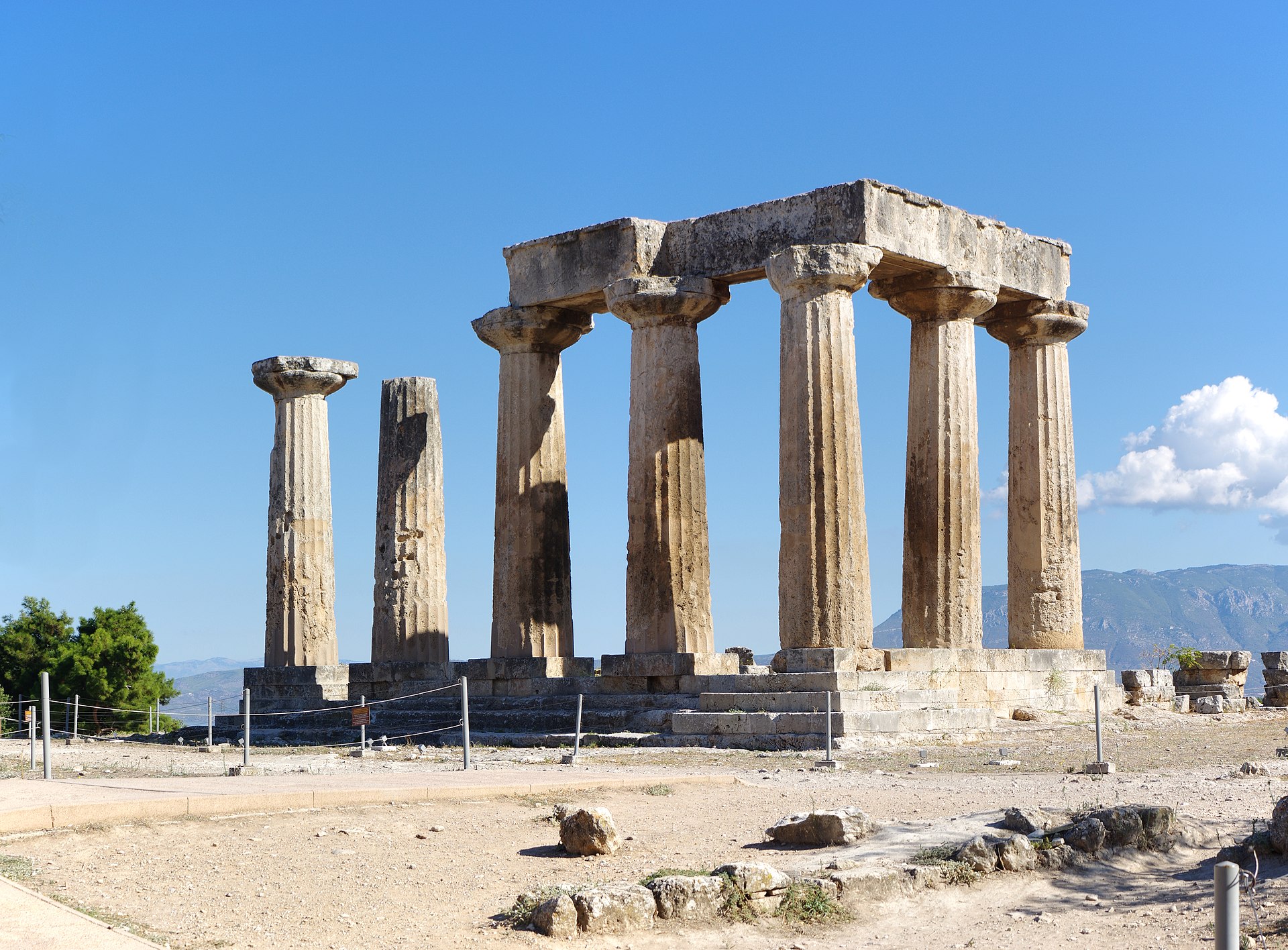 Acts 18 · c. AD 50–52
Paul in Corinth — and the Letters He Wrote There
Paul plants a church in Corinth and writes his earliest surviving letters from there — and one inscription about a Roman named Gallio pins the whole New Testament timeline to a year.
1 Thessalonians 1 · c. AD 50–51A Letter Home to Thessalonica
Writing from Corinth, Paul thanks God for the young Thessalonian church — its faith, love and hope under pressure — and recalls how they turned from idols to the living God to wait for his Son.
1 Thessalonians 2 · c. AD 50–51Gentle as a Nursing Mother
Paul reminds the Thessalonians how he lived among them — without flattery or greed, working night and day, gentle as a mother — thanks God they received the message as God's word, and longs to see them again.
1 Thessalonians 3 · c. AD 50–51Timothy Brings Good News
Unable to bear the silence, Paul sends Timothy back to Thessalonica. His report of a church still standing under pressure turns Paul's anxiety into thanksgiving and prayer.
1 Thessalonians 4 · c. AD 50–51Grief with Hope
Paul urges a holy, quiet, hard-working life, then comforts grieving believers: those who have died in Christ are not lost, and the living and dead will be gathered to the Lord together.
1 Thessalonians 5 · c. AD 50–51Children of the Day
The day of the Lord will come like a thief, so believers live awake and sober. Paul closes with a string of short commands for church life and a blessing over the whole person.
2 Thessalonians 1 · c. AD 50–51, if by PaulJustice for a Suffering Church
A second letter to Thessalonica thanks God for a church growing under persecution and promises that God will set things right when Jesus is revealed from heaven.
2 Thessalonians 2 · c. AD 50–51, if by PaulNot Yet: The Man of Lawlessness
Someone has alarmed the church by claiming the day of the Lord has already come. Paul says it has not: a great rebellion and a 'man of lawlessness' must appear first, and something is holding him back.
2 Thessalonians 3 · c. AD 50–51, if by PaulKeep Working, Keep Doing Good
Paul asks for prayer, then confronts believers who have stopped working and live off others. Follow my example, he says: work quietly, and never tire of doing good.
Acts 19 · c. AD 52–55Uproar in Ephesus
Paul spends over two years in Ephesus. The message spreads across Asia, magic books are burned, and the silversmiths who profit from Artemis stir the city into a riot in its great theatre.
1 Corinthians 1 · c. AD 53–55Whose Side Are You On?
Writing from Ephesus, Paul hears that the Corinthian church is splitting into fan clubs. His answer: Christ is not divided, and the message of a crucified Messiah overturns every human boast.
1 Corinthians 2 · c. AD 53–55Nothing but Christ Crucified
Paul reminds the Corinthians that he came to them without polished rhetoric, preaching only Christ crucified, and explains the hidden wisdom of God that the Spirit reveals.
1 Corinthians 3 · c. AD 53–55Planted, Watered, Grown by God
Paul calls the quarrelling Corinthians spiritual infants. He and Apollos are only workers; God gives the growth. The church is God's field, God's building, God's temple.
1 Corinthians 4 · c. AD 53–55Fools for Christ's Sake
Paul answers a church that ranks its teachers like celebrities: apostles are stewards who answer to God, and just now they look less like heroes than like the condemned men at the back of a parade.
1 Corinthians 5 · c. AD 53–55A Sin the Church Applauded
A man in the Corinthian church is living with his father's wife, and the congregation is proud of its tolerance. Paul demands that they stop boasting and put him outside the fellowship — for his own eventual rescue.
1 Corinthians 6 · c. AD 53–55Brothers in Court, Bodies as Temples
Paul is appalled that believers are suing each other before pagan judges, then answers slogans that treated the body as unimportant: bodies belong to the Lord, and sex is never merely a bodily matter.
1 Corinthians 7 · c. AD 53–55To Marry or Not to Marry
Answering the Corinthians' own letter, Paul treats marriage and singleness as two honourable callings: mutual obligation within marriage, limits on divorce, contentment in one's situation, and a surprising preference for the freedom of the unmarried.
1 Corinthians 8 · c. AD 53–55Knowledge Puffs Up, Love Builds Up
Some Corinthians knew idols were nothing and ate sacrificial meat freely; others' consciences were wounded by it. Paul agrees with the knowledge but sides with love: never let your freedom ruin a brother.
1 Corinthians 9 · c. AD 53–55Rights Laid Down, a Race Run
Paul could claim financial support like other apostles but refuses it, so the gospel costs its hearers nothing. He becomes all things to all people, and trains like an athlete for a prize that never withers.
1 Corinthians 10 · c. AD 53–55Warnings from the Wilderness
Paul warns the confident Corinthians with Israel's wilderness story, forbids joining in temple feasts, and then gives practical rules for market meat and dinner invitations: do everything for God's glory and others' good.
1 Corinthians 11 · c. AD 53–55Covered Heads and a Divided Table
Paul regulates how men and women pray and prophesy in worship, then rebukes a Lord's Supper where the wealthy ate first and the poor went hungry, handing on the earliest written account of Jesus' last meal.
1 Corinthians 12 · c. AD 53–55One Body, Many Parts
Paul answers the Corinthians' question about spiritual gifts: one Spirit gives many different gifts for the common good, and the church is a single body in which the weakest-looking parts are indispensable.
1 Corinthians 13 · c. AD 53–55The Still Better Way
In the middle of a quarrel about spiritual gifts, Paul writes his portrait of love: without it every gift is noise, it is patient and kind, and when all partial things end, love remains.
1 Corinthians 14 · c. AD 53–55 (written from Ephesus)Tongues, Prophecy and an Orderly Church
Paul weighs tongues against prophecy, insists that worship build everyone up, and asks for order — including a much-debated line about women keeping silent.
1 Corinthians 15 · c. AD 53–55 (written from Ephesus)If Christ Has Not Been Raised
Paul repeats an early creed naming the witnesses of the risen Jesus, then argues that everything stands or falls on the resurrection — and that the dead will be raised in transformed bodies.
1 Corinthians 16 · c. AD 53–55 (written from Ephesus, before Pentecost)A Collection for Jerusalem's Poor
Paul closes the letter with practical business — a weekly collection for the poor believers in Jerusalem, his travel plans, news of co-workers and warm greetings.
Acts 20 · c. AD 55–57A Farewell on the Beach at Miletus
Paul travels through Macedonia and Greece, raises young Eutychus at Troas, and says an emotional goodbye to the Ephesian elders at Miletus before heading for Jerusalem.
2 Corinthians 1 · c. AD 55–56 (written from Macedonia)The God of All Comfort
Writing from Macedonia after a crisis with Corinth, Paul opens with comfort in affliction, recalls a near-death ordeal in Asia, and defends his change of travel plans.
2 Corinthians 2 · c. AD 55–56 (written from Macedonia)A Tearful Letter and Forgiveness
Paul explains the painful visit and tearful letter, urges the church to forgive the one who wronged him, and describes ministry as a victory procession spreading a fragrance.
2 Corinthians 3 · c. AD 55–56 (written from Macedonia)Letters Written on Hearts
Asked for credentials, Paul says the Corinthian church itself is his letter of recommendation, and contrasts the fading glory on Moses' face with the lasting glory of the Spirit's new covenant.
2 Corinthians 4 · c. AD 55–56 (written from Macedonia)Treasure in Clay Jars
Paul says the light of God shines through fragile human messengers — afflicted but not crushed — and that present troubles are light compared with the glory to come.
2 Corinthians 5 · c. AD 55–56 (written from Macedonia)A New Creation, a Message of Reconciliation
Paul contrasts the body as a temporary tent with the eternal home God is preparing, and says that in Christ anyone becomes a new creation, entrusted with a message of reconciliation.
2 Corinthians 6 · c. AD 55–56 (written from Macedonia)Hearts Opened Wide
Paul urges Corinth not to waste God's grace, lists the hardships and paradoxes of his ministry, pleads for their affection, and adds a sharp call to separate from idolatry.
2 Corinthians 7 · c. AD 55–56Good News from Titus
Titus reaches Paul in Macedonia with word that the Corinthians took his painful letter to heart. Paul's relief pours out, and he explains the difference between sorrow that heals and sorrow that only crushes.
2 Corinthians 8 · c. AD 55–56The Poor Who Gave First
Paul urges Corinth to finish the collection for Jerusalem's poor, holding up the Macedonian churches who gave beyond their means, and Christ who became poor for their sake.
2 Corinthians 9 · c. AD 55–56The Cheerful Giver
Paul asks Corinth to have its gift ready before he arrives, compares generosity to sowing seed, and says the gift will overflow in thanks to God and bind Jew and Gentile together.
2 Corinthians 10 · c. AD 55–56Bold on Paper, Weak in Person?
Stung by the jibe that he is forceful in letters but feeble face to face, Paul insists his weapons are not worldly ones and that the only boasting worth anything is boasting in the Lord.
2 Corinthians 11 · c. AD 55–56The Fool's Speech
Facing rivals Paul mockingly calls 'super-apostles', he refuses their terms, then boasts like a fool — not of successes but of beatings, shipwrecks, hunger and a humiliating escape in a basket.
2 Corinthians 12 · c. AD 55–56Strength in Weakness
Paul tells of being caught up into paradise, then of a 'thorn in the flesh' God refused to remove — and of the answer that his grace is enough, because power is made perfect in weakness.
2 Corinthians 13 · c. AD 55–56Examine Yourselves
Paul warns he will not spare the unrepentant on his third visit, urges the Corinthians to test their own faith, and closes with a blessing of grace, love and fellowship.
Romans 1 · c. AD 56–57Not Ashamed of the Good News
Writing from Corinth to a church he has never visited, Paul announces his theme — the gospel as God's power to save everyone who believes — and then describes a humanity that has turned from God.
Romans 2 · c. AD 56–57The Judge in the Mirror
Paul turns on the reader who has been nodding at chapter 1: whoever judges others is doing the same things. God judges everyone impartially, and privilege — even God's law — is no shelter.
Romans 3 · c. AD 56–57All Have Sinned, All Can Be Put Right
Paul's case reaches its verdict: Jew and Gentile alike are under sin. Then comes the turn — God's righteousness is revealed apart from the law, through faith in Jesus Christ, as a free gift for all.
Romans 4 · c. AD 56–57Abraham, Counted Righteous by Trust
Paul turns to Abraham, the father of Israel, to show that God counted him righteous through trust before he was circumcised, making him father of all who believe, Jew and Gentile alike.
Romans 5 · c. AD 56–57Two Men, Two Humanities
Put right with God, believers have peace and a hope that suffering cannot shame. Then Paul sets Adam beside Christ: one act brought sin and death to all, one act of obedience brings grace and life.
Romans 6 · c. AD 56–57Dead to Sin, Alive to God
If grace outruns sin, why not keep sinning? Paul answers with baptism: believers have died with Christ and been raised with him, and have changed masters — from sin, whose wage is death, to God, whose gift is life.
Romans 7 · c. AD 56–57The Good Law and the Divided Self
Freed from the law as a widow is freed from her marriage, believers belong to Christ. Yet the law is holy; the problem is sin, which uses the commandment — leaving the famous 'I' who wants good but does evil.
Romans 8 · c. AD 56–57No Condemnation, Nothing Can Separate
The Spirit does what the law could not. Believers are God's children crying 'Abba', creation groans in labour for its freedom, the Spirit prays within them, and nothing in all creation can separate them from God's love.
Romans 9 · c. AD 56–57Paul's Grief for Israel
Paul grieves that most of his own people have not believed in their Messiah. Has God's word failed? He argues that God's promise always worked by his choosing and his mercy, from Isaac and Jacob to a remnant now.
Romans 10 · c. AD 56–57The Word Is Near You
Paul prays for Israel's salvation. Christ is the goal of the law, and the word of faith is near: whoever confesses Jesus as Lord and believes God raised him will be saved. But people must hear, and hearing needs messengers.
Romans 11 · c. AD 56–57The Olive Tree and the Mystery
God has not rejected his people. A remnant believes, Israel's stumbling has opened the door to the Gentiles, and Gentile branches grafted into Israel's olive tree must not boast. Paul ends in hope that all Israel will be saved, and in praise.
Romans 12 · c. AD 56–57A Living Sacrifice
In view of God's mercies, Paul urges believers to offer their whole selves to God, to be transformed in mind, to serve as one body with many gifts, and to love sincerely — even blessing those who persecute them.
Romans 13 · c. AD 56–57Caesar, Taxes and the Debt of Love
Paul tells the Roman believers to submit to governing authorities as God's servants and to pay their taxes, then says the only debt left is love, and urges them to wake up, for the day is near.
Romans 14 · c. AD 56–57The Weak and the Strong
Roman believers disagree over meat, wine and holy days. Paul refuses to crown a winner: each answers to the Lord, and the strong must not wreck a weaker believer's faith over a plate of food.
Romans 15 · c. AD 56–57Welcome One Another — Then Spain
Paul closes the argument with Christ's welcome of Jew and Gentile, then explains his mission from Jerusalem to Illyricum, the gift he is carrying to Jerusalem, and his hope of reaching Spain by way of Rome.
Romans 16 · c. AD 56–57Phoebe, Junia and the Roll-Call
Paul commends Phoebe, deacon and patron of the church at Cenchreae, and greets a crowd of Roman believers — women and men, slaves and free — including Andronicus and Junia, 'outstanding among the apostles'.
Acts 21 · c. AD 57, around PentecostWarned, Welcomed, Then Seized
Paul sails for Jerusalem despite tearful warnings, is welcomed by James and the elders, joins a temple purification to calm rumours — and is mobbed in the temple court and rescued by Roman soldiers.
Acts 22 · c. AD 57Paul Tells His Story
From the barracks steps Paul tells the Jerusalem crowd how he persecuted the Way and met Jesus near Damascus. At the word 'Gentiles' the crowd explodes; about to be flogged, he reveals he is a Roman citizen.
Acts 23 · c. AD 57The Plot and the Night March
Paul divides the council over the resurrection, is reassured by the Lord in the night, and is saved from an assassination plot when his nephew warns the tribune — who sends him under heavy guard to Governor Felix.
Acts 24 · c. AD 57–59/60Before Felix, and Two Lost Years
A hired orator accuses Paul before Governor Felix; Paul answers calmly. Felix, well informed about the Way, delays the verdict, listens to Paul with his wife Drusilla, hopes for a bribe — and leaves him in custody for two years.
Acts 25 · c. AD 59/60I Appeal to Caesar
The new governor Festus reopens Paul's case. When Festus proposes a trial in Jerusalem, Paul appeals to the emperor; then King Agrippa II and Bernice arrive, and Festus asks for help writing up a charge he cannot define.
Acts 26 · c. AD 59/60Almost Persuaded? Paul Before Agrippa
Before King Agrippa II, Bernice and Festus, Paul tells his conversion story a third time and presses the king himself. Festus calls him mad; Agrippa deflects; all agree he could have been freed had he not appealed.
Acts 27 · Autumn c. AD 59/60Storm and Shipwreck
Sailing for Rome too late in the season, Paul's grain ship is caught by a north-easterly gale, drifts for two weeks and runs aground off Malta. Paul steadies the crew, and all 276 on board reach land.
Acts 28 · c. AD 60–62Rome at Last — and an Open Door
Shipwrecked on Malta, Paul winters there, reaches Rome under guard and spends two years in a rented house welcoming all comers — and Acts ends without telling us his verdict.
Ephesians 1 · c. AD 60–62 (if by Paul during the Roman custody)Every Blessing, All at Once
From custody, Paul (or a close disciple writing in his name) opens with one breathless blessing — chosen, adopted, redeemed, sealed — and a prayer that readers grasp the power that raised Christ.
Ephesians 2 · c. AD 60–62 (if by Paul during the Roman custody)The Wall Comes Down
Once dead in wrongdoing and once shut out as outsiders, Gentile believers are made alive by grace and joined with Jewish believers into one new people — the old dividing wall torn down.
Ephesians 3 · c. AD 60–62 (if by Paul during the Roman custody)A Prisoner Let in on a Secret
Paul, the prisoner, explains the 'mystery' entrusted to him — that Gentiles share fully in God's promises — then kneels to pray that his readers grasp a love too wide to measure.
Ephesians 4 · c. AD 60–62 (if by Paul during the Roman custody)One Body, Many Gifts
The letter turns to practice: keep the unity the Spirit gives, use the varied gifts Christ has handed out to build each other up, and take off the old way of life like worn clothes.
Ephesians 5 · c. AD 60–62 (if by Paul during the Roman custody)Walk in Love, Wake Up
Imitate God, live as children of light, be filled with the Spirit and sing — then the first part of a household code: wives and husbands, set beside the love of Christ for the church.
Ephesians 6 · c. AD 60–62 (if by Paul during the Roman custody)Slaves, Masters, and Borrowed Armour
The household code continues with children and parents, slaves and masters — texts later used to defend slavery — before the letter ends with the believer's armour and a request for prayer.
Colossians 1 · c. AD 60–62 (if by Paul during the Roman custody)The Firstborn Over All Creation
Writing to a church he never visited, Paul gives thanks for its faith, prays for it, and quotes or composes a soaring hymn: Christ as the image of God, through whom all things were made and reconciled.
Colossians 2 · c. AD 60–62 (if by Paul during the Roman custody)Nothing Needs Adding
Paul warns the Colossians against persuasive teachings about food rules, festivals, visions and angel worship: in Christ they already have the fullness of God, and their debts are nailed to the cross.
Colossians 3 · c. AD 60–62 (if by Paul during the Roman custody)Clothed in a New Life
Raised with Christ, believers set their minds on things above, take off old vices, put on compassion and love where ethnic and social labels no longer divide — then comes a household code.
Colossians 4 · c. AD 60–62 (if written from Rome)Greetings, Couriers and a Returning Man
Colossians closes with prayer, wise speech and a crowded list of names — and quietly mentions that Onesimus is travelling home with Tychicus, the thread that leads straight into Philemon.
Philemon 1 · c. AD 60–62 (if written from Rome)No Longer as a Slave
Paul's shortest letter asks Philemon to welcome back Onesimus, an enslaved man from his household, 'as a beloved brother'. It does not condemn slavery — yet it has also been read as quietly undermining it.
Philippians 1 · c. AD 60–62 (if written from Rome; earlier if from Ephesus)To Live Is Christ
Writing in chains to the church he planted at Philippi, Paul thanks them for their partnership, says his imprisonment has actually spread the gospel, and weighs life against death with startling calm.
Philippians 2 · c. AD 60–62 (if written from Rome; earlier if from Ephesus)The Christ Who Emptied Himself
Paul calls the Philippians to humble unity and grounds it in a poetic passage about Christ: equal with God, he took the form of a slave, died on a cross, and was exalted as Lord.
Philippians 3 · c. AD 60–62 (if written from Rome; earlier if from Ephesus)Everything Counted as Loss
Paul warns sharply against those pressing circumcision on Gentile believers, lists the impressive Jewish credentials he once relied on, and says he now counts them loss for the sake of knowing Christ.
Philippians 4 · c. AD 60–62 (if written from Rome; earlier if from Ephesus)Rejoice — and Thank You for the Gift
Paul urges two women leaders to agree, calls the church to rejoice and trade anxiety for prayer, and thanks the Philippians for their gift, saying he has learned contentment in plenty and in want.
The reading order · 107 of 107 readings written
- Acts 1 Waiting in the Upper Room Debated
- Acts 2 Fire, Wind and Many Languages Debated
- Acts 3 Silver and Gold I Do Not Have Debated
- Acts 4 Ordinary Men Before the Council Debated
- Acts 5 A Lie, Two Deaths, and Gamaliel Debated
- Acts 6 Seven Chosen to Serve Tables Debated
- Acts 7 Stephen's Speech and Stoning Debated
- Acts 8 Scattered Seed: Samaria and the Desert Road Debated
- Acts 9 The Persecutor on the Damascus Road Documented
- Acts 10 Peter at a Gentile's Table Debated
- Acts 11 Antioch, Where They Were First Called Christians Documented
- Acts 12 Herod's Sword, Peter's Escape, Herod's End Documented
- James 1 Trials, Wisdom and Doing the Word Debated
- James 2 Faith That Works Debated
- James 3 The Tongue and the Wisdom from Above Debated
- James 4 Quarrels, Pride and 'If the Lord Wills' Debated
- James 5 Unpaid Wages and the Prayer of Faith Debated
- Acts 13 Sent Out: Cyprus and Pisidian Antioch Debated
- Acts 14 Mistaken for Gods, Stoned as Criminals Debated
- Galatians 1 No Other Gospel Debated
- Galatians 2 Paul Faces Peter at Antioch Debated
- Galatians 3 Children of Abraham by Faith Debated
- Galatians 4 Heirs, Not Slaves Debated
- Galatians 5 Free to Serve in Love Debated
- Galatians 6 Written in Large Letters Debated
- Acts 15 The Jerusalem Council Documented
- Acts 16 Across the Sea to Philippi Documented
- Acts 17 To an Unknown God Documented
- Acts 18 Paul in Corinth — and the Letters He Wrote There Documented
- 1 Thessalonians 1 A Letter Home to Thessalonica Documented
- 1 Thessalonians 2 Gentle as a Nursing Mother Documented
- 1 Thessalonians 3 Timothy Brings Good News Documented
- 1 Thessalonians 4 Grief with Hope Documented
- 1 Thessalonians 5 Children of the Day Documented
- 2 Thessalonians 1 Justice for a Suffering Church Debated
- 2 Thessalonians 2 Not Yet: The Man of Lawlessness Debated
- 2 Thessalonians 3 Keep Working, Keep Doing Good Debated
- Acts 19 Uproar in Ephesus Documented
- 1 Corinthians 1 Whose Side Are You On? Documented
- 1 Corinthians 2 Nothing but Christ Crucified Documented
- 1 Corinthians 3 Planted, Watered, Grown by God Documented
- 1 Corinthians 4 Fools for Christ's Sake Documented
- 1 Corinthians 5 A Sin the Church Applauded Documented
- 1 Corinthians 6 Brothers in Court, Bodies as Temples Documented
- 1 Corinthians 7 To Marry or Not to Marry Documented
- 1 Corinthians 8 Knowledge Puffs Up, Love Builds Up Documented
- 1 Corinthians 9 Rights Laid Down, a Race Run Documented
- 1 Corinthians 10 Warnings from the Wilderness Documented
- 1 Corinthians 11 Covered Heads and a Divided Table Documented
- 1 Corinthians 12 One Body, Many Parts Documented
- 1 Corinthians 13 The Still Better Way Documented
- 1 Corinthians 14 Tongues, Prophecy and an Orderly Church Documented
- 1 Corinthians 15 If Christ Has Not Been Raised Documented
- 1 Corinthians 16 A Collection for Jerusalem's Poor Documented
- Acts 20 A Farewell on the Beach at Miletus Documented
- 2 Corinthians 1 The God of All Comfort Debated
- 2 Corinthians 2 A Tearful Letter and Forgiveness Debated
- 2 Corinthians 3 Letters Written on Hearts Debated
- 2 Corinthians 4 Treasure in Clay Jars Debated
- 2 Corinthians 5 A New Creation, a Message of Reconciliation Debated
- 2 Corinthians 6 Hearts Opened Wide Debated
- 2 Corinthians 7 Good News from Titus Documented
- 2 Corinthians 8 The Poor Who Gave First Documented
- 2 Corinthians 9 The Cheerful Giver Documented
- 2 Corinthians 10 Bold on Paper, Weak in Person? Debated
- 2 Corinthians 11 The Fool's Speech Debated
- 2 Corinthians 12 Strength in Weakness Debated
- 2 Corinthians 13 Examine Yourselves Debated
- Romans 1 Not Ashamed of the Good News Documented
- Romans 2 The Judge in the Mirror Documented
- Romans 3 All Have Sinned, All Can Be Put Right Documented
- Romans 4 Abraham, Counted Righteous by Trust Documented
- Romans 5 Two Men, Two Humanities Documented
- Romans 6 Dead to Sin, Alive to God Documented
- Romans 7 The Good Law and the Divided Self Documented
- Romans 8 No Condemnation, Nothing Can Separate Documented
- Romans 9 Paul's Grief for Israel Documented
- Romans 10 The Word Is Near You Documented
- Romans 11 The Olive Tree and the Mystery Documented
- Romans 12 A Living Sacrifice Documented
- Romans 13 Caesar, Taxes and the Debt of Love Documented
- Romans 14 The Weak and the Strong Documented
- Romans 15 Welcome One Another — Then Spain Documented
- Romans 16 Phoebe, Junia and the Roll-Call Documented
- Acts 21 Warned, Welcomed, Then Seized Documented
- Acts 22 Paul Tells His Story Documented
- Acts 23 The Plot and the Night March Documented
- Acts 24 Before Felix, and Two Lost Years Documented
- Acts 25 I Appeal to Caesar Documented
- Acts 26 Almost Persuaded? Paul Before Agrippa Documented
- Acts 27 Storm and Shipwreck Documented
- Acts 28 Rome at Last — and an Open Door Documented
- Ephesians 1 Every Blessing, All at Once Debated
- Ephesians 2 The Wall Comes Down Debated
- Ephesians 3 A Prisoner Let in on a Secret Debated
- Ephesians 4 One Body, Many Gifts Debated
- Ephesians 5 Walk in Love, Wake Up Debated
- Ephesians 6 Slaves, Masters, and Borrowed Armour Debated
- Colossians 1 The Firstborn Over All Creation Debated
- Colossians 2 Nothing Needs Adding Debated
- Colossians 3 Clothed in a New Life Debated
- Colossians 4 Greetings, Couriers and a Returning Man Debated
- Philemon 1 No Longer as a Slave Debated
- Philippians 1 To Live Is Christ Debated
- Philippians 2 The Christ Who Emptied Himself Debated
- Philippians 3 Everything Counted as Loss Debated
- Philippians 4 Rejoice — and Thank You for the Gift Debated
The Later Letters & Revelation
c. AD 62–95 (debated) — The last letters of Paul, Peter, John and others, written as the first generation passed — ending with John's Revelation.
Stay in Ephesus, Timothy
Paul leaves his young co-worker in charge of a church troubled by speculative teachers, reminds him what the law is for, and tells his own story as the worst of sinners shown mercy.
1 Timothy 2 · c. AD 62–64 (on the traditional view; later if written in Paul's name)Prayer for All, and a Hard Passage
Paul asks the church to pray for everyone, rulers included, because God wants all people saved; then come instructions on men, women and teaching that churches still read in very different ways.
1 Timothy 3 · c. AD 62–64 (on the traditional view; later if written in Paul's name)Overseers, Deacons, and the Household of God
Paul lists the character a church should look for in its overseers and deacons, mentions 'women' among the deacons, and ends with an early hymn about Christ.
1 Timothy 4 · c. AD 62–64 (on the traditional view; later if written in Paul's name)Train Yourself in Godliness
Paul warns of teachers who forbid marriage and certain foods, insists that everything God made is good, and urges young Timothy not to let anyone look down on his youth.
1 Timothy 5 · c. AD 62–64 (on the traditional view; later if written in Paul's name)Widows, Elders, and Family Duty
Paul tells Timothy to treat the church as a family, sets out how widows are to be supported, and gives rules for honouring, paying and disciplining elders.
1 Timothy 6 · c. AD 62–64 (on the traditional view; later if written in Paul's name)Contentment and the Love of Money
Paul tells slaves to honour their masters, warns that the love of money is a root of all kinds of evil, charges Timothy to fight the good fight, and tells the rich to be rich in good works.
Titus 1 · c. AD 62–64 (on the traditional view; later if written in Paul's name)Elders for Every Town in Crete
Paul reminds Titus why he was left on Crete — to appoint elders in each town — lists the character they need, and warns against teachers who upset whole households for gain.
Titus 2 · c. AD 62–64 (on the traditional view; later if written in Paul's name)Grace That Trains Us
Titus is to teach older men and women, younger women and men, and slaves how to live so the message is not discredited — all grounded in the grace of God that has appeared.
Titus 3 · c. AD 62–64 (on the traditional view; later if written in Paul's name)Saved by Mercy, Ready for Good Works
Paul tells the Cretan believers to be good citizens and gentle neighbours, reminds them they were saved by God's mercy and not their own works, and ends with travel plans and greetings.
1 Peter 1 · c. AD 62–64 (traditional; many scholars date it later, c. AD 70–90)A Living Hope for Exiles
Peter writes to scattered believers in Asia Minor who are suffering, reminding them of a living hope through Christ's resurrection and calling them to be holy because they were redeemed at great cost.
1 Peter 2 · c. AD 62–64 (traditional; many scholars date it later)Living Stones, Exiles and Slaves
Peter calls scattered believers living stones in God's house and a royal priesthood, urges good conduct and respect for the emperor, and tells slaves to endure even harsh masters as Christ endured.
1 Peter 3 · c. AD 62–64 (traditional; many scholars date it later)Wives, Husbands and Spirits in Prison
Peter tells wives to win unbelieving husbands by their conduct and husbands to honour their wives, calls all to repay evil with blessing and gently explain their hope, and speaks of Christ proclaiming to 'spirits in prison'.
1 Peter 4 · c. AD 62–64 (traditional; many scholars date it later)The Fiery Ordeal
Peter tells believers to arm themselves with Christ's resolve, love deeply and serve with their gifts because the end is near, and not to be surprised by the fiery ordeal but to suffer as Christians without shame.
1 Peter 5 · c. AD 62–64 (traditional; many scholars date it later)Shepherds, a Roaring Lion and 'Babylon'
Peter, a fellow elder, charges church leaders to shepherd willingly and humbly, calls everyone to cast their anxieties on God and resist the devil, and sends greetings from 'Babylon' with Silvanus and Mark.
2 Timothy 1 · c. AD 64–67 (traditional)Not a Spirit of Fear
From chains in Rome, Paul writes to Timothy with tears and gratitude, urging him to fan his gift into flame, not to be ashamed of the gospel or of Paul, and to guard the teaching entrusted to him.
2 Timothy 2 · c. AD 64–67 (traditional)Soldier, Athlete, Farmer
Paul urges Timothy to pass the teaching on to faithful people, to endure hardship like a soldier, an athlete and a farmer, to handle God's word rightly, to avoid quarrels and to correct opponents gently.
2 Timothy 3 · c. AD 64–67 (traditional)Hard Times and God-Breathed Scripture
Paul warns of terrible times in the last days, when people love themselves and money more than God, and urges Timothy to hold to what he learned, since all Scripture is God-breathed and useful.
2 Timothy 4 · c. AD 64–67 (traditional)I Have Finished the Race
Paul charges Timothy to preach the word in every season, looks back on his life as a finished race, asks for his cloak and scrolls, names who left and who stayed, and trusts the Lord to bring him home.
2 Peter 1 · c. AD 64–68 (traditional); many scholars c. AD 80–130Peter's Farewell: Eyewitness of Majesty
Facing death, Peter urges believers to add virtue upon virtue to their faith, recalls seeing Christ's glory on the holy mountain, and points them to the prophetic word as a lamp in a dark place.
2 Peter 2 · c. AD 64–68 (traditional); many scholars c. AD 80–130False Teachers and Waterless Springs
Peter warns of false teachers driven by greed and pleasure, recalls that God judged rebel angels, the ancient world and Sodom but rescued Noah and Lot, and describes the teachers in vivid, harsh images.
2 Peter 3 · c. AD 64–68 (if by Peter; many date it later)A Thousand Years, One Day
Scoffers mock the promise of Christ's return. Peter answers: God's patience is not slowness but mercy, the day will come like a thief, and Paul's letters — hard in places — belong with the scriptures.
Hebrews 1 · Probably the AD 60s, before AD 70 (debated)The Son Above the Angels
Hebrews opens without a greeting: God spoke in many ways through the prophets, but now through a Son who made the worlds, cleansed sins, and sits above every angel.
Hebrews 2 · Probably the AD 60s, before AD 70 (debated)Do Not Drift Away
The first warning: if the message through angels carried weight, how much more this salvation? Then the Son is shown made lower than angels for a while — sharing flesh and blood, tasting death, becoming a merciful high priest.
Hebrews 3 · Probably the AD 60s, before AD 70 (debated)Greater Than Moses
Moses was faithful as a servant in God's house; Jesus is faithful as the Son over it. Then Psalm 95 and the wilderness generation: do not harden your hearts 'today'.
Hebrews 4 · Probably the AD 60s, before AD 70 (debated)A Rest Still Waiting
God's promised rest was never used up by Joshua's conquest; a Sabbath-rest remains for God's people. His word lays everything bare — and a high priest who was tested in every way invites us to his throne of grace.
Hebrews 5 · Probably the AD 60s, before AD 70 (debated)A Priest Like Melchizedek
A high priest is chosen from among people and gently shares their weakness. Christ did not appoint himself: God named him a priest 'after the order of Melchizedek', and he learned obedience through tears. Then a rebuke — you still need milk.
Hebrews 6 · Probably the AD 60s, before AD 70 (debated)Warning and Anchor
The sermon's hardest passage: those who fall away after tasting the heavenly gift cannot be brought back to repentance. Then the writer turns — he expects better of them — and points to God's oath as an anchor for the soul.
Hebrews 7 · Probably the AD 60s, before AD 70 (debated)King of Righteousness, King of Peace
Melchizedek, without recorded genealogy, blessed Abraham and received his tithe — so his priesthood outranks Levi's. Jesus, from Judah, is a priest of that order: permanent, sworn by oath, able to save completely.
Hebrews 8 · Probably the AD 60s, before AD 70 (debated)A New Covenant Written on Hearts
Our high priest serves in the true sanctuary, of which the earthly one is a copy and shadow. Hebrews quotes Jeremiah's promise of a new covenant — laws written on hearts, sins remembered no more — and calls the first one old.
Hebrews 9 · Probably the AD 60s, before AD 70 (debated)The Tabernacle and the Blood
The old tabernacle's layout taught that the way into God's presence was not yet open. Christ entered once for all, with his own blood, as mediator of a new covenant — and will appear a second time to bring salvation.
Hebrews 10 · Probably before AD 70 (see the note on Hebrews)Once for All, Then Hold On
The sacrifices that had to be repeated every year give way to one offering that never needs repeating — and the letter turns that fact into a call to draw near, meet together and not give up.
Hebrews 11 · Probably before AD 70 (see the note on Hebrews)The Great Roll-Call of Faith
From Abel to the unnamed martyrs, Hebrews walks through the Old Testament showing people who trusted God for what they could not yet see — and ends by saying none of them received the promise without us.
Hebrews 12 · Probably before AD 70 (see the note on Hebrews)Running the Race
With a crowd of witnesses around them and Jesus ahead, the readers are told to throw off what slows them, to read hardship as a father's training, and to remember they have come to a better mountain than Sinai.
Hebrews 13 · Probably before AD 70 (see the note on Hebrews)Outside the Camp
The long sermon ends in everyday instructions — welcome strangers, remember prisoners, honour marriage, loosen your grip on money — and a call to follow Jesus 'outside the camp', bearing his disgrace.
Jude 1 · Undated; we read it in the AD 60s (see the note on Jude)Contend for the Faith
A brother of James drops the letter he meant to write and sends an urgent warning instead: intruders are turning grace into licence. He draws on Israel's history — and on two Jewish writings outside our Bible — to make the point.
1 John 1 · c. AD 85–95 (traditional and widely held; not certain)What We Have Seen and Touched
An elder writes to a hurting community: the life he proclaims was heard, seen and touched in a real human being. Then he sets out the first test of genuine fellowship — walking in the light and admitting sin.
1 John 2 · c. AD 85–95 (traditional and widely held; not certain)They Went Out From Us
John offers his 'little children' tests of real faith — keeping God's commands, loving one another, refusing to love the world — and speaks openly of those who left the community and denied that Jesus is the Christ.
1 John 3 · c. AD 85–95 (traditional and widely held; not certain)Children of God
What great love, to be called God's children — and to be made like Christ when he appears. That identity shows itself in turning from sin and in a love that is practical, costly and not just words.
1 John 4 · c. AD 85–95 (traditional and widely held; not certain)God Is Love
First, test the spirits: whoever confesses that Jesus Christ has come in the flesh is from God. Then the letter's most famous words — God is love — and the claim that you cannot love the unseen God while hating a visible brother.
1 John 5 · c. AD 85–95 (traditional and widely held; not certain)That You May Know
Faith in Jesus overcomes the world; the Spirit, the water and the blood testify to him. The letter ends with assurance of eternal life — and a textual footnote: the famous 'three in heaven' words of 5:7–8 were added centuries later.
2 John 1 · c. AD 85–95 (debated)A Short Letter About the Open Door
The elder writes to a 'chosen lady and her children' — probably a house church — urging love, truth, and caution about welcoming travelling teachers who deny that Jesus came in the flesh.
3 John 1 · c. AD 85–95 (debated)Gaius, Diotrephes and Demetrius
A personal note from the elder to his friend Gaius: praise for his hospitality to travelling believers, a rebuke of Diotrephes who 'loves to be first', and a recommendation for Demetrius.
Revelation 1 · c. AD 95 (traditional; some date it to the late AD 60s)The Voice Behind Him on Patmos
Exiled on Patmos, John hears a voice like a trumpet and turns to see the risen Christ, blazing, among seven golden lampstands — and is told to write to seven churches.
Revelation 2 · c. AD 95 (traditional; some date it to the late AD 60s)Four Letters: Ephesus to Thyatira
Christ's messages to four real cities: Ephesus has lost its first love, Smyrna is poor but rich, Pergamum lives where Satan's throne is, and Thyatira tolerates a false prophetess.
Revelation 3 · c. AD 95 (traditional; some date it to the late AD 60s)Sardis, Philadelphia and Lukewarm Laodicea
Sardis looks alive but is dead; little Philadelphia is given an open door; wealthy Laodicea is neither hot nor cold — and Christ stands at its door and knocks.
Revelation 4 · c. AD 95 (traditional; some date it to the late AD 60s)A Door Opened in Heaven
John is called up through an open door into heaven's throne room: the one on the throne, a rainbow, twenty-four elders, four living creatures, and unending worship of the Creator.
Revelation 5 · c. AD 95 (traditional; some date it to the late AD 60s)The Lion Who Is a Lamb
No one can open the sealed scroll, and John weeps — until he is told the Lion of Judah has conquered, turns, and sees a Lamb standing as though slain. All creation breaks into song.
Revelation 6 · c. AD 95 (traditional; some date it to the late AD 60s)Four Horsemen and Six Seals
The Lamb opens six seals: conquest, war, famine and death ride out; martyrs cry 'how long?'; and a great earthquake shakes the sky as people hide from the Lamb's wrath.
Revelation 7 · c. AD 95 (traditional; some date it to the late AD 60s)Sealed Servants, Uncountable Crowd
The winds of judgment are held back while 144,000 from the tribes of Israel are sealed; then John sees a great multitude from every nation, in white, before the throne.
Revelation 8 · c. AD 95 (traditional; some date it to the late AD 60s)Silence, Then the Trumpets
The seventh seal brings half an hour of silence in heaven; the prayers of God's people rise with incense, and the first four trumpets strike land, sea, rivers and sky.
Revelation 9 · c. AD 95 (traditional); some date it to the late 60sLocusts from the Abyss
The fifth and sixth trumpets: a locust-army from the abyss that torments but cannot kill, then a vast cavalry from the Euphrates — and a humanity that still will not turn.
Revelation 10 · c. AD 95 (traditional); some date it to the late 60sThe Sweet and Bitter Scroll
A towering angel plants one foot on the sea and one on the land, swears there will be no more delay, and hands John a little scroll — sweet to eat, bitter in the stomach.
Revelation 11 · c. AD 95 (traditional); some date it to the late 60sTwo Witnesses and the Last Trumpet
John measures the temple; two witnesses prophesy in sackcloth, are killed and left in the street, then rise. The seventh trumpet sounds: the world's kingdom has become the Lord's.
Revelation 12 · c. AD 95 (traditional); some date it to the late 60sThe Woman and the Dragon
A woman clothed with the sun gives birth while a great red dragon waits to devour her child. The child is taken up to God, Michael wins the war in heaven, and the dragon turns on the woman's other children.
Revelation 13 · c. AD 95 (traditional); some date it to the late 60sThe Beasts and the Number 666
A beast rises from the sea with a healed death-wound and the world worships it; a second beast from the land enforces its cult and its mark. Its number is 666 — or, in some manuscripts, 616.
Revelation 14 · c. AD 95 (traditional); some date it to the late 60sThe Lamb on Zion and Two Harvests
Against the beast's followers stand the Lamb's 144,000 on Mount Zion. Three angels proclaim the gospel, Babylon's fall and a solemn warning; then the earth is reaped — grain first, then grapes for the winepress.
Revelation 15 · c. AD 95 (traditional); some date it to the late 60sThe Song Beside the Sea of Glass
Before the last plagues, the conquerors of the beast stand beside a sea of glass mixed with fire and sing the song of Moses and the Lamb. Then seven angels come out of the heavenly temple carrying seven golden bowls.
Revelation 16 · c. AD 95 (traditional); some date it to the late 60sSeven Bowls and Armageddon
Seven angels pour out seven bowls of God's wrath — sores, blood, scorching heat, darkness, a dried Euphrates, kings gathered at Armageddon — and the voice from the throne declares, 'It is done.'
Revelation 17 · c. AD 95 (traditional); some date it to the late 60sBabylon Rides the Beast
An angel shows John a woman dressed in purple and scarlet, drunk on the blood of the saints, riding a seven-headed beast. Her name is Babylon the great, the city that rules over the kings of the earth.
Revelation 18 · c. AD 95 (traditional); some date it to the late 60sFallen Is Babylon the Great
An angel announces Babylon's fall; God's people are told to come out of her. Kings, merchants and sailors lament a city burned in an hour, and a millstone hurled into the sea marks her end.
Revelation 19 · c. AD 95 (traditional); some date it to the late 60sThe Rider on the White Horse
Heaven sings over fallen Babylon, the wedding supper of the Lamb is announced, and then heaven opens: a rider called Faithful and True comes, and the powers that ruined the earth are finished.
Revelation 20 · c. AD 95 (traditional); some date it to the late 60sThe Thousand Years and the Throne
Satan is bound for a thousand years while the faithful reign with Christ; then a last rebellion, the devil's final defeat, and the great white throne where the dead are judged and death itself is destroyed.
Revelation 21 · c. AD 95 (traditional); some date it to the late 60sAll Things New
A new heaven and a new earth, a holy city coming down like a bride, and God himself living with his people — wiping away every tear, and ending death, mourning and pain for good.
Revelation 22 · c. AD 95 (traditional); some date it to the late 60sThe River, the Tree, and 'Come'
The river of life flows from God's throne, the tree of life stands on its banks, and the curse is gone. The Bible ends with a promise — 'I am coming soon' — and an open invitation: come.
The reading order · 64 of 64 readings written
- 1 Timothy 1 Stay in Ephesus, Timothy Debated
- 1 Timothy 2 Prayer for All, and a Hard Passage Debated
- 1 Timothy 3 Overseers, Deacons, and the Household of God Debated
- 1 Timothy 4 Train Yourself in Godliness Debated
- 1 Timothy 5 Widows, Elders, and Family Duty Debated
- 1 Timothy 6 Contentment and the Love of Money Debated
- Titus 1 Elders for Every Town in Crete Debated
- Titus 2 Grace That Trains Us Debated
- Titus 3 Saved by Mercy, Ready for Good Works Debated
- 1 Peter 1 A Living Hope for Exiles Debated
- 1 Peter 2 Living Stones, Exiles and Slaves Debated
- 1 Peter 3 Wives, Husbands and Spirits in Prison Debated
- 1 Peter 4 The Fiery Ordeal Debated
- 1 Peter 5 Shepherds, a Roaring Lion and 'Babylon' Debated
- 2 Timothy 1 Not a Spirit of Fear Debated
- 2 Timothy 2 Soldier, Athlete, Farmer Debated
- 2 Timothy 3 Hard Times and God-Breathed Scripture Debated
- 2 Timothy 4 I Have Finished the Race Debated
- 2 Peter 1 Peter's Farewell: Eyewitness of Majesty Debated
- 2 Peter 2 False Teachers and Waterless Springs Debated
- 2 Peter 3 A Thousand Years, One Day Debated
- Hebrews 1 The Son Above the Angels Debated
- Hebrews 2 Do Not Drift Away Debated
- Hebrews 3 Greater Than Moses Debated
- Hebrews 4 A Rest Still Waiting Debated
- Hebrews 5 A Priest Like Melchizedek Debated
- Hebrews 6 Warning and Anchor Debated
- Hebrews 7 King of Righteousness, King of Peace Debated
- Hebrews 8 A New Covenant Written on Hearts Debated
- Hebrews 9 The Tabernacle and the Blood Debated
- Hebrews 10 Once for All, Then Hold On Debated
- Hebrews 11 The Great Roll-Call of Faith Debated
- Hebrews 12 Running the Race Debated
- Hebrews 13 Outside the Camp Debated
- Jude 1 Contend for the Faith Debated
- 1 John 1 What We Have Seen and Touched Debated
- 1 John 2 They Went Out From Us Debated
- 1 John 3 Children of God Debated
- 1 John 4 God Is Love Debated
- 1 John 5 That You May Know Debated
- 2 John 1 A Short Letter About the Open Door Debated
- 3 John 1 Gaius, Diotrephes and Demetrius Debated
- Revelation 1 The Voice Behind Him on Patmos Debated
- Revelation 2 Four Letters: Ephesus to Thyatira Debated
- Revelation 3 Sardis, Philadelphia and Lukewarm Laodicea Debated
- Revelation 4 A Door Opened in Heaven Debated
- Revelation 5 The Lion Who Is a Lamb Debated
- Revelation 6 Four Horsemen and Six Seals Debated
- Revelation 7 Sealed Servants, Uncountable Crowd Debated
- Revelation 8 Silence, Then the Trumpets Debated
- Revelation 9 Locusts from the Abyss Debated
- Revelation 10 The Sweet and Bitter Scroll Debated
- Revelation 11 Two Witnesses and the Last Trumpet Debated
- Revelation 12 The Woman and the Dragon Debated
- Revelation 13 The Beasts and the Number 666 Debated
- Revelation 14 The Lamb on Zion and Two Harvests Debated
- Revelation 15 The Song Beside the Sea of Glass Debated
- Revelation 16 Seven Bowls and Armageddon Debated
- Revelation 17 Babylon Rides the Beast Debated
- Revelation 18 Fallen Is Babylon the Great Debated
- Revelation 19 The Rider on the White Horse Debated
- Revelation 20 The Thousand Years and the Throne Debated
- Revelation 21 All Things New Debated
- Revelation 22 The River, the Tree, and 'Come' Debated