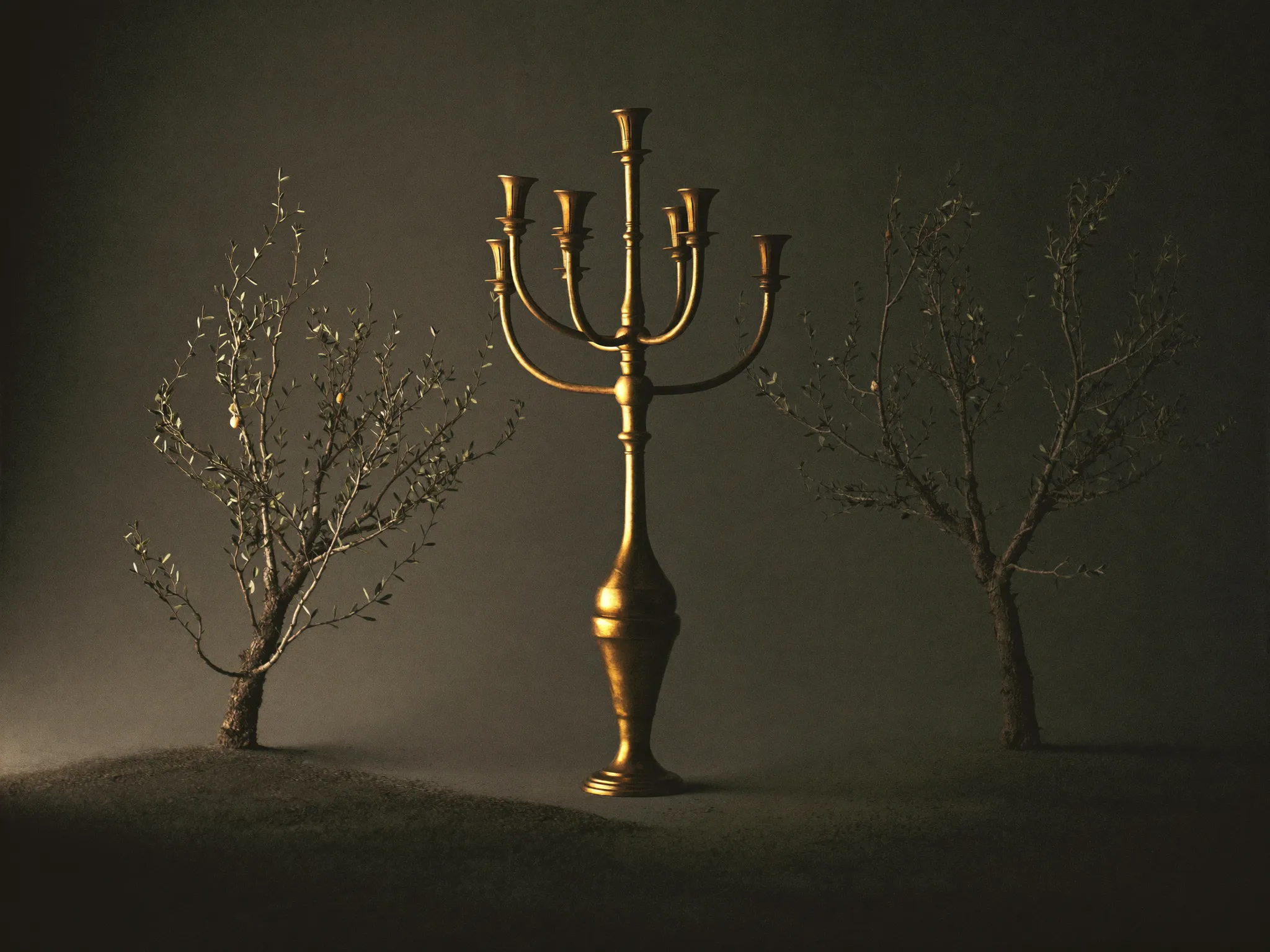
Zechariah 6 — A Priest Upon His Throne
The eighth and final night vision: four chariots from between two mountains of brass — the four spirits of the heavens, going forth from standing before the Lord of all the earth, the black horses toward the north country quieting God's spirit there. Then the visions give way to a symbolic act: take silver and gold from the returned captives, make crowns, and set them upon the head of Joshua the high priest. Speak unto him, saying, Behold the man whose name is The BRANCH; he shall grow up out of his place, and he shall build the temple of the LORD — and he shall bear the glory, and shall sit and rule upon his throne; and he shall be a priest upon his throne: and the counsel of peace shall be between them both. The crowns remain in the temple for a memorial; and they that are far off shall come and build.
“Even he shall build the temple of the LORD; and he shall bear the glory, and shall sit and rule upon his throne; and he shall be a priest upon his throne: and the counsel of peace shall be between them both.”
— Zechariah 6:13
- v.1-8 The four chariots between the brass mountains
- v.9-11 Crowns upon the head of Joshua
- v.12-15 The BRANCH — priest upon his throne
Quieted my spirit — Babylon, the north country, the great oppressor, judged at last; the divine indignation satisfied and at rest. God's wrath is not a temper but a verdict, and it can be quieted by execution of justice.
For the exiles this was the all-clear behind chapter 2's flee from the land of the north: the power that held them was finished. Every Babylon that detains God's people has an appointment with the black horses.
An act without precedent in the law: crowns — royal crowns, plural, of silver and gold — on the head of a priest. Israel's constitution kept crown and ephod rigorously apart (Uzziah's leprosy guarded the line); here God Himself orders the union.
The act is deliberately typical: Joshua wears what only the coming One can own. The offices sundered since Sinai are sealed together on one head, as prophecy in metal.
Behold the man — Pilate's unwitting words (John 19:5) were first God's formal introduction of Messiah. The BRANCH grows up out of his place — lowly, organic, from Bethlehem's root of Jesse, not descending in imperial display.
He shall build the temple of the LORD — read by Christians as pointing beyond Zerubbabel's structure (already underway) to the true house: His body raised in three days, and the living temple of the church built on Him.
The verse piles office upon office: builder, glory-bearer, enthroned ruler, priest upon his throne. Melchizedek's order realized — sacrifice and sovereignty in one Person, interceding with the authority of a King.
The counsel of peace between them both — between the priesthood and the kingship united in Him, mercy and majesty agreeing; and behind it, the everlasting counsel between the Father and the Son by which peace was planned before it was purchased.
They that are far off — beyond the returned remnant, beyond Israel: the Gentiles, made nigh and built in. Paul's words to the Ephesians — ye who sometimes were far off — read like a citation of this promise.
The chapter that crowns the Priest-King ends with laborers from every distance joining His construction. Whoever comes to the BRANCH is put to work on the temple He is building.
Live consciously under a Priest upon His throne: every approach for mercy is heard by One with full authority to act, and every decree of the throne is issued by One who bears your name on His heart. The counsel of peace is not fragile diplomacy but settled government. And as one of the far off who came, take up tools — His temple has no spectators on the payroll.
This is among the clearest Christological texts in the prophets: the man whose name is The BRANCH, growing from His place, building the LORD's temple, bearing glory, ruling, and serving as priest upon His throne. Hebrews' whole argument — a Melchizedek priesthood joined to Davidic kingship — stands crowned in silver and gold in this chapter.
The night visions close where they opened — with horses patrolling the earth — but the riders have become war-chariots, and they issue from between mountains of brass: the immovable, fixed counsels of God. History's forces exit through gates He cast.
The vision cycle thus runs from surveillance (1:10) to execution (6:7): God first walks the earth in observation, then rides it in judgment. Nothing in between was out of His hand.