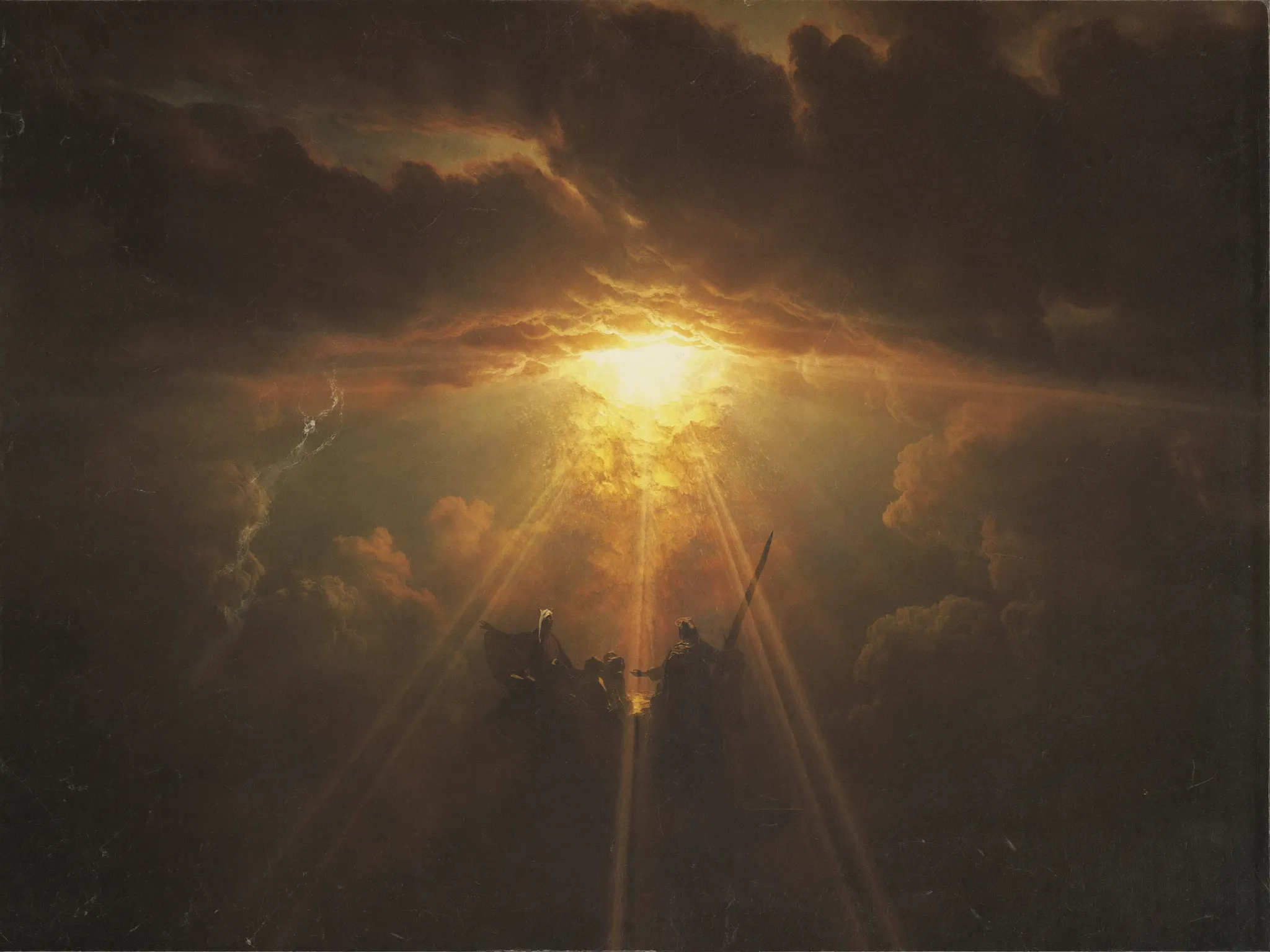
Revelation 21 — The New Heaven and New Earth
John sees the final state — a new heaven, a new earth, the holy city descending, and God Himself dwelling with His people. Every sorrow is answered here. This is where the story ends — and where it really begins.
“And God shall wipe away all tears from their eyes; and there shall be no more death, neither sorrow, nor crying, neither shall there be any more pain: for the former things are passed away.”
— Revelation 21:4
- v.1-2 A new heaven, a new earth, the holy city
- v.3-4 God dwells with men — no more tears
- v.5-8 All things made new — and what is excluded
- v.9-21 The bride, the holy city, the dimensions and beauty
- v.22-27 No temple, no sun, no night — for the Lord is the light
The goal of the whole Bible. From Genesis (God walking with Adam in the garden) through Exodus (the tabernacle) through John 1 ("the Word dwelt among us") to here — God dwelling with His people, finally and forever.
"Tabernacle" — Greek skēnē, the same word used in John 1:14 for the Word "tabernacling" among us. Jesus was the prototype; this is the fulfillment.
God Himself wipes away the tears. Not an angel. Not a saint. God. Personally. With His own hand.
Six things abolished: tears, death, sorrow, crying, pain, "the former things." Every category of human suffering is named and eliminated.
This verse is one of the most quoted at funerals — and rightly so. The promise is not a vague comfort. It is a concrete future.
"I make all things new" — present tense. The process is already underway in every believer (2 Cor 5:17) and will be consummated here.
"Write" — God Himself emphasizes that John must record this. These promises are too precious to be lost.
"True and faithful" — two words John uses elsewhere for Christ Himself (Rev 19:11). The promise carries His own character.
A sobering interruption. The new creation is not for everyone.
Notice the first category: the fearful. Not because fear is unforgivable, but because the fearful here are those who feared man more than God — and so refused to confess Christ when it cost them.
"The second death" — physical death is the first. The second is eternal separation from God. Only those born twice die once; those born once die twice.
A pearl is formed by suffering — a wound to the oyster. The gates of heaven are pearls because the entrance is purchased by the wounds of Christ.
"Street of pure gold" — what we hoard, He paves with. The most valuable substance on earth is the asphalt of heaven.
"Transparent glass" — there is nothing hidden, nothing impure, nothing opaque in the city.
No sun is needed because the original Light (Gen 1:3) is unveiled.
"The Lamb is the light" — the same Lamb who was slain (Rev 5:6) is the city's lamp. Eternity is illuminated by the cross.
The entrance requirement is not measured righteousness, but a name written in the Book.
How is your name written? By the new birth, when you are made a citizen of heaven (Phil 3:20). The Lamb wrote it Himself.
When the pain of this life feels heavy, read this chapter aloud. Slowly. Twice. You are not made for this broken world — you are made for the new one. Your home is being built now. The tears you cry today will be wiped away by God Himself one day. Live like it is real, because it is.
The Lamb is everywhere in this chapter. The pearls are formed by His wounds. The gates open because of His blood. The light is His glory. The Book is His. The city is the bride He purchased. Heaven is not a place — it is a Person, and being where He is.
New — Greek kainos, meaning new in quality not just new in time. Not a refurbished old creation, but a qualitatively new one.
"No more sea" — the sea throughout Revelation symbolizes restless chaos and the source of the beast (Rev 13:1). Its absence symbolizes the end of all chaos.