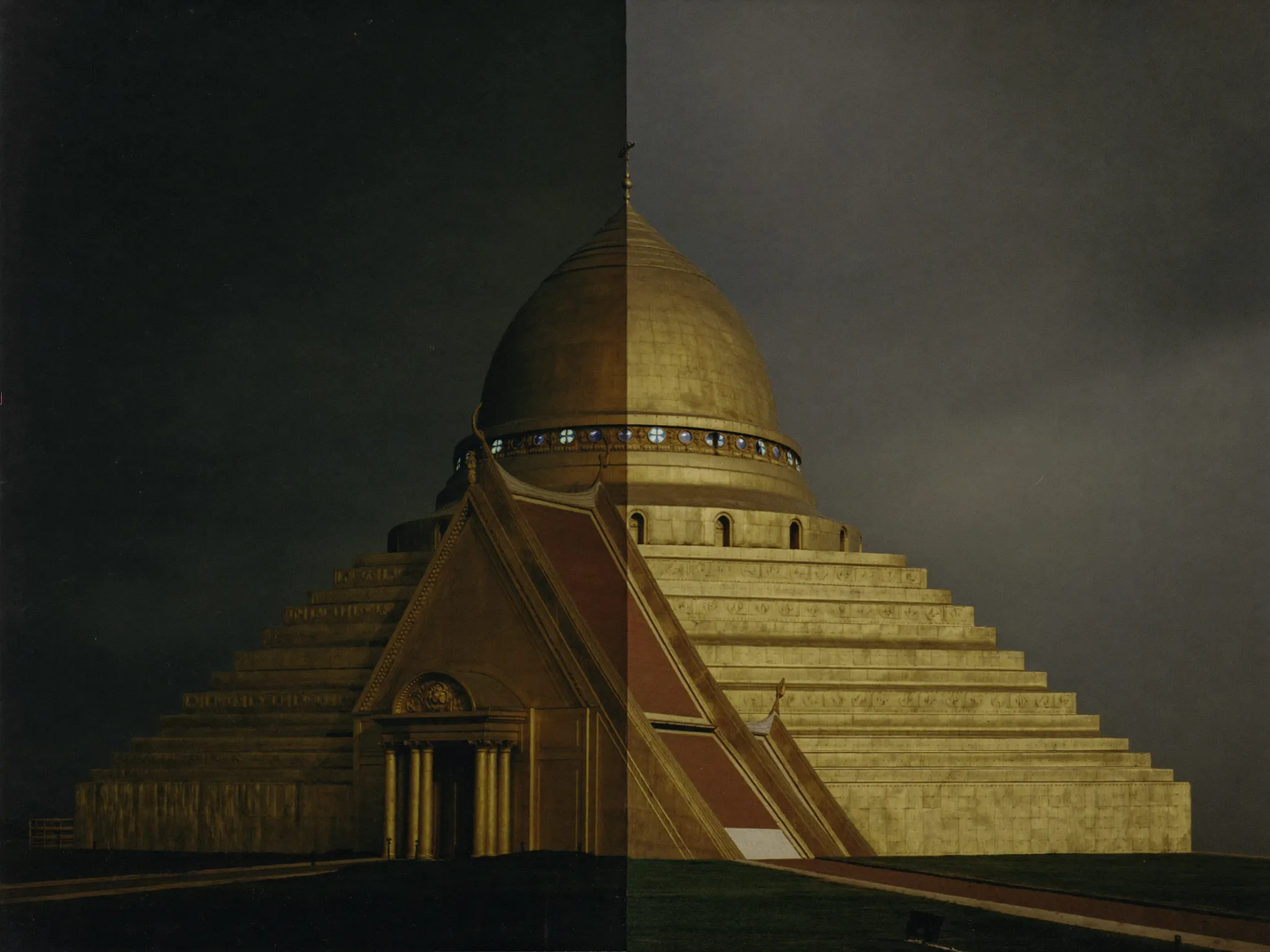
1 Kings 8 — The Heaven of Heavens Cannot Contain Thee
Solomon assembles the elders and heads of the tribes at Jerusalem, at the feast in the month Ethanim, to bring up the ark of the covenant out of the city of David, which is Zion. The priests carry the ark and the holy vessels, while the king and people sacrifice sheep and oxen that could not be numbered. The ark is set in the oracle under the wings of the cherubims; nothing is in it save the two tables of stone. When the priests come out, the cloud fills the house, and they cannot stand to minister, for the glory of the LORD has filled it. Solomon blesses the people and the LORD who kept his word to David. Then, before the altar with hands spread toward heaven, he prays: there is no God like thee; the heaven of heavens cannot contain thee, how much less this house; yet hear thou in heaven, and forgive. He prays for the oath at the altar, the defeated, the drought, the plague, the stranger from a far country, the army, and the captive who repents. He rises and blesses Israel: not one word has failed. Peace offerings, a feast of fourteen days, and the people go home joyful.
“But will God indeed dwell on the earth? behold, the heaven and heaven of heavens cannot contain thee; how much less this house that I have builded?”
— 1 Kings 8:27
- v.1-11 The ark brought up at the feast; under the wings of the cherubims; the cloud fills the house
- v.12-21 The LORD would dwell in thick darkness; Solomon blesses the people; a promise kept to David
- v.22-30 Hands spread toward heaven; no God like thee; heaven cannot contain thee; hear, and forgive
- v.31-53 The petitions — oath, defeat, drought, plague, the stranger, battle, captivity; no man that sinneth not
- v.54-66 Not one word hath failed; let your heart be perfect; peace offerings; fourteen days; joyful and glad
When the priests were come out of the holy place... the cloud filled the house of the LORD (v. 10), So that the priests could not stand to minister because of the cloud. This is the tabernacle's dedication again: a cloud covered the tent of the congregation, and the glory of the LORD filled the tabernacle. And Moses was not able to enter (Exodus 40:34-35). The narrator wants readers to see that the God of Sinai and of the wilderness tent has come to the house of stone. 2 Chronicles 5:13 places the moment as the singers praised the LORD, For he is good; for his mercy endureth for ever.
Then spake Solomon, The LORD said that he would dwell in the thick darkness (v. 12). Solomon reads the cloud by Scripture: at Sinai Moses drew near unto the thick darkness where God was (Exodus 20:21), and the LORD had said I will appear in the cloud upon the mercy seat (Leviticus 16:2). The glory that fills the house also hides. I have surely built thee an house to dwell in, a settled place for thee to abide in for ever (v. 13). Readers should hold this beside verse 27: God truly comes to the house, and He is never confined in it.
At the height of his achievement, the builder confesses its limits. The heaven of heavens means the highest heavens; if they cannot hold God, a house sixty cubits long cannot. Solomon had said the same to Hiram (2 Chronicles 2:6). The study takes this as the key to the chapter: the temple is not a container for God but the place where He sets His name (v. 29) and hears His people. Isaiah 66:1 asks, where is the house that ye build unto me? Solomon had already asked it, on the day of dedication.
Stephen recalled Isaiah 66 at his trial — the most High dwelleth not in temples made with hands (Acts 7:48) — and Paul told the Athenians that God dwelleth not in temples made with hands (Acts 17:24). Neither was correcting Solomon; Solomon had said it first. The verse guards worship from two errors: thinking God is far away, and thinking He can be held or managed in a building. The study notes the humility of it: Israel's own temple was dedicated by a king who said that God could not be contained in it.
Solomon's request is simple: hear thou in heaven thy dwelling place: and when thou hearest, forgive. The house is a place to pray toward (v. 29); God's dwelling is in heaven; and the first thing asked is forgiveness. Hear thou in heaven returns again and again through the prayer like a refrain. Readers commonly count seven petitions in verses 31-53: the oath at the altar, defeat before the enemy, drought, famine and plague, the stranger, going out to battle, and captivity. Each describes a trouble, often caused by sin, and each asks God to hear and act.
Notice what the prayer assumes. Solomon does not ask that Israel never sin; he asks that when they sin and turn again, God will forgive (vv. 33-36). The drought petition adds that thou teach them the good way wherein they should walk (v. 36) — forgiveness that leads to teaching. The plague petition speaks of those which shall know every man the plague of his own heart (v. 38): the worst sickness is inward. God's answer is remembered in 2 Chronicles 7:14: If my people... shall humble themselves, and pray... then will I hear from heaven, and will forgive their sin.
In the middle of a prayer for Israel comes a prayer for foreigners. They will come because they shall hear of thy great name, and of thy strong hand, and of thy stretched out arm (v. 42) — the language of the exodus (Deuteronomy 4:34). Solomon asks God to do according to all that the stranger calleth to thee for (v. 43); the stranger's prayer is to be heard as freely as Israel's. The queen of Sheba, who comes from far having heard of Solomon's fame concerning the name of the LORD (10:1), is the story's next example of such a seeker.
The purpose: that all people of the earth may know thy name, to fear thee, as do thy people Israel (v. 43). The temple was meant from its first day to be a witness to the nations. Isaiah 56:7 took it up: mine house shall be called an house of prayer for all people. Jesus quoted it when He cleansed the temple court: Is it not written, My house shall be called of all nations the house of prayer? (Mark 11:17). Readers from the nations, India among them, may hear this verse as a door open from the beginning: the God of Israel was never meant to be known by Israel alone.
(for there is no man that sinneth not,) — a parenthesis that says what the whole Bible says. Solomon does not pray for a sinless people; he knows there is none. Ecclesiastes 7:20 says it again, there is not a just man upon earth, that doeth good, and sinneth not, and Paul gathers such texts in Romans 3:23, all have sinned. The petition foresees the worst: the LORD angry, the people delivered to the enemy, carried away captives unto the land of the enemy, far or near. The prayer looks ahead to the exile that Kings will record at its close (2 Kings 25:21).
Yet even there hope remains: if they shall bethink themselves... and repent, and make supplication... saying, We have sinned, and have done perversely, we have committed wickedness (v. 47), and pray unto thee toward their land (v. 48), God will hear. Readers have long seen this answered in Daniel, who in Babylon prayed with his windows being open in his chamber toward Jerusalem (Daniel 6:10) and confessed, We have sinned, and have committed iniquity (Daniel 9:5). They be thy people... which thou broughtest forth out of Egypt, from the midst of the furnace of iron (v. 51). Sin does not cancel belonging.
Solomon arose from before the altar of the LORD, from kneeling on his knees with his hands spread up to heaven (v. 54). Verse 22 had him standing; it seems he knelt as the prayer went on, and 2 Chronicles 6:13 says he kneeled down upon his knees on a brasen scaffold before the people. Then he stood, and blessed all the congregation of Israel with a loud voice (v. 55). There hath not failed one word of all his good promise — what Joshua said at the end of the conquest (Joshua 21:45; 23:14), Solomon says at the dedication of the house.
Which he promised by the hand of Moses his servant — the rest of Deuteronomy 12:9-10, and the place for the name. The blessing turns to prayer: let him not leave us, nor forsake us: That he may incline our hearts unto him (vv. 57-58). Solomon knows that keeping the commandments needs God's work in the heart, as Psalm 119:36 prays, Incline my heart unto thy testimonies. The goal is wider than Israel: That all the people of the earth may know that the LORD is God, and that there is none else (v. 60). Promise kept, heart inclined, nations told.
Perfect here means whole, undivided, fully given — not sinless, since verse 46 has just said that no one is. Solomon calls the people to it as at this day: on the day of dedication the nation stood before God together. The study marks the words because the narrator will turn them on the speaker: his heart was not perfect with the LORD his God, as was the heart of David his father (11:4). The man who prayed this charge would not, in the end, keep it himself.
Readers should not take this as a cheap irony. The prayer was true when it was prayed, and the narrator records it in full. The lesson is the one Paul draws from Israel's story: let him that thinketh he standeth take heed lest he fall (1 Corinthians 10:12). Great days of worship do not keep the heart; daily walking does, and the heart must be kept with all diligence (Proverbs 4:23). Verse 61 is a charge every congregation may hear at the end of its own best days.
2 Chronicles 7:5 gives the same figures — twenty-two thousand oxen and a hundred and twenty thousand sheep. The scale has been much discussed; the study keeps the numbers as the text gives them. Readers should note that peace offerings were largely eaten by the worshippers (Leviticus 7:15), so this was a vast feast as well as a sacrifice, shared by a great congregation, from the entering in of Hamath unto the river of Egypt (v. 65) over many days. The brasen altar was too little, and the middle of the court was hallowed for the offerings (v. 64).
The feast ran seven days and seven days, even fourteen days (v. 65); 2 Chronicles 7:9 explains it as the dedication of the altar for seven days and the feast for seven. On the eighth day he sent the people away (v. 66), which many read as the eighth day of the second week; Chronicles dates the sending away to the twenty-third day of the seventh month (2 Chronicles 7:10). They blessed the king, and went unto their tents joyful and glad of heart for all the goodness that the LORD had done for David his servant, and for Israel his people. The chapter ends in gladness at God's goodness.
Solomon's prayer is a school of prayer. Begin, as he did, with who God is — there is no God like thee — and with what He has already done. Confess that God is greater than any place or ritual; yet come to Him in the way He has given. Bring your real troubles: the broken oath, the defeat you caused, the drought, the sickness, the plague of your own heart. Pray for the stranger too — the person of another people who is looking for God. When you sin, as everyone does, do not run from God; bethink yourself, say We have sinned, and turn back. And after the best day of worship you have known, hear verse 61: let your heart be whole with the LORD, not only today.
The New Testament takes up this chapter's hope. The glory that filled Solomon's house was seen again, John says, when the Word was made flesh, and dwelt among us... and we beheld his glory (John 1:14); Jesus spoke of His body as the temple (John 2:19-21). Christian readers have long seen Him as the true place toward which Solomon's prayers were turned: the one mediator between God and men (1 Timothy 2:5), through whom the sinner who prays We have sinned is heard and forgiven. The stranger from a far country is welcomed in Him, for those who were far off are made nigh by the blood of Christ (Ephesians 2:13). The church has read the dedication prayer as a shadow of the intercession of Christ, who ever liveth to make intercession (Hebrews 7:25).
The ark goes up from Zion, the city of David, to the new house (vv. 1-4) at the feast in the month Ethanim, which is the seventh month (v. 2) — most take this as the feast of tabernacles (Leviticus 23:34). Since the house was finished in the eighth month (6:38), the text seems to imply a wait of some months, though it does not say which year. The priests set the ark under the wings of the cherubims (v. 6) and drew out the staves so that their ends could be seen from the holy place: there they are unto this day (v. 8) — words that seem to come from a time when the temple still stood.
There was nothing in the ark save the two tables of stone, which Moses put there at Horeb. Readers ask about Hebrews 9:4, which describes the ark of the tabernacle wherein was the golden pot that had manna, and Aaron's rod that budded, and the tables of the covenant. Exodus says the pot and the rod were laid up before the Testimony (Exodus 16:34; Numbers 17:10) — near the ark, perhaps not inside. Some suggest Hebrews describes the arrangement of Moses' day and Kings that of Solomon's, the other objects having been lost; others read before as in. The study notes the question. Both agree that the tables of the covenant lay at its heart.