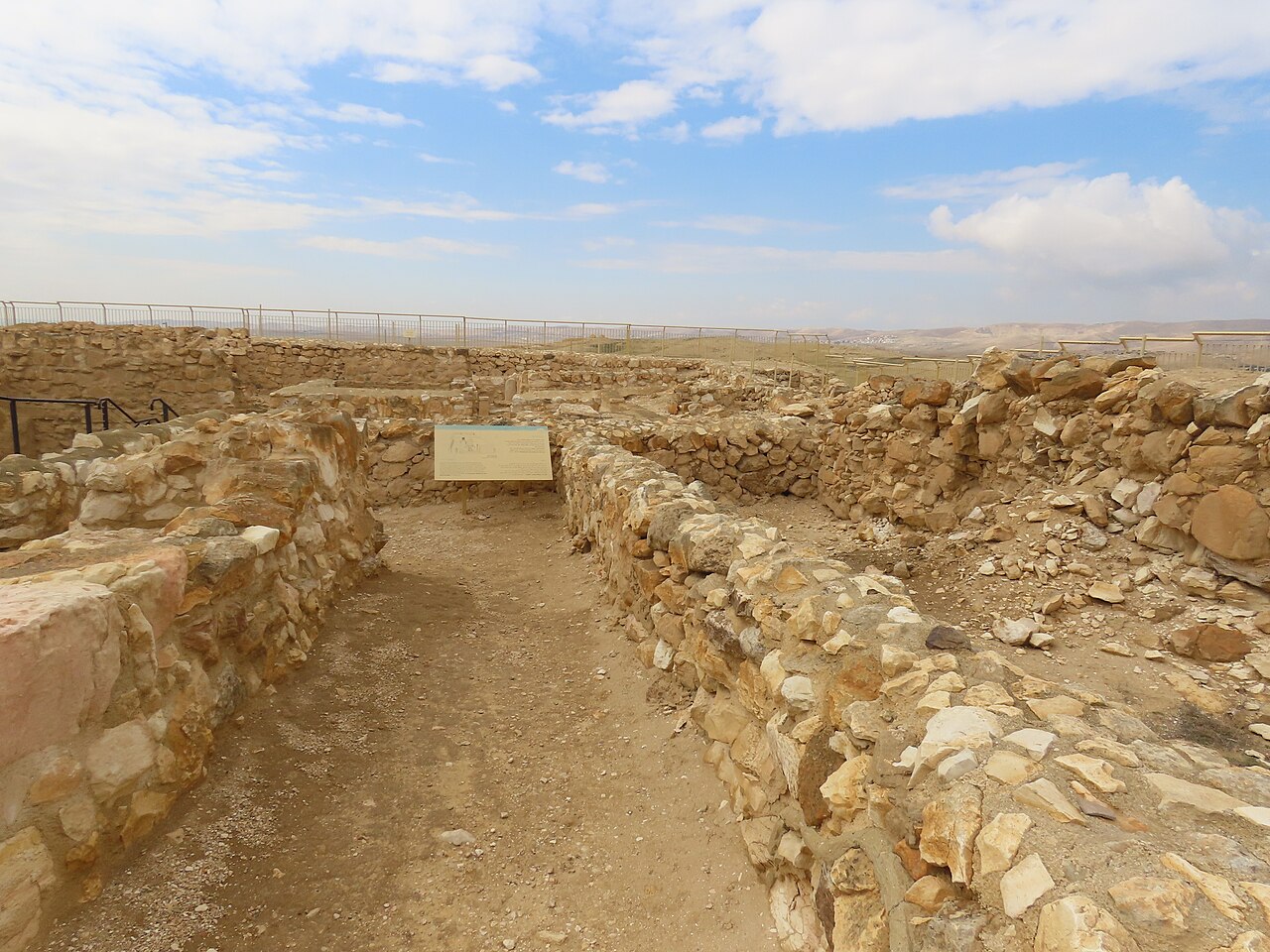

The Bible says Judah's kings tried to abolish worship outside Jerusalem, tearing down local “high places.” Two Negev fortresses show both sides of that story. Arad had a small working temple — a courtyard altar and an inner shrine with standing stones — the only Judahite temple ever excavated. At Beersheba, a large horned altar had been taken apart and its stones reused in a wall, exactly what a royal order to shut down a local altar would leave behind. Arad's own letters even name priestly families known from Jeremiah.
- What it is
- A fortress temple at Arad (courtyard altar, inner shrine with standing stones and incense altars) and a dismantled four-horned altar reused in a wall at Beersheba
- Date of artifact
- in use 9th–8th century BC; Beersheba altar dismantled late 8th century BC
- Discovered
- the fortresses of Tel Arad and Tel Beersheba, in the Negev (Yohanan Aharoni's excavations)
- Where it is now
- Israel Museum and in situ
- Related to
- Local Judahite worship — and the cult reforms of Hezekiah and Josiah
- Scripture
- 2 Kings 18:4 · 2 Kings 18:22 · 2 Kings 23:8
What this find showsThat worship really did happen at Judahite sanctuaries outside Jerusalem, and that at least one such altar was deliberately dismantled — consistent with the reforms Kings describes.
What it does not proveNo inscription ties either directly to Hezekiah or Josiah; the “reform” reading is a strong inference, not a proven fact.
Contested: Arad's stratigraphy and dating were debated for decades, and the meaning of its two standing stones is uncertain. Notably, both altars are neatly dressed ashlar — which sits awkwardly with the biblical command to build altars of un-cut stone.
Sources & further reading