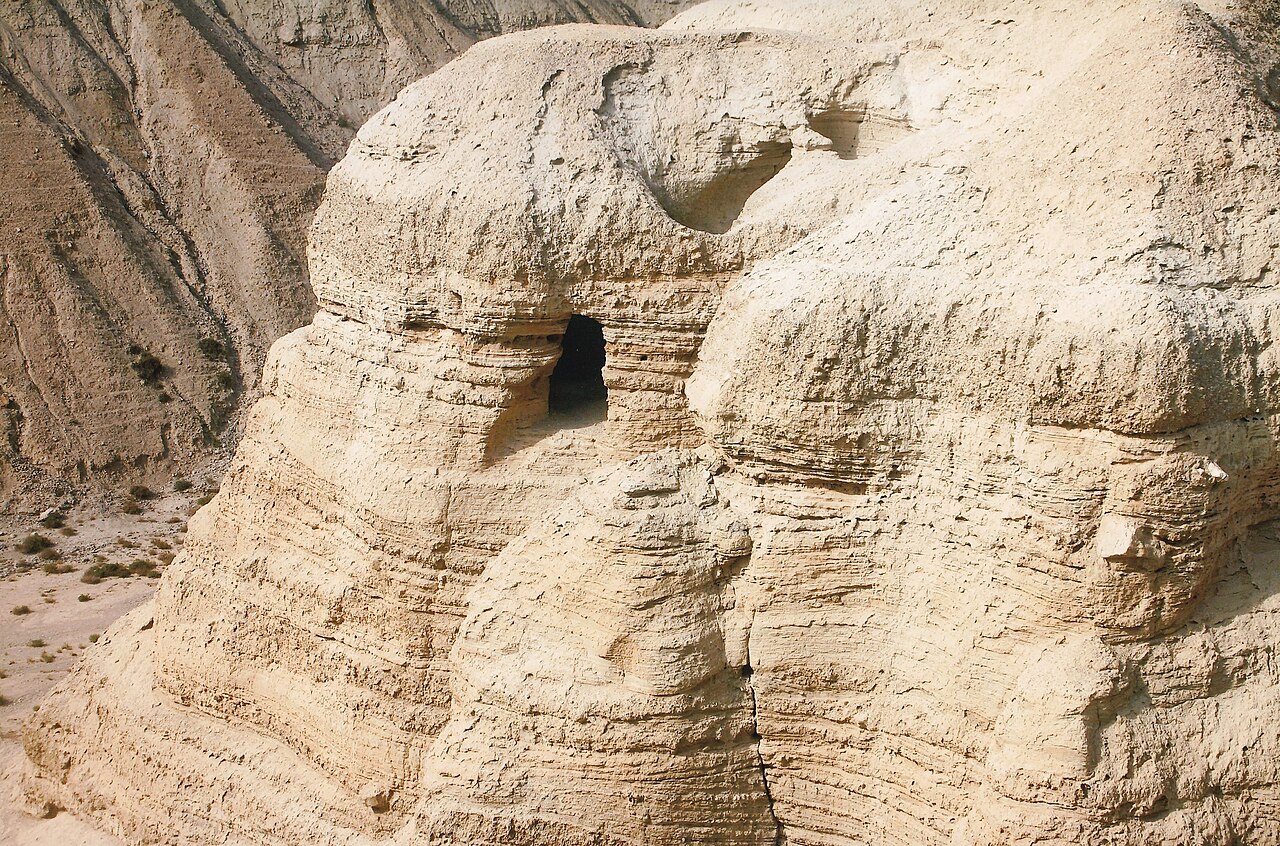

The Great Isaiah Scroll (its own entry here) came from Cave 1 — but it was one of hundreds. Behind it lies a whole library: nearly every book of the Hebrew Bible a thousand years older than any copy known before, alongside the writings of the community that hid them — a rule book, a running “this-prophecy-means-us” commentary on Habakkuk, a treasure list etched on copper, and an enormous rewritten Temple Scroll. Together they hand us the actual religious world of Judaism in the centuries around Jesus.
- What it is
- Around 900 manuscripts — biblical, apocryphal and sectarian — on leather, papyrus and one on copper, found in eleven caves beside a ruined desert settlement
- Date of artifact
- c. 3rd century BC – AD 68
- Discovered
- caves near Khirbet Qumran, on the north-western shore of the Dead Sea, 1947 (Bedouin shepherds, then archaeologists (Roland de Vaux and others))
- Where it is now
- Shrine of the Book, Israel Museum, Jerusalem; the Copper Scroll in Amman, Jordan
- Related to
- The Jewish world into which Jesus and the earliest church were born
- Scripture
- Isaiah 1–66 · Habakkuk 1–2 · Psalms
What this find showsThat the Hebrew Bible was transmitted with remarkable care across a millennium — and it lays bare the diverse, disputing Judaism of the Second Temple period.
What it does not proveThe scrolls never mention Jesus, John the Baptist, or Christians; and rather than one fixed Bible, they show the text still circulating in several editions before it was standardized.
Contested: Who wrote and hid them is debated — most link them to the Essenes at Qumran, but some argue they were a library carried out from Jerusalem, and the settlement's very purpose (religious commune? estate? fort?) is disputed.
Sources & further reading