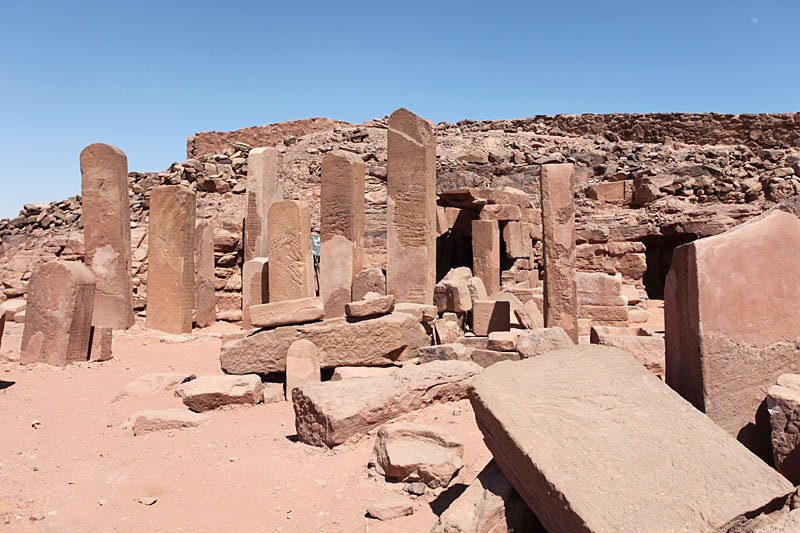

Deep in the Sinai, Egyptian expeditions mined turquoise for Hathor, 'Lady of Turquoise,' and left a temple stacked with votive offerings to her. Among the miners were Northwest-Semitic-speaking laborers — and someone among them did something extraordinary: instead of Egypt's hundreds of hieroglyphs, they used a handful of picture-signs to stand for single sounds. These Proto-Sinaitic inscriptions are among the oldest alphabetic writing known, the distant ancestor of the Hebrew, Greek and Latin letters. They show Semitic workers inside the Egyptian system — literate, inventive — in exactly the world the Bible's Egypt-and-Sinai narratives assume.
- What it is
- An Egyptian turquoise-mining settlement in the Sinai, with a temple to the goddess Hathor and the earliest known alphabetic inscriptions
- Date of artifact
- c. 1900–1500 BC
- Discovered
- Serabit el-Khadim, south-western Sinai, Egypt, 1905 (Flinders Petrie, who recorded the Proto-Sinaitic inscriptions)
- Where it is now
- In situ; votive objects and inscriptions in the Egyptian Museum, Cairo, and elsewhere
- Related to
- Semitic laborers in Egyptian service, and the birth of the alphabet behind the Hebrew script
- Scripture
- Exodus 3:1
What this find showsSemitic-speaking people worked within Egyptian operations in the Sinai in the second millennium BC, and alphabetic writing — the family the Hebrew script belongs to — already existed there, making early Israelite literacy entirely plausible.
What it does not proveNothing at Serabit names Israel, Moses or the exodus; it sets the cultural scene, it does not narrate the biblical events.
Contested: The precise date of the Proto-Sinaitic script, and the readings of its short inscriptions, are still debated.