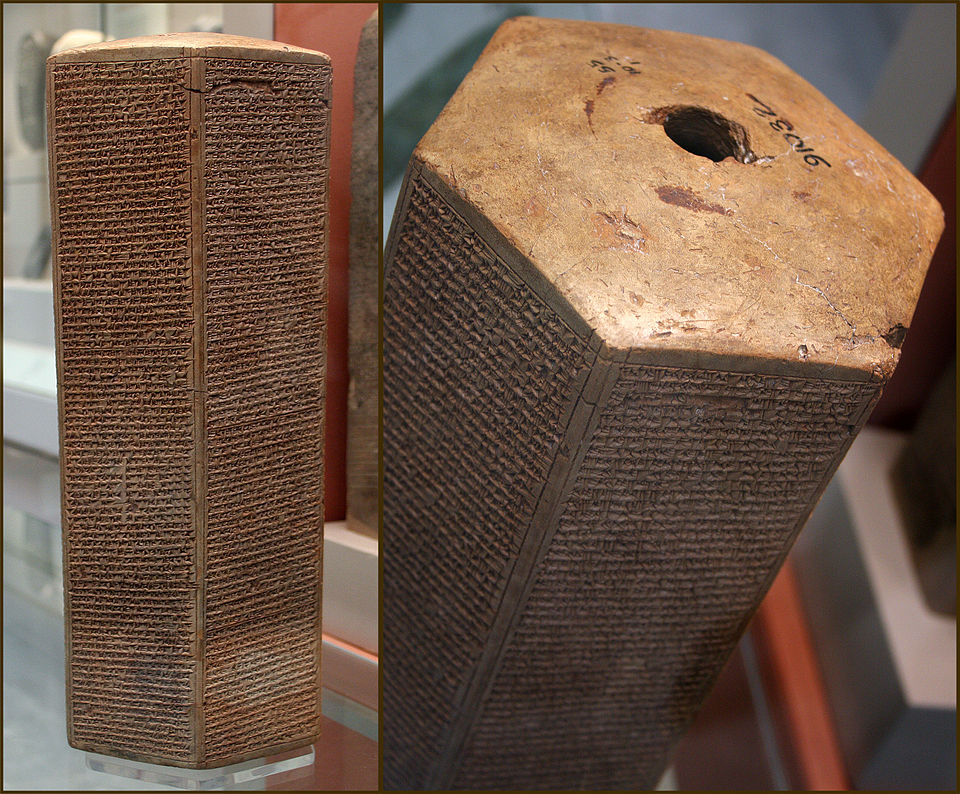

Sennacherib's own annals brag through Judah city by city: forty-six walled towns taken, enormous plunder, and Hezekiah shut up in Jerusalem “like a bird in a cage.” Then the boasting goes quiet. Assyrian kings never admitted defeat, but they always recorded a capture — and for Jerusalem there is none. The prism claims tribute; the Bible reports tribute too, and a siege that ended with the city still standing. On the decisive point, the enemy's silence and the Bible's story agree.
- What it is
- Hexagonal baked-clay prism carrying Sennacherib's official campaign record in cuneiform
- Date of artifact
- c. 691 BC
- Discovered
- Nineveh, Iraq, 1830 (acquired by Colonel Robert Taylor; duplicates in Chicago and Jerusalem)
- Where it is now
- British Museum, London
- Related to
- The siege of Jerusalem under King Hezekiah in 701 BC
- Scripture
- 2 Kings 18–19 · Isaiah 36–37
What this find showsSennacherib invaded Judah in 701 BC, devastated its towns, extracted heavy tribute from Hezekiah — and did not take Jerusalem.
What it does not proveWhy the siege ended is beyond archaeology. The Bible attributes it to the angel of the LORD; historians weigh plague, politics or payoff. The prism can confirm the outcome, not the cause. (Its “46 cities” and captive counts are also likely inflated.)
Sources & further reading