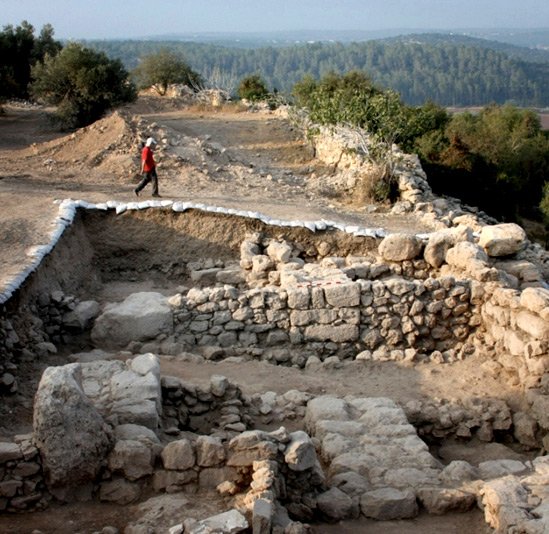

On a hilltop above the Elah Valley — the setting of David and Goliath — excavators found a small city built to a plan: a massive casemate wall, two gates, and houses set against the fortification. Radiocarbon dating puts it around 1000 BC, the very period the Bible assigns to Saul and David, and a short inscription (the Qeiyafa Ostracon) shows people there were already writing. For the excavators this is the fingerprint of an organized Judahite state that early; other scholars read the same stones far more cautiously.
- What it is
- An early-tenth-century BC fortified town in the Elah Valley, with a planned casemate wall, two gates and an early alphabetic ostracon
- Date of artifact
- c. 1020–980 BC
- Discovered
- Khirbet Qeiyafa, Elah Valley, Judah, 2007 (excavations led by Yosef Garfinkel and Saar Ganor)
- Where it is now
- Finds in the Israel Museum and the Israel Antiquities Authority
- Related to
- The debate over whether a centralized Judahite kingdom existed in the time of David
- Scripture
- 1 Samuel 17:2
What this find showsA fortified, planned, literate settlement existed in the Judean lowlands around 1000 BC — evidence that some organized polity, not merely scattered villages, was present in the period the Bible places David.
What it does not proveNo inscription at the site names David or Saul, and the stones cannot show how large or centralized any kingdom was; the leap from 'a fortified town' to 'the united monarchy' is an interpretation.
Contested: Hotly — Yosef Garfinkel reads Qeiyafa as proof of an early Davidic state, while Israel Finkelstein and others dispute both the significance of the dating and the 'kingdom' interpretation.
Sources & further reading