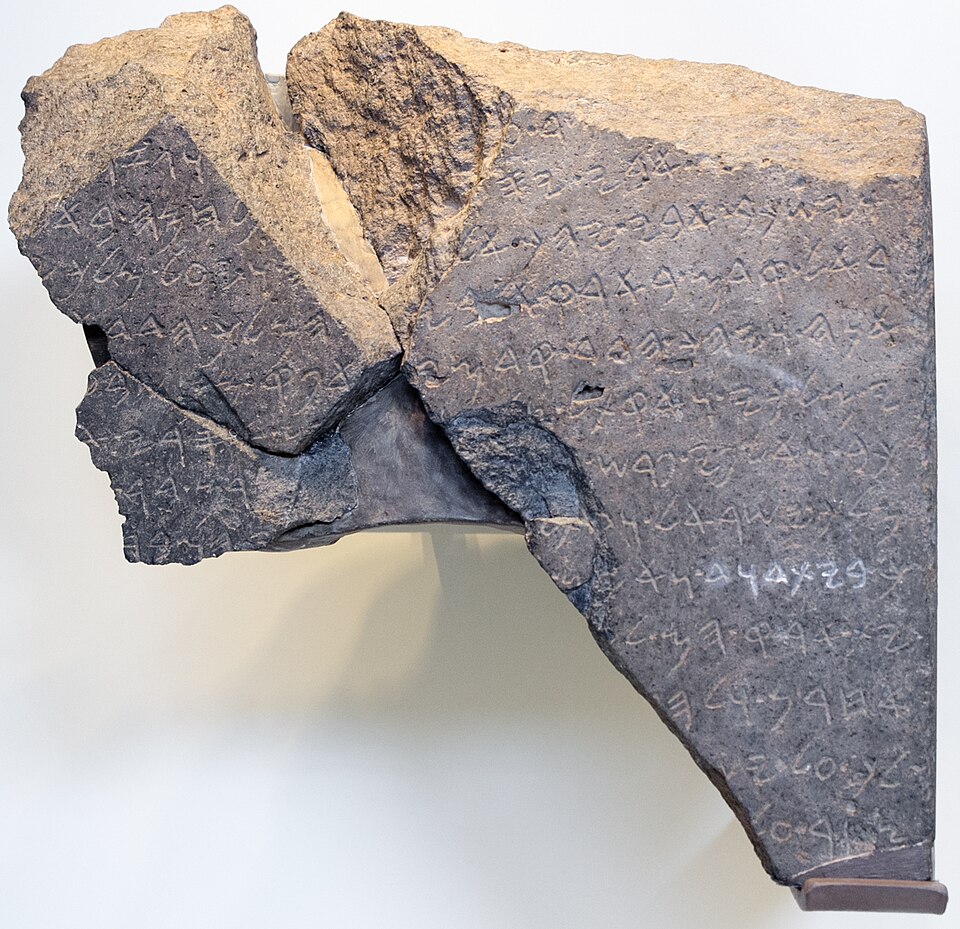

An Aramean king — most scholars think Hazael of Damascus — set up this stone at Dan to celebrate victories over Israel and Judah. Its ninth line calls Judah's ruling family bytdwd, “the House of David.” Before its discovery in 1993, no text outside the Bible named David at all, and some scholars argued he was legend. Here an enemy of Israel, writing barely a century and a half after David's lifetime, treats his dynasty as an ordinary political fact.
- What it is
- Fragments of a basalt victory monument carved with an Aramaic inscription
- Date of artifact
- c. 840 BC
- Discovered
- Tel Dan, northern Israel, 1993 (Avraham Biran's excavation)
- Where it is now
- Israel Museum, Jerusalem
- Related to
- King David — his dynasty, called the “House of David”
- Scripture
- 2 Samuel 7 · 2 Kings 8–9
What this find showsDavid was remembered in the ninth century BC as the real founder of Judah's royal house — by Israel's enemies, not its own scribes.
What it does not proveIt tells us nothing about the size of David's kingdom or the events of his life — Goliath, the census, the psalms. It attests the dynasty's name, not the stories.
Contested: A small minority once read bytdwd as a place name rather than “House of David”; the dynastic reading is now the broad scholarly consensus, though the reconstruction of the two kings' names in the broken lines remains partly conjectural.
Sources & further reading