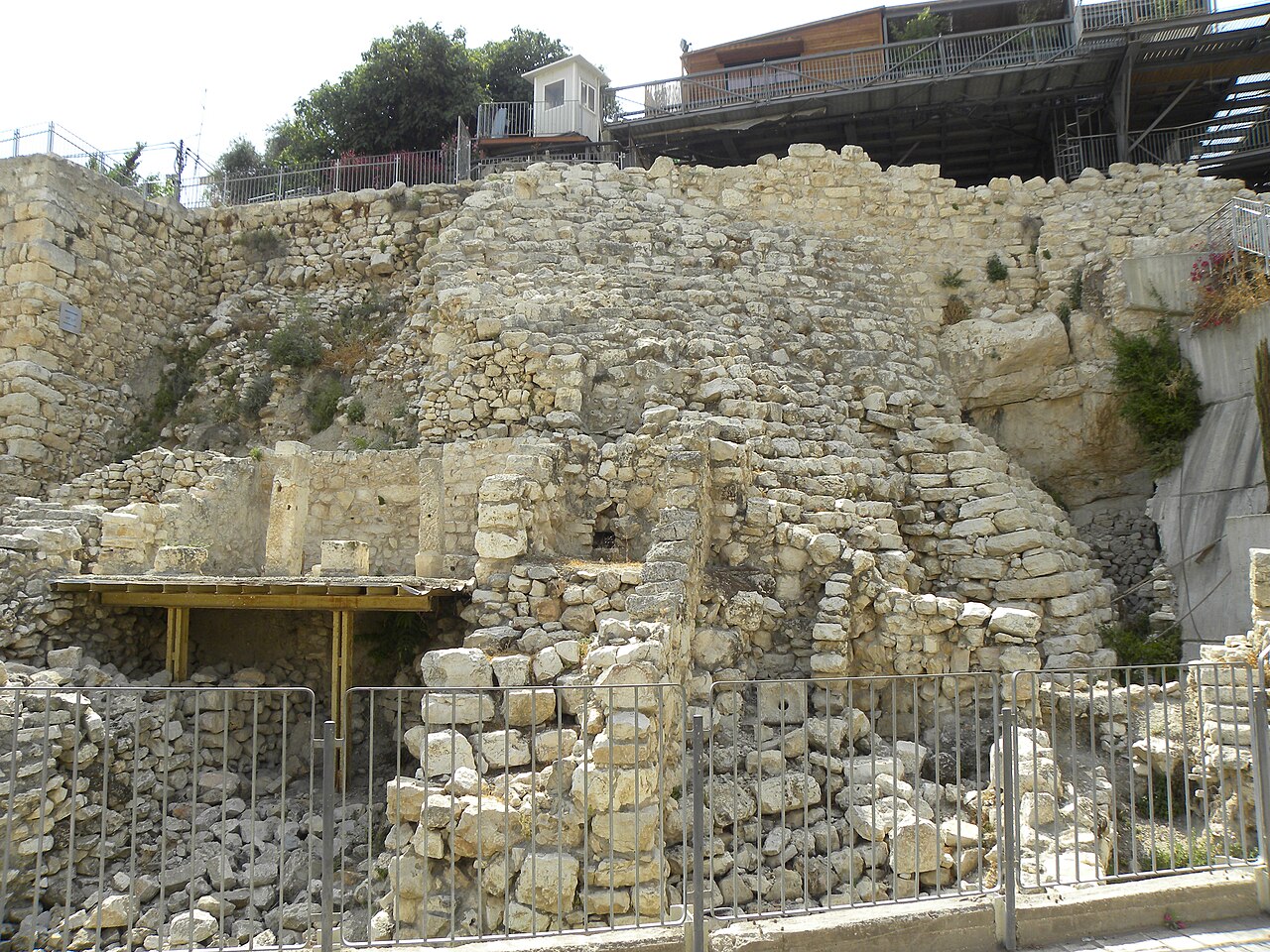

The archaeology of David's own Jerusalem is famously thin, which makes this huge stepped rampart on the city's eastern slope the most tempting candidate for monumental building from around his time — perhaps the substructure of a citadel or the “Millo.” We include it as an honest example of evidence that is real but ambiguous: something big was built here early, but exactly when, and by whom, is hard to pin down.
- What it is
- A massive stone-terraced retaining wall, preserved over 16 metres high, on the eastern slope of ancient Jerusalem
- Date of artifact
- tentatively 10th century BC, over earlier terraces
- Discovered
- the City of David, above the Gihon Spring, Jerusalem (successive Jerusalem excavations)
- Where it is now
- In situ, Jerusalem
- Related to
- David's Jerusalem — the “fortress of Zion”
- Scripture
- 2 Samuel 5:6–9 · 1 Chronicles 11:5
What this find showsThat monumental construction existed in early Jerusalem — a serious candidate for a Davidic-era fortress.
What it does not proveNo building survives on top, nothing names David, and the 10th-century date is offered only tentatively.
Contested: Mazar himself calls the evidence for David's reign in Jerusalem “poor and ambiguous.” Dating the structure and linking it to David are both disputed; it is a strong candidate, not a proof.
Sources & further reading